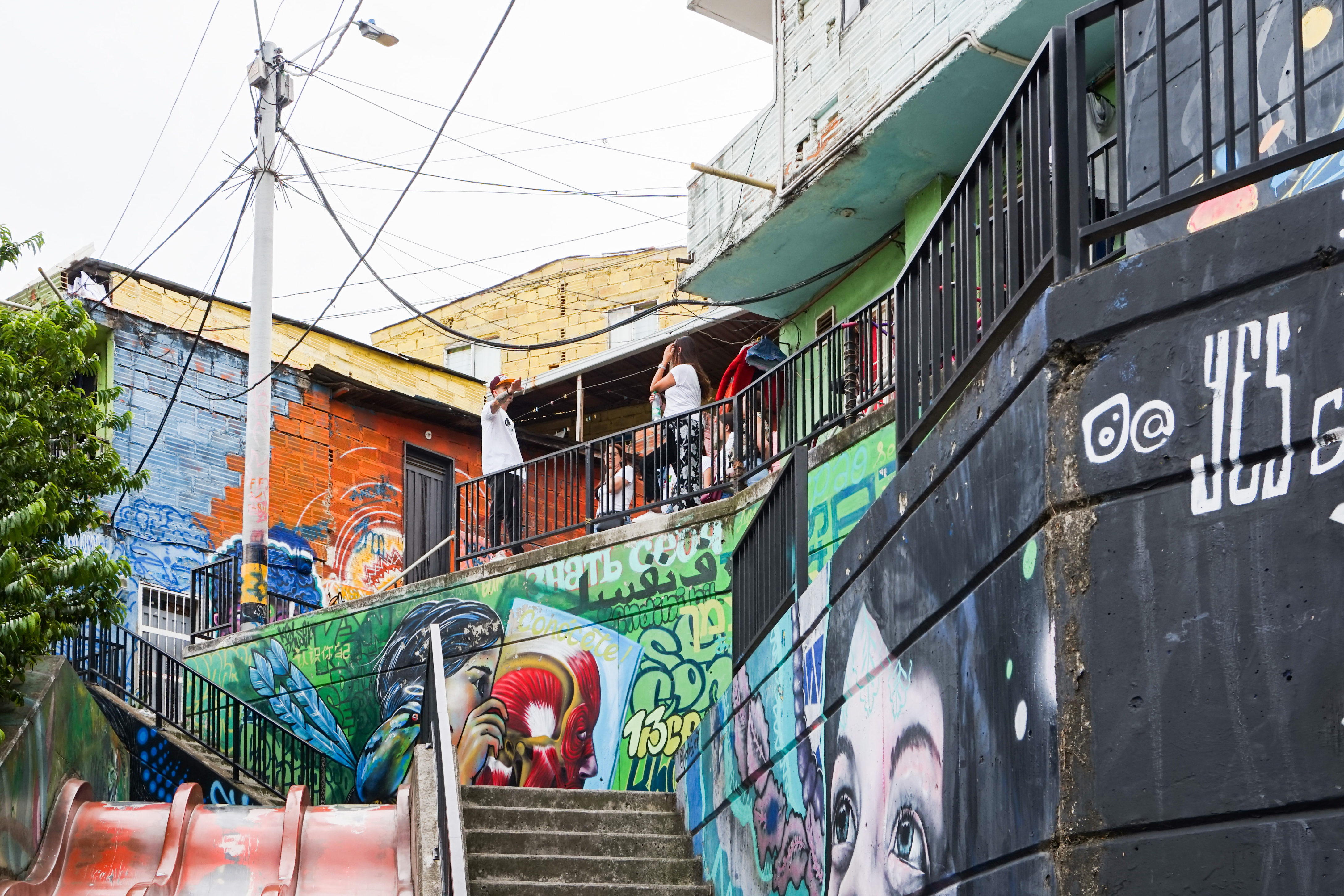
Comuna 13, Medellín
On weekends, up to 6,000 visitors ride a set of outdoor escalators bolted to a steep hillside in western Medellín, gliding past murals that tell stories of war, loss, and rebirth. The escalators are only 384 meters long. They replaced a climb equivalent to 28 stories that residents used to make daily, often in the dark, often at a run, because the neighborhoods above were controlled by armed groups who imposed curfews, taxed shopkeepers, and recruited teenagers at gunpoint. That the same hillside now draws tourists from around the world is the central fact of Comuna 13 -- a transformation so dramatic that people struggle to believe the before and after describe the same place.
Built by Those Who Had Nowhere Else to Go
Comuna 13 was never planned. Beginning in the mid-twentieth century, waves of migrants fleeing La Violencia -- the decade of civil war that killed an estimated 200,000 Colombians -- arrived in Medellín with nothing and settled on the steep western hillsides where land was cheapest, which meant it was steepest. They built homes from brick and cement, stacking them tightly against slopes so steep that some sectors carry official designations for high risk of natural disaster. The neighborhoods of Las Independencias I, II, III and Nuevos Conquistadores were built almost entirely by these immigrants, who were often treated as invaders by established city residents. The geography that made the land affordable also made it strategic: elevation provided clear sightlines over police movements and rival territory, and the dense maze of narrow alleys made pursuit nearly impossible.
Years of Crossfire
Through the 1980s and 1990s, Comuna 13 became a battlefield contested by forces that treated the neighborhood's 160,000 residents as obstacles or recruits. Pablo Escobar's Medellín Cartel drew heavily on marginalized hillside barrios across the city to recruit sicarios, and after Escobar's death in 1993, the power vacuum fragmented into violent disputes among neighborhood gangs. Guerrilla groups -- the FARC, the ELN, and a local paramilitary force called the Comandos Armados del Pueblo -- occupied different sections of the commune, imposing curfews, banning gatherings, and controlling commerce. In October 2002, the Colombian military launched Operation Orion, sending approximately 3,000 troops backed by helicopters into the neighborhood. The operation targeted guerrilla groups, but residents were caught in the crossfire. At least 18 people were killed and dozens more injured, including minors. Residents waved white flags from their rooftops, pleading for the fighting to stop.
Escalators and the Medellín Model
The turning point came not from military force but from municipal investment. Under mayors Sergio Fajardo and Luís Pérez, Medellín adopted a philosophy called social urbanism, which directed infrastructure spending to the communities that had been most neglected. Libraries, parks, schools, and community centers were built in the poorest neighborhoods. The MetroCable gondola system connected hillside communes to the city's metro network, giving residents access to employment opportunities they could never have reached on foot. In 2011, the city installed the outdoor escalators in Comuna 13 -- six connected sections that reduced a 35-minute climb to a six-minute ride. The escalators did more than save residents' knees and lungs. They brought foot traffic, and foot traffic brought commerce, and commerce brought a reason to make the neighborhood beautiful.
Walls That Speak
The murals came next. Local artists, led by John Alexander Serna -- known in the neighborhood as Chota 13 -- began covering the walls along the escalator route with vivid, large-scale paintings that told the commune's history. Some murals depict Operation Orion directly: helicopters over rooftops, white flags, children's faces. Others celebrate hip-hop culture, breakdancing, and the community organizations that held the neighborhood together during its darkest years. Casa Kolacho, a cultural collective founded by local hip-hop artists, now runs Grafitours -- walking tours that combine the street art with oral histories from residents who lived through the violence. The tours have become so popular that Comuna 13 receives more visitors than any other site in Medellín, a distinction that brings its own tensions. Residents of Plan del Che and the Independencias neighborhoods live among a constant flow of tourists, and the community continues to negotiate the balance between economic opportunity and the right to live without being treated as an attraction.
From the Air
Located at 6.26°N, 75.62°W on the western hillsides of Medellín, Colombia. From the air, Comuna 13 is visible as a dense grid of small buildings clinging to steep slopes on the city's western edge, where the urban grid meets the Andes foothills. The outdoor escalators are not visible at cruising altitude but the neighborhood's position on the hillside, distinct from the valley-floor grid, is clear. The Atanasio Girardot Sports Complex and the MetroCable gondola lines are nearby visual landmarks. Nearest major airport: José María Córdova International Airport (SKRG), approximately 29 km southeast. Olaya Herrera Airport (SKMD) is closer, in the city center. Best viewed at 5,000-8,000 ft where the transition from valley to hillside neighborhoods is most visible.