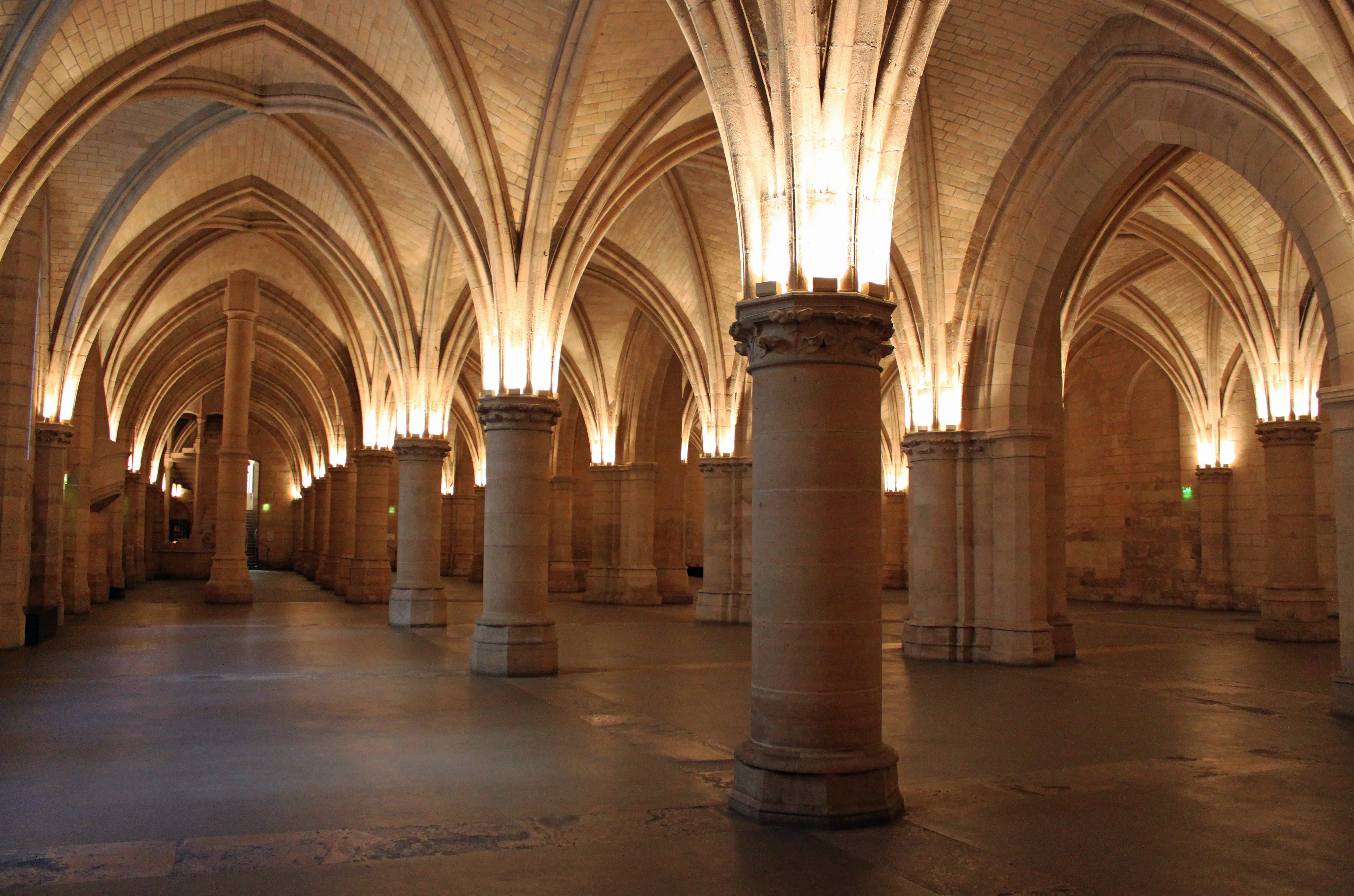
Conciergerie
The cell measured roughly eleven square meters. A cot, a table, two chairs, a screen for privacy. Marie Antoinette lived here for 76 days in the summer and autumn of 1793, watched around the clock by two guards who never left the room. She was 37, her hair had gone white, and the building that held her had once been home to the kings of France. The Conciergerie's journey from royal palace to death's waiting room took five centuries - a span in which the same Gothic halls that hosted medieval banquets became the last address of thousands condemned to die.
Where Kings Held Court
The Conciergerie occupies the western end of the Ile de la Cite, the island in the Seine where Paris began. A Roman governor built a fortress here; the Merovingian King Clovis made it his capital in 508 AD. But the building visitors see today dates primarily from the reign of Philip IV, who between 1302 and 1313 transformed the complex into the most magnificent royal residence in Europe. His great hall, the Salle des Gens d'Armes, stretched 64 meters long and 27 meters wide - the largest surviving medieval hall in Europe. Four massive fireplaces heated it. The hall beside it, the Salle des Gardes, served the king's personal guard. Philip also built the iconic four towers along the Seine waterfront, including the Tour de l'Horloge, which received Paris's first public clock in 1370.
From Palace to Prison
In 1358, following a revolt led by Etienne Marcel, King Charles V abandoned the Palais de la Cite for the Louvre and the Hotel Saint-Pol, never to return. The palace was handed over to the Parliament of Paris and the royal judicial system. A concierge - a high-ranking official responsible for the building and its prisoners - gave the complex its enduring name. Over the following centuries, the Conciergerie became the principal prison of Paris, holding everyone from common criminals to political prisoners. The building acquired a grim reputation long before the Revolution, but nothing prepared it for what came after 1789.
The Antechamber of the Guillotine
During the Reign of Terror, the Conciergerie became the central processing point for revolutionary justice. Between 1793 and 1795, 2,781 prisoners were held here, tried in the adjacent Tribunal, and sentenced - overwhelmingly to death. The Revolutionary Tribunal met in the Grande Chambre, once the bedroom of Louis IX. Prisoners were escorted across the Cour du Mai to waiting tumbrels that carried them through the streets to the guillotine. Marie Antoinette arrived on August 2, 1793, transferred from the Temple prison. She was tried on October 14, accused of treason, depletion of the national treasury, and conspiracy with foreign powers. The trial lasted two days. She was guillotined on October 16 at the Place de la Revolution, the square now called Place de la Concorde.
The Prisoners' World
Not all inmates experienced the Conciergerie equally. Wealthier prisoners could pay for a private cell - a pistole - with a bed, table, and the ability to receive visitors and food from outside. The destitute were packed into fetid communal cells called pailleux, sleeping on straw on damp stone floors with no light and minimal air. Between these extremes existed an entire economy of imprisonment: barbers, laundresses, letter-writers, even restaurateurs operated within the prison walls. Among the famous names who passed through were Danton, Robespierre himself in the final irony, the poet Andre Chenier, and Charlotte Corday, who assassinated Marat. The prison's records, meticulously kept by its administrators, provide one of the most detailed accounts of the Terror's human cost.
Stone Memory
After the Revolution, the Conciergerie continued as a prison until 1914. The building was classified as a historical monument in 1862, and a chapel was created in the space believed to be Marie Antoinette's cell during the Restoration period - a royalist memorial within a revolutionary landmark. Today the Conciergerie is a museum, part of the Centre des Monuments Nationaux. Visitors walk through the immense medieval halls that Philip IV built, past the reconstructed cells of the Revolution, beneath vaulted ceilings that have witnessed seven centuries of French power and its consequences. The building stands as a reminder that the same architecture can serve a feast and a tribunal, that grandeur and horror can share an address. The Seine still flows past the four towers, indifferent to the history they contain.
From the Air
The Conciergerie (48.856°N, 2.346°E) sits on the western half of the Ile de la Cite in the center of Paris, immediately adjacent to the Palais de Justice and the Sainte-Chapelle. From altitude, the Ile de la Cite is clearly visible as the larger of two islands in the Seine. The Conciergerie's distinctive four towers along the northern waterfront are identifiable at lower altitudes. Notre-Dame Cathedral occupies the eastern end of the same island. Nearest airports: Paris Charles de Gaulle (LFPG) 25km northeast, Paris Orly (LFPO) 14km south. Best viewed at 2,000-3,000 feet, where the island setting and the building's relationship to the Seine bridges become clear.