Condor Club
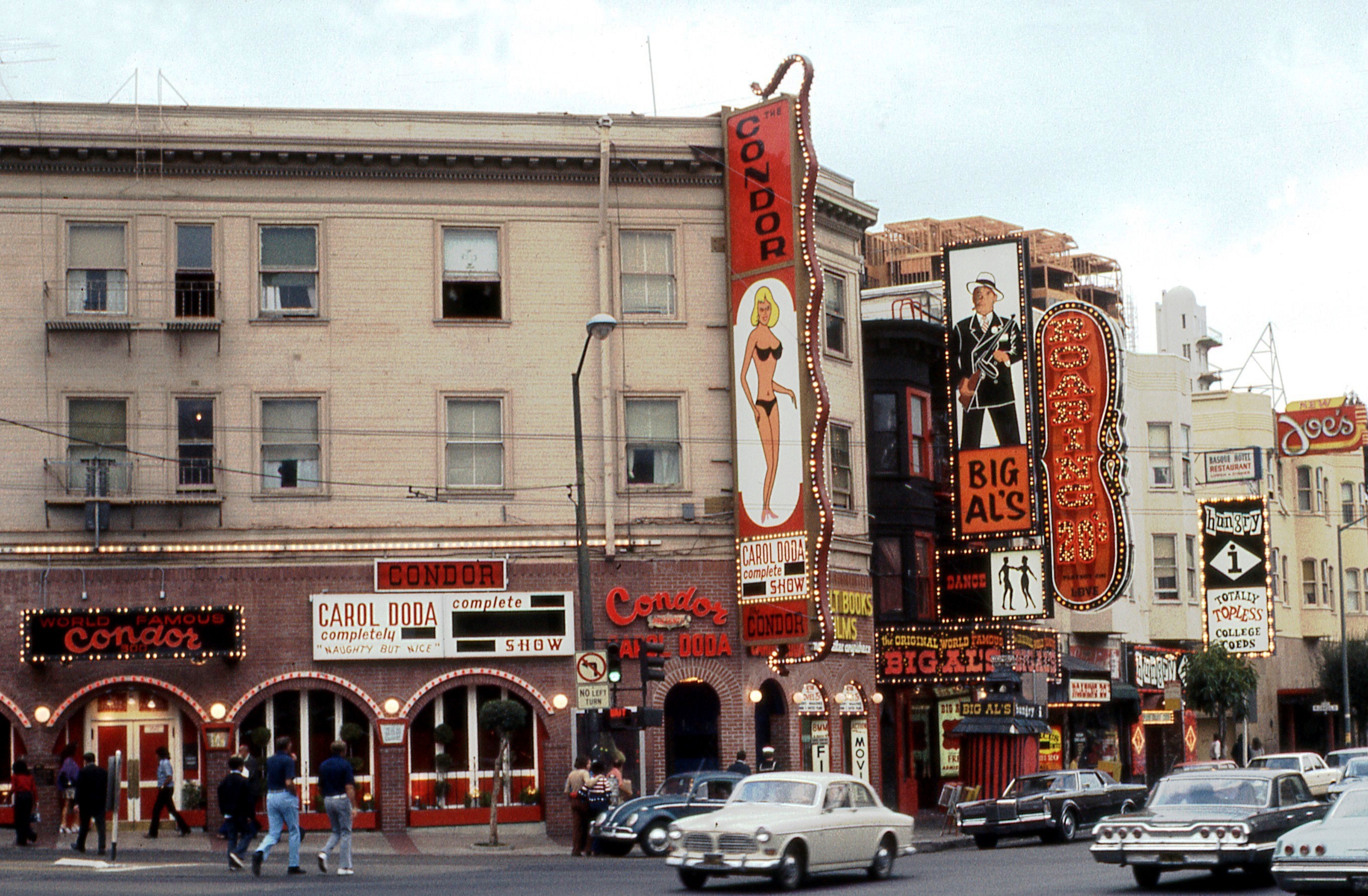
On the evening of June 19, 1964, a cocktail waitress stepped onto a stage at the corner of Broadway and Columbus Avenue wearing a monokini -- a topless swimsuit designed by Rudi Gernreich that had made headlines but had never been worn in a nightclub. Carol Doda was 26 years old, and by the time she finished her first dance at the Condor Club, she had launched a cultural revolution that would reshape American nightlife. The neon signs of North Beach had seen plenty, but nothing quite like this.
From Pisco to Rock and Roll
The building at Broadway and Columbus had been a neighborhood bar for most of the twentieth century, known as the Pisco Bar before Mario Puccinili bought it and renamed it Pucci's House of Pisco. By the time Gino Del Prete owned it in 1958, the venue had evolved into a music club. Pete Mattioli became Gino's partner and booked acts that made the room jump -- Bobby Freeman, the Righteous Brothers, Sly Stone. The house band, George and Teddy and the Condors, gave the club its name. North Beach in the early 1960s was a neighborhood where the Beat Generation's literary energy was giving way to something louder and more visual. The Condor Club sat at the crossroads of that transition.
The Revolution and Its Neon
Doda's topless debut drew crowds immediately, and the club erected a neon sign that became a North Beach landmark: a giant image of Doda with red flashing lights where her nipples would be, blinking above Broadway like a beacon for the curious. In 1969, she began dancing fully nude, pushing the boundaries further until California made bottomless dancing illegal in establishments serving alcohol in 1972. She continued performing topless at the Condor until 1985, a twenty-one-year run that made her one of the most recognized entertainers in San Francisco. The club's famous white piano, on which Doda was lowered from the ceiling by cables for her entrance, became as iconic as the neon sign outside.
The Piano Incident
That white piano also became the setting for one of San Francisco's most bizarre tragedies. In November 1983, bouncer Jimmy Ferrozzo and his girlfriend, dancer Theresa Hill, stayed after hours and climbed onto the piano. They accidentally triggered the hydraulic mechanism, and over the next ninety seconds, the piano rose to the ceiling, crushing Ferrozzo against the floor above. He was asphyxiated. Hill survived only because her smaller frame left enough space for her to breathe. The incident became part of North Beach lore, a grim reminder that the club's theatrical machinery was designed for spectacle, not safety.
Reinventions on Columbus Avenue
The Condor Club closed in 2000 and briefly became a sports bar, then Andrew Jaeger's House of Seafood and Jazz between 2005 and 2007. But the name proved stronger than any rebrand. In August 2007, the Condor Club reopened, once again featuring dancers, now billing itself as "San Francisco's Original Gentlemen's Club." In 2022, the city added it to the San Francisco Legacy Business registry, a program designed to protect the kinds of long-running establishments that give neighborhoods their character. The 2024 documentary Carol Doda Topless at the Condor revisited the club's story for a new generation, examining both the liberation and the exploitation embedded in Doda's legacy. The corner of Broadway and Columbus still glows with neon after dark, though the neighborhood around it has changed in ways that would astonish the patrons who lined up on that June evening in 1964.
From the Air
The Condor Club is located at 37.7981N, 122.407W in San Francisco's North Beach neighborhood at the corner of Broadway and Columbus Avenue. Not individually visible from the air, but the Broadway entertainment strip is identifiable by its dense neon lighting at night. Nearby airports: KSFO (11nm S), KOAK (8nm E). Within San Francisco Class B airspace.