Confederate Obelisk
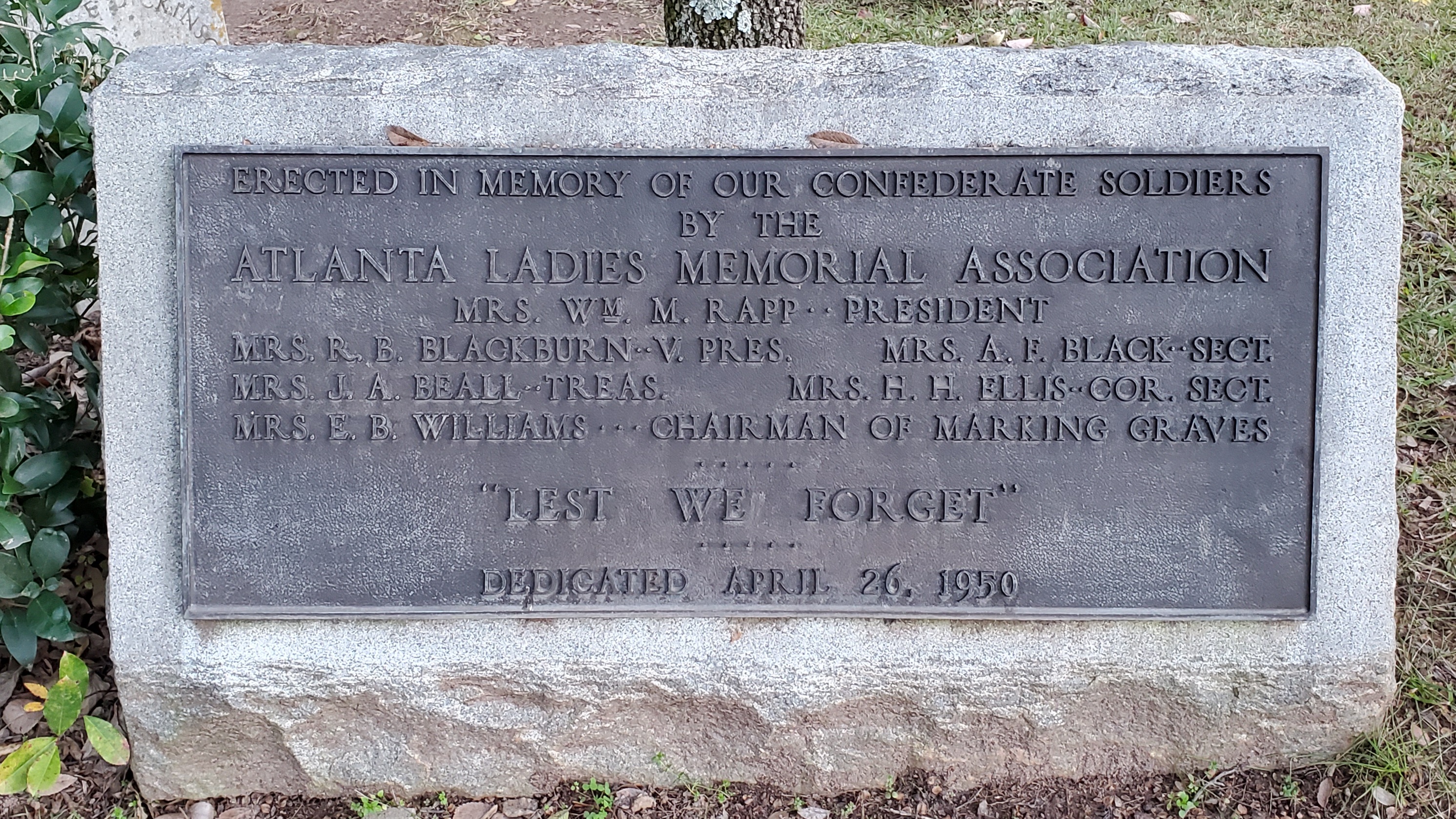
The cornerstone was laid on the day they buried Robert E. Lee. On October 15, 1870, as the defeated general's funeral procession wound through Lexington, Virginia, a crowd gathered in Atlanta's Oakland Cemetery to watch John Brown Gordon -- Confederate general, future Georgia governor -- deliver an oration over a block of granite that would anchor one of the South's earliest monuments to its Lost Cause. Sealed inside that cornerstone: a portrait of Lee, an 1862 Confederate flag, Confederate currency and stamps, a bullet, two gloves, and a membership roster of the Atlanta Ladies' Memorial Association. Four years later, the finished obelisk rose above the cemetery's Confederate section, inscribed with three words -- "OUR CONFEDERATE DEAD" -- and for a time it stood as the tallest structure in all of Atlanta.
Six Thousand, Nine Hundred Graves
Oakland Cemetery is one of Atlanta's oldest and largest burial grounds, and its Confederate section holds the remains of over 6,900 soldiers -- most of them casualties of the brutal Atlanta campaign of 1864. Many died in the battles of Peachtree Creek, Ezra Church, and the Battle of Atlanta itself, fighting to defend a rail hub that the Confederacy could not afford to lose. The Atlanta Ladies' Memorial Association, or ALMA, organized the monument effort and raised $8,000 for its construction. The Stone Mountain Granite Company donated the granite, and a local marble merchant designed and contributed the marble tablets that adorn the base. When the obelisk was dedicated in 1874, it towered over a city still rebuilding from Sherman's occupation. For several years, this memorial to the defeated was literally the highest point on the Atlanta skyline.
Stone Mountain to Piedmont Park
The Confederate Obelisk does not stand alone. It belongs to a constellation of Confederate monuments scattered across Atlanta, each erected in the decades following the war as part of a broader movement to memorialize the Confederate cause. The Lion of the Confederacy, also in Oakland Cemetery, depicts a dying lion draped over a Confederate flag. Piedmont Park holds the Peace Monument, dedicated in 1911. These monuments were not erected in the immediate aftermath of the war but during the era of Jim Crow, when their construction carried political weight well beyond simple remembrance. The granite for the Oakland obelisk came from Stone Mountain, the same massive rock face where, beginning in 1916, the United Daughters of the Confederacy would commission a monumental carving of Confederate leaders -- a project that would take decades to complete and generate its own cycles of controversy.
Contextual Markers and Their Critics
The national reckoning over Confederate monuments reached Atlanta in August 2017, after the Unite the Right rally in Charlottesville, Virginia. Mayor Kasim Reed assembled a committee to assess the city's Confederate memorials and recommend action. Georgia state law prohibited removal, so the city partnered with the Atlanta History Center to develop "contextual markers" -- interpretive signs placed alongside the monuments to provide historical framing about slavery, the war, and the monuments' construction during the Jim Crow era. The Confederate Obelisk, the Lion, and the Peace Monument all received markers. The Historic Oakland Foundation welcomed the approach. "We want to say these things have different meanings," one of its executive directors explained. "Depending on the era and time, it can mean different things to different people." But the Atlanta NAACP called the markers "a profound disappointment," arguing that explanatory plaques did not adequately counter the monuments' celebration of white supremacy.
Paint on Granite
The debate did not stay in committee rooms. On the night of May 28, 2020, during the protests that followed the killing of George Floyd, the Confederate Obelisk and the Lion were vandalized with spray paint. Over the following weeks in May and June 2020, the monuments were targeted on several additional occasions. The Historic Oakland Foundation documented the damage and undertook remediation, but the episodes underscored a tension that no contextual marker could fully resolve: for some, these monuments are irreplaceable historical artifacts marking the graves of the dead; for others, they are public endorsements of a cause built on slavery. The obelisk still stands in Oakland Cemetery, its inscription still reading "OUR CONFEDERATE DEAD," its granite surface bearing the faint traces of paint that has been scrubbed away and may yet return.
From the Air
Located at 33.748N, 84.372W in Oakland Cemetery, just southeast of downtown Atlanta. The cemetery is a prominent green space visible from the air amid dense urban development. Nearest airports: Atlanta Hartsfield-Jackson International (KATL) approximately 8nm south, DeKalb-Peachtree Airport (KPDK) approximately 7nm northeast, Fulton County Airport-Brown Field (KFTY) approximately 10nm northwest. Oakland Cemetery covers 48 acres and is bounded by Memorial Drive to the north and the MARTA rail line to the west. The obelisk itself is not distinguishable from altitude, but the cemetery's layout and the contrast between its green space and the surrounding city blocks are clearly visible at 2,000-3,000 feet AGL.