Cong Abbey
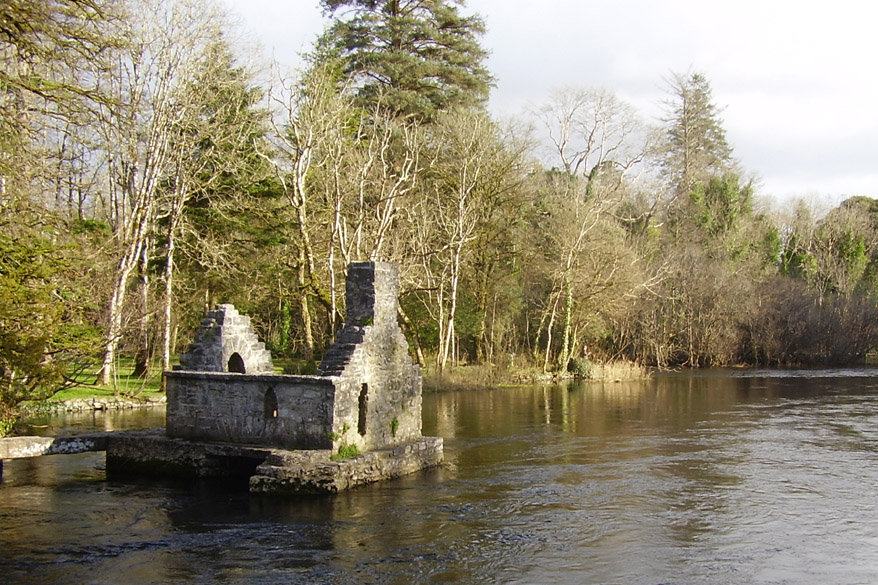
A bell rings in the monastery kitchen. Fresh fish. Somewhere upstream, in a small stone house built on an island in the River Cong, a monk has felt a tug on the line that runs from his fishing hole to the kitchen door. The fish is alive, kept fresh in a trapdoor pool beneath the floor while the river flows underneath the building. It is an arrangement of such ingenious practicality that it seems modern, but the monks' fishing house at Cong Abbey was probably built in the fifteenth or sixteenth century. The monks of Cong had been solving problems creatively for a very long time.
Kings and Stone
Cong Abbey's origins reach back to the early seventh century, when a church was reportedly built on the site by Saint Feichin. That building was destroyed by fire in 1114. What rose in its place would become one of the most important religious houses in the west of Ireland. Turlough Mor O'Connor, High King of Ireland, refounded the abbey and established it as an Augustinian settlement in 1138 -- one of the earliest Augustinian houses south of Armagh, which had been founded only twelve years earlier. But Cong's most poignant royal connection came through Turlough's son, Ruaidri Ua Conchobair, known as Rory O'Connor. He was Ireland's last High King, and after losing his throne he retreated to Cong Abbey in 1183, spending the last fifteen years of his life here. He died at the abbey and was briefly buried within its walls before being exhumed and re-interred at Clonmacnoise. His name remains inscribed on the processional Cross of Cong, one of Ireland's great medieval treasures.
Carved in Stone, Borrowed from France
The ruins of Cong Abbey have been praised as featuring some of the finest early Gothic architecture and masonry in Ireland. The present church dates from an early thirteenth-century rebuilding, and its sculptural decoration suggests links to French styles of the period -- a reminder that medieval Ireland was not isolated but connected to European artistic currents through its religious networks. The north doorway of the church is particularly notable, as are the elaborate doorways opening onto the cloister from the monastery's east range. The chapter house, framed by two fine windows, was where the community conducted its daily business, heard a chapter of the Augustinian rule read aloud, and gathered to confess their sins publicly. The cloister fragments that survive hint at the scale and ambition of the original complex.
The Fishing House
Of all the abbey's features, the monks' fishing house is the most memorable. Built on a small island in the River Cong, near where it flows into Lough Corrib, the house sits on a stone platform above a small arch that allows the river to pass beneath the floor. A trapdoor in the floor gave access to the flowing water, where fish could be kept alive and fresh -- an elegant solution to the problem of feeding a monastic community that observed regular fast days requiring fish. Local tradition holds that a line connected the fishing house to the monastery kitchen, so the cook would know the moment a catch arrived. Whether or not the bell-and-line story is literally true, the fishing house itself is real, visible, and still standing -- a small stone building over running water, its function immediately clear to any visitor.
Ruins in the Care of the State
Cong Abbey is today a national monument, maintained by Ireland's Office of Public Works. The village of Cong sits nearby, famous in its own right as the filming location for The Quiet Man. Lough Corrib, Ireland's largest lake, lies just to the south. From the air, the abbey ruins are visible as a cluster of grey stone walls and arches set among green fields, the River Cong threading its way past the fishing house island toward the lake. The ruins are open to visitors, and on quiet mornings -- before the tour buses arrive from Ashford Castle down the road -- you can still sense the contemplative atmosphere that drew a deposed king to spend his final years among these stones.
From the Air
Located at 53.54°N, 9.29°W in the village of Cong, County Mayo, near the northern shore of Lough Corrib. The abbey ruins are visible as a cluster of medieval stone walls and arches. Ashford Castle is located nearby on the lakeshore. Lough Corrib, Ireland's largest lake, is the dominant visual reference. Nearest airports: Knock Airport (EIKN), approximately 55 km north; Galway Airport (EICM), approximately 35 km south.