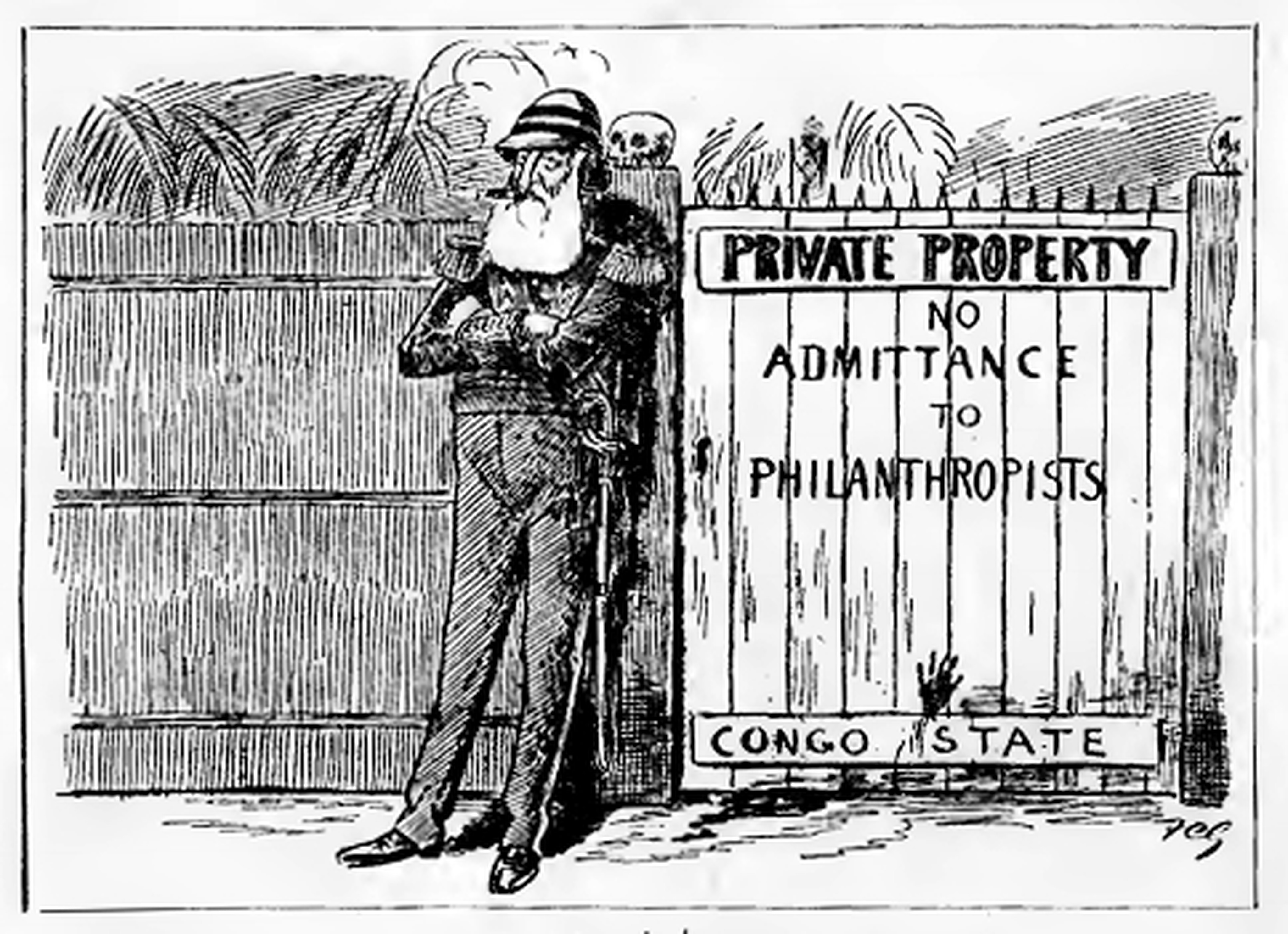
Congo Free State
The name itself was a lie. The Congo Free State was not free. It was the private property of one man -- Leopold II, King of the Belgians -- who acquired nearly a million square miles of central Africa through diplomatic manipulation, ran it as a personal fiefdom, and turned its population into forced laborers extracting rubber and ivory for European markets. Between 1885 and 1908, millions of Congolese people died from violence, starvation, disease, and a system of exploitation so extreme that it eventually provoked one of the first organized international human rights campaigns. When Leopold was finally forced to relinquish control, he burned the archives. "I will give them my Congo," he reportedly said of the Belgian state, "but they have no right to know what I did there."
The Philanthropist's Mask
Leopold wanted a colony. Belgium did not want one for him. So he built a web of deception. In 1876, he hosted a Brussels Geographic Conference and established the International African Association, presenting it as a scientific and humanitarian body dedicated to civilizing central Africa and suppressing the slave trade. He hired explorer Henry Morton Stanley to negotiate treaties with local leaders -- agreements made under duress with people who could not read what they were signing. Leopold lobbied President Chester Arthur in Washington, convincing the United States to become the first nation to recognize his claim. He promised France first option to buy the territory if his venture failed. He assured Bismarck that German traders would be welcome. At the Berlin Conference of 1884-85, European powers formally granted Leopold personal sovereignty over the Congo Basin -- roughly 2.3 million square kilometers and some 30 million people -- on the condition that he promote free trade and suppress slavery. He agreed to all of it. He meant none of it.
The Machinery of Extraction
Leopold declared all unoccupied land -- meaning any land without a dwelling or garden plot, which was most of the country -- to be state property. He divided the Congo into concession zones and leased extraction rights to private companies, which were allowed to detain Congolese people who did not work hard enough and to police their territories as they saw fit. A system of rubber quotas was imposed on villages, enforced by the Force Publique, Leopold's private army. The Force Publique's officers were European; its soldiers were often Congolese men kidnapped as children and raised in mission stations under conditions resembling slavery. Armed with modern rifles and the chicotte -- a whip made of dried hippopotamus hide -- they took hostages, burned villages, and mutilated those who failed to meet their quotas. Soldiers were required to present a severed hand for every bullet fired, to prove ammunition had not been wasted on hunting. The hands of men, women, and children became the currency of this system.
Those Who Bore Witness
The atrocities did not go unrecorded. Joseph Conrad, who had served as a steamboat captain on the Congo River, drew on what he witnessed to write Heart of Darkness in 1899. British journalist Edmund Dene Morel, working for a Liverpool shipping firm, noticed that ships returning to the Congo from Belgium carried only guns and ammunition, never trade goods -- evidence that the supposed free trade economy was in fact a forced-labor state. Roger Casement, British consul at Boma, investigated and published a devastating eyewitness report in 1904. Together, Morel and Casement founded the Congo Reform Association, which drew support from Arthur Conan Doyle, Mark Twain, and Booker T. Washington. Missionaries documented mutilations and photographed the evidence. William Henry Sheppard, an African American Presbyterian missionary, published accounts of rubber company abuses and was sued for libel by the Kasai Rubber Company -- a case he won in 1909 that further embarrassed Leopold on the world stage.
Counting the Dead
No census existed before Leopold's rule, and he destroyed the financial and administrative records before handing over control. This makes precise accounting impossible -- a fact that was almost certainly intentional. A 1919 Belgian government commission concluded that the population had roughly halved during the Free State period. The first official Belgian census in 1924 counted approximately 10 million people. Working backward from that figure, historians have estimated the pre-colonial population at around 20 million, suggesting a death toll in the range of 10 million -- a figure cited by both Adam Hochschild and Congolese historian Isidore Ndaywel e Nziem. More recent demographic research has revised these numbers, with some scholars estimating the 1885 population at closer to 11.5 million and the decline at 1 to 1.5 million. The debate remains heated and unresolved. What is not in dispute is that the causes of death were multiple and devastating: armed violence, famine, forced labor, mass displacement, epidemic diseases including sleeping sickness, and a catastrophic decline in birth rates.
The Transfer and Its Aftermath
International pressure finally forced Leopold's hand. In 1908, the Belgian parliament annexed the Congo Free State, establishing it as the colony of the Belgian Congo. Leopold was effectively stripped of personal control, though the concessionary companies continued operating and the Congolese population merely exchanged one form of colonial rule for another -- albeit one with somewhat more oversight. Leopold died in Brussels on December 17, 1909. He had spent his final years burning the evidence. The legacy endures in ways both visible and contested. Statues of Leopold in Belgium have been vandalized and debated. The Order of the Crown, created in 1897 to honor service in the Congo Free State, is still awarded by the Belgian state. Whether what occurred in the Congo constitutes genocide remains an open question -- Adam Hochschild called the killing "of genocidal proportions" but "not strictly speaking a genocide," a distinction that continues to be challenged by scholars and the Congolese people whose ancestors lived and died under Leopold's rule.
From the Air
The Congo Free State encompassed most of the modern Democratic Republic of the Congo, centered on the Congo River basin. The administrative capital was Boma (5.85S, 13.05E), a port town on the Congo River about 100 km from the Atlantic coast in present-day Kongo Central Province. Key landmarks include Fort de Shinkakasa near Boma, the Inga Dams upstream, and the port of Matadi. Nearest airports: Boma Airport, N'Djili International Airport in Kinshasa (FZAA). The vast Congo Basin rainforest is visible from altitude stretching eastward from the river. The Congo River itself, one of the most distinctive features visible from space, traces a sweeping arc across central Africa.