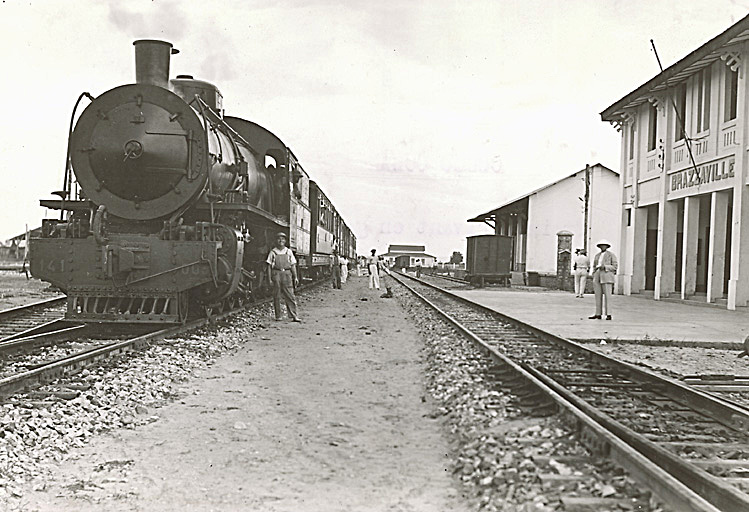
Congo-Ocean Railway
The French writer Andre Gide traveled through the Congo in 1926 and witnessed the construction of a railway that would haunt him. Workers conscripted from what is now southern Chad and the Central African Republic were being driven through equatorial forest to lay track between Brazzaville and the Atlantic port of Pointe-Noire. They were dying in enormous numbers. By the time the Congo-Ocean Railway was completed in 1934, more than 17,000 workers had perished from industrial accidents, malaria, and the systematic brutality of the forced labor system. The railway they built -- 502 kilometers of track bypassing the unnavigable rapids of the lower Congo River -- still operates today. Its history is one of the starkest examples of the human cost of colonial infrastructure in Africa.
Why the Line Was Built
The problem the railway was meant to solve was geographic. The Congo River is navigable from Brazzaville deep into the interior of the continent and along major tributaries like the Oubangui River all the way to Bangui. But below Brazzaville, a 350-kilometer stretch of rapids and falls makes the river impassable. Colonial administrators and merchants needed a way to move goods -- timber, minerals, agricultural products -- from the interior to a seaport. In 1921, the French colonial administration contracted the Societe de Construction des Batignolles to build the line. France had not ratified the International Labour Organization's Forced Labour Convention of 1930, and the colonial government saw no obstacle to conscripting workers from distant territories to do the job.
The Forest of No Joy
The workers came from hundreds of kilometers away, uprooted from their communities in southern Chad and the Central African Republic and marched to construction sites in the dense Mayombe forest. Conditions were appalling. Housing was inadequate. Sanitation was primitive. Malaria ravaged work camps. Physical abuse by overseers was rampant, and the rations provided were often insufficient to sustain people performing grueling physical labor in tropical heat. The death toll mounted steadily throughout the thirteen years of construction: more than 17,000 workers died, a figure that reflects not a single catastrophe but an ongoing, systemic disregard for human life. The disdain that the conscripted population felt toward this forced labor, combined with other forms of colonial oppression, fueled the Kongo-Wara rebellion between 1928 and 1931. France did not ratify the Forced Labour Convention until 1946, by which point decades of indigenous resistance had made the status quo untenable.
A Line That Survived Its Makers
The railway outlasted the colonial system that created it. In 1962, a branch was built to Mbinda near the Gabonese border, connecting with the COMILOG Cableway to carry manganese ore to Pointe-Noire. When Gabon built its own railway in 1986, the cableway closed, but the branch line continued to operate. The civil war that erupted in the Republic of the Congo in 1997 shut the entire line down for six years. When operations restarted in 2004, the track was in dire condition. By 2007, a BBC News report described the railway as being in a "decrepit state, with the majority of trains now broken." A Korean-manufactured luxury passenger train called La Gazelle was introduced in 2012, making the Pointe-Noire to Brazzaville run every other day in fourteen to sixteen hours. On June 21, 2010, a derailment between Bilinga and Tchitondi sent four carriages into a ravine, killing at least seventy-six people.
Remembering the People Who Built It
In 2015, the railway purchased ten new locomotives from Electro-Motive Diesel in Muncie, Indiana, and proposals for extensions to carry iron ore have followed. The line endures because the geographic logic that created it has not changed: the rapids still block the river, and goods still need to reach the coast. But the Congo-Ocean Railway carries a weight that no locomotive hauls. More than 17,000 people -- conscripted from their homes, forced to labor in conditions that killed them by the thousands, buried in unmarked graves along the right-of-way -- built every kilometer of this line. Their names are largely unrecorded, their communities disrupted in ways that reverberated for generations. Historian J. P. Daughton titled his 2021 book about the railway's construction "In the Forest of No Joy." The title captures what the engineering triumph language obscures: this was infrastructure built on human suffering, and the people who suffered deserve to be remembered as more than a death toll.
From the Air
The railway runs 502 km from Pointe-Noire on the Atlantic coast (4.77S, 11.87E) to Brazzaville (4.27S, 15.28E), passing through the dense Mayombe forest. The route is visible from altitude as a cleared corridor through tropical vegetation, roughly paralleling the coast before turning inland. Pointe-Noire (FCPP) and Maya-Maya Airport in Brazzaville (FCBB) are the nearest major airports. Recommended viewing altitude: 5,000-10,000 feet AGL to trace the railway corridor through the forest. The Mayombe section, where much of the heaviest construction and highest death toll occurred, passes through particularly dense jungle terrain.