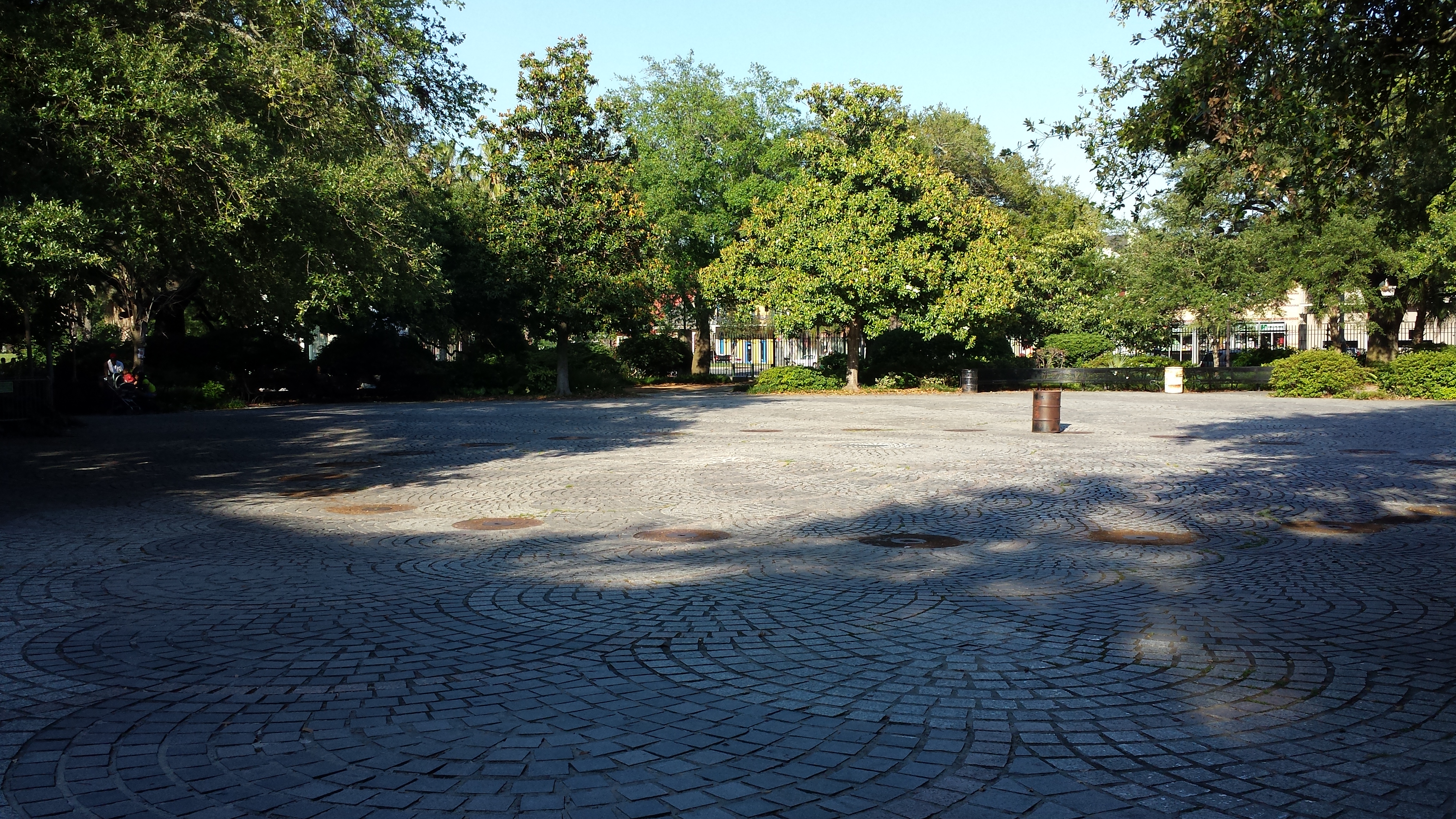
Congo Square
Every Sunday afternoon, the drums began. In an open clearing just across Rampart Street from the French Quarter, hundreds of enslaved Africans gathered to do what colonial law and Protestant custom had suppressed nearly everywhere else in North America: play their own music. Observers heard the deep pulse of bamboulas and the twang of banzas -- precursors to the banjo -- while dancers performed the Bamboula, Calinda, Congo, and Juba in circles of packed earth. This was Congo Square, and the rhythms born here did not stay here. They traveled outward through the decades, weaving into jazz funerals, second line parades, Mardi Gras Indian processions, and ultimately into the DNA of jazz itself.
Where Sundays Belonged to the Enslaved
Under Louisiana's French and Spanish colonial rule, the Code Noir of 1724 granted enslaved Africans Sundays off from work, though it said nothing about the right to congregate. They gathered anyway -- along levees, in backyards, in public squares, wherever they could. On Bayou St. John at a clearing called "la place congo," the various ethnic and cultural groups of colonial Louisiana traded goods and socialized. In 1817, a city ordinance restricted all such gatherings to a single location: the open ground known variously as the Place des Negres, Place Publique, Circus Square, or simply Place Congo, at the back edge of town. There the enslaved could set up markets, buy and sell goods freely, and raise money to purchase their own freedom. The singing, dancing, and drumming that accompanied the markets were not performance -- they were culture refusing to die.
The Sound That Amazed a Nation
After the Louisiana Purchase brought New Orleans into the United States, Congo Square's weekly gatherings became a spectacle that drew astonished visitors from across the country. African music had been suppressed in the Protestant states, making the spectacle on this small patch of New Orleans earth unlike anything most Americans had ever witnessed. Architect Benjamin Latrobe visited in 1819 and documented the celebrations in his journal, describing dances he could scarcely comprehend. The ring shout -- a sacred circular dance rooted in West African spiritual practice -- was performed to invoke ancestral spirits for healing. The rhythms played at Congo Square survive today in the syncopated brass of jazz funerals, the rolling percussion of second line parades, and the chanting call-and-response of the Mardi Gras Indians. Even Louisiana Voodoo rites drew their musical language from these Sunday gatherings.
A Name They Could Not Erase
In 1893, city leaders officially renamed the square Beauregard Square, after Confederate General P.G.T. Beauregard. The renaming was part of a deliberate effort to suppress the mass gatherings that had defined the space for generations. But New Orleanians refused to comply. Most locals kept calling it Congo Square, and the name persisted stubbornly through more than a century of official maps that said otherwise. In the 1960s, a controversial urban renewal project leveled much of the surrounding Treme neighborhood, and the city eventually folded the square into the new Louis Armstrong Park. In 2011, thanks largely to the advocacy of local historian Freddi Williams Evans and City Councilwoman Kristin Gisleson Palmer, the New Orleans City Council voted to officially restore the name Congo Square. Palmer declared it "the birthplace of the culture and music of New Orleans" and called jazz "the only truly indigenous American art form, and arguably its genesis was Congo Square."
The Drums Have Never Stopped
Congo Square's musical legacy is not historical -- it is ongoing. Starting in 1970, the city organized the New Orleans Jazz and Heritage Festival and held early events at the square before outgrowing it and moving to the Fairgrounds. The Congo Square Preservation Society, founded by percussionist Luther Gray, carries on the original Sunday tradition through weekly drum circles, dancing, and musical performances. The square hosts Martin Luther King Day celebrations, where a ceremonial march departs for the MLK Monument on South Claiborne Avenue. Composers and musicians across generations have drawn inspiration from the space: Henry F. Gilbert wrote a symphonic poem staged at the Metropolitan Opera in 1918, Wynton Marsalis composed an African-themed jazz score titled Congo Square, and Donald Harrison produced a three-movement Congo Square Suite blending Afro-New Orleans chant with orchestral jazz. The square is small. The sound it created is not.
From the Air
Located at 29.961N, 90.068W within Louis Armstrong Park in the Treme neighborhood of New Orleans, just north of the French Quarter. The park's open green space is visible from the air, bordered by Rampart Street to the south and Basin Street to the west. Nearest airport is Louis Armstrong New Orleans International (KMSY), approximately 11 nm west. Lakefront Airport (KNEW) is about 6 nm northeast. Best viewed at 2,000-3,000 ft AGL; the park contrasts clearly against the dense surrounding neighborhood.