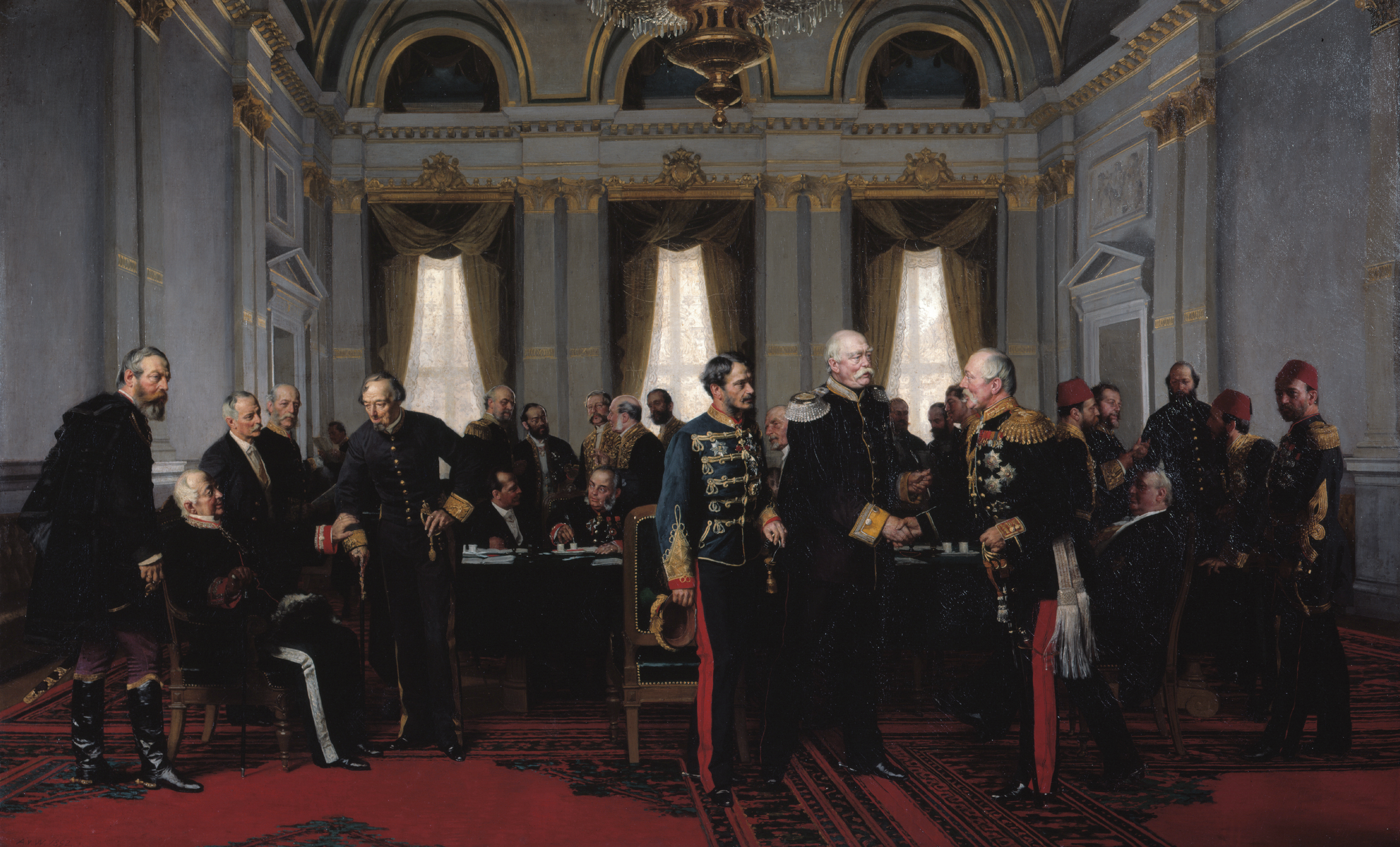
Congress of Berlin
Bulgaria walked into the Congress of Berlin on 13 June 1878 with the borders of a great Balkan state. Russia's recent victory over the Ottomans had produced the Treaty of San Stefano three months earlier, and on paper Bulgaria stretched from the Danube to the Aegean, holding most of Macedonia. By the time Bulgarian delegates left Berlin a month later, more than sixty per cent of that territory had been taken away. The land was given back to the Ottomans, divided into a smaller Principality of Bulgaria and a separate semi-autonomous province called Eastern Rumelia. The decisions were made by men sitting in the Reich Chancellery — the Prussian, the Austrian, the Briton, the Russian — none of whom were Bulgarian. Most were not Balkan at all. The Bulgarian people's reaction to having their country cut down by more than half by foreigners has shaped Balkan politics ever since.
Why a Congress at All
The Russo-Turkish War of 1877–1878 had ended with Russian armies camped within sight of Constantinople. The Treaty of San Stefano in March 1878 gave Russia what it had wanted: a large autonomous Bulgaria as a Russian client state, a Russian foothold reaching to the Aegean, and a clear path toward control of the Dardanelles. Britain refused to accept it. The British Mediterranean Fleet was moved to the Sea of Marmara to threaten war. Austria-Hungary, which had its own designs on Bosnia and Herzegovina, refused too. Otto von Bismarck, chancellor of the new German Empire, was asked to mediate. Bismarck called himself an honest broker, but his hosting of the congress in Berlin was also a demonstration that the new Germany — only seven years old as a unified empire — was now the centre of European diplomacy. The major powers, plus the Ottomans, plus delegates from Greece, Serbia, Romania and Montenegro who could attend only the sessions concerning their own countries, sat down at the Reich Chancellery, the former Radziwill Palace, on 13 June 1878.
Decisions Made About People in Their Absence
The congress sat for a month and produced the Treaty of Berlin on 13 July 1878. Romania, Serbia and Montenegro received full independence — though Romania was forced to give part of Bessarabia back to Russia, gaining the malarial Northern Dobruja in exchange, and Romanians resented this for decades. Montenegro received small territorial gains around Nikšić, Podgorica and Bar. Bosnia and Herzegovina, with its mixed Orthodox, Catholic and Muslim population, was placed under Austro-Hungarian occupation, despite still being formally part of the Ottoman Empire — a transitional arrangement that became a full annexation in 1908. Britain, which had not even fought in the war, walked away with administrative control of Cyprus through a secret deal with the Ottomans concluded nine days before the congress opened. And Bulgaria — the country whose people had risen against Ottoman rule in the April Uprising of 1876 and watched their cause spark the Russo-Turkish War — was reduced to less than half its San Stefano size. The Bulgarian and Macedonian peoples were spoken about in those rooms as administrative problems to be balanced. They had no votes.
Who Was Pleased and Who Was Not
Almost no one left the congress satisfied. The Ottomans had been confirmed as what European diplomats called the sick man of Europe, weakened and humiliated. Russia had won its war and lost its peace; Foreign Minister Alexander Gorchakov called the Berlin Treaty the darkest page of his life. Russian nationalists turned against Bismarck for what they saw as a betrayal, and the Three Emperors' League — the conservative alliance binding Germany, Austria-Hungary and Russia — never recovered. The Serbs were furious that Russia had agreed to hand Bosnia to Austria-Hungary, where many Serbs lived. The Greeks felt cheated of territory they had been promised in Thessaly and Epirus, though they eventually received Thessaly and the Arta region in 1881. The Bulgarians felt the deepest betrayal: they had seen a unified Bulgarian state recognised in writing only to watch it taken back by foreigners who had never asked their opinion. Britain and Austria-Hungary, the two powers that had not fought, came away with the most. Britain had Cyprus. Austria-Hungary had Bosnia, Herzegovina, and the right to garrison the Sanjak of Novi Pazar between Serbia and Montenegro.
The Long Fuse
The British historian A. J. P. Taylor wrote in 1954 that the Congress of Berlin was a turning point in modern European history. The diplomats went home pleased that they had averted an immediate war. What they had done instead was bury the grievances that would erupt thirty-five years later. South Slav resentment at Austrian rule in Bosnia simmered through the 1880s and 1890s, deepened in 1908 when Vienna formally annexed the province, and on 28 June 1914 produced the assassination of Archduke Franz Ferdinand by Gavrilo Princip in Sarajevo. The First and Second Balkan Wars of 1912 and 1913 were direct consequences of the borders the Berlin Congress had drawn — the Bulgarian, Serbian and Greek attempts to redress what they had been denied in 1878. The First World War followed in 1914. Of all the diplomatic gatherings of the 19th century, the Congress of Berlin produced the longest and most catastrophic afterlife. The men in the Reich Chancellery thought they were balancing the powers. They were balancing them on the edge of a precipice, and the people who would fall over it were not in the room when the decisions were made.
From the Air
The Congress was held at Bismarck's Reich Chancellery, the former Radziwill Palace, at approximately 52.512°N, 13.382°E in central Berlin's Mitte district, just south of Unter den Linden and a short walk from the Brandenburg Gate. The Chancellery building was destroyed in World War II and the site has been redeveloped. Berlin Brandenburg (EDDB) is 23 km southeast. From altitude central Berlin shows as a dense urban grid bisected by the Spree river, with the long green strip of the Tiergarten extending west from the Brandenburg Gate.