The Congress of Vienna: The Party That Redrew Europe
The joke made the rounds through every salon in Vienna: "Le congres danse beaucoup, mais il ne marche pas" - the Congress dances a lot but makes no progress. It was witty, widely repeated, and wrong. Between September 1814 and June 1815, representatives of more than 200 states, principalities, and interest groups gathered in the Austrian capital to do something unprecedented: redesign the political map of an entire continent through negotiation rather than conquest. They held lavish balls, attended the opera, drank prodigious quantities of wine, and conducted a staggering amount of backroom diplomacy. When they finished, nine days before Napoleon's final defeat at Waterloo, they had produced a settlement that kept Europe largely at peace for the next ninety-nine years.
A Continent in Pieces
The problem facing the Congress was twenty-three years of nearly continuous war. The French Revolutionary and Napoleonic Wars had redrawn borders across Europe, dissolved the thousand-year-old Holy Roman Empire, shuffled monarchies like playing cards, and left millions dead. Napoleon's defeat and exile to Elba in May 1814 created a vacuum that someone had to fill. The victorious powers - Britain, Austria, Prussia, and Russia - each arrived in Vienna with their own ambitions. Russia's Tsar Alexander I wanted Poland, Prussia wanted Saxony, Austria wanted to contain both of them, and Britain wanted to prevent any single power from dominating the continent again. France, the defeated party, sent Charles-Maurice de Talleyrand, a diplomat of legendary cunning who intended to ensure that his humiliated nation was not carved up by its conquerors. The Treaty of Paris had already settled some questions. The Congress would settle the rest - or so they hoped.
Talleyrand's Masterclass
France should have been the weakest voice in the room. Instead, Talleyrand made it indispensable. The four victorious powers initially tried to exclude France from the inner negotiations, but Talleyrand outmaneuvered them within weeks. He allied himself with eight lesser powers - Spain, Sweden, Portugal among them - and used their collective weight to force his way into the core discussions. Congress Secretary Friedrich von Gentz wrote that Talleyrand "hopelessly upset all our plans" in a two-hour tirade that left the Allied representatives scrambling. When they protested that a procedural document they had signed meant nothing, Talleyrand's Spanish ally the Marquess of Labrador shot back: "If it means so little, why did you sign it?" The most delicate crisis - the Polish-Saxon question, which nearly triggered a new war between Russia-Prussia and Austria-Britain - was resolved when Talleyrand proposed admitting France to the inner circle as a counterweight. On January 3, 1815, France, Austria, and Britain secretly signed a treaty pledging mutual defense against Russian and Prussian aggression. The defeated power had become kingmaker.
Waltzes Between the Wars
Vienna during the Congress was the most expensive party Europe had ever thrown. The Austrian court spent lavishly on entertainment, hosting balls, sleigh rides, hunts, concerts, and theatrical productions. Emperor Francis I kept his guests close and well-fed while Metternich's secret police monitored their correspondence and pillow talk. More than a hundred thousand visitors swelled the city's population. The social calendar served a diplomatic purpose: informal gatherings at salons and banquets created opportunities for conversation that rigid negotiating sessions could not. Deals were struck over champagne that might have stalled across a conference table. The Congress also attracted publishers demanding copyright law, religious organizations seeking protections, and representatives of cities hoping to preserve their autonomy. It was, in effect, the first modern international conference - messy, expensive, occasionally absurd, and ultimately productive. The dancing was not a distraction from the diplomacy. It was part of it.
The Map They Made
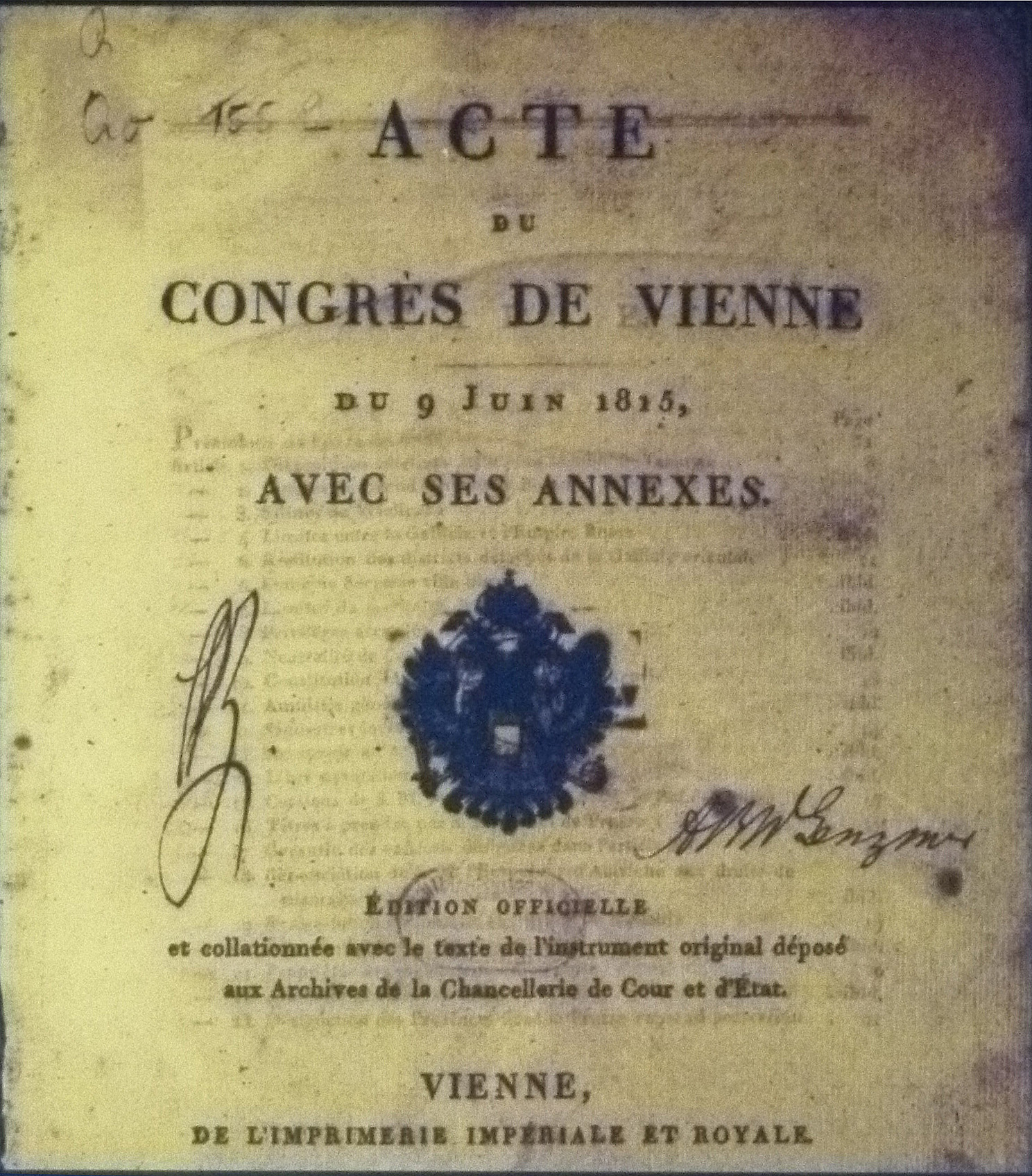
The Final Act, signed on June 9, 1815, reshaped Europe comprehensively. Russia received most of the Duchy of Warsaw as a nominally independent "Congress Poland" under the Tsar. Prussia gained three-fifths of Saxony, Swedish Pomerania, and significant Rhineland territories. Austria recovered the Tyrol, Salzburg, and gained Lombardy-Venetia in northern Italy. The Netherlands and Belgium merged into a united kingdom meant to buffer France. Switzerland's neutrality was formally guaranteed. The German Confederation of thirty-nine states replaced the defunct Holy Roman Empire. The slave trade was condemned, and freedom of navigation was established on major rivers including the Rhine and Danube. Britain retained the Cape Colony, Ceylon, and various colonial holdings. The settlement was imperfect - it suppressed liberal and nationalist movements, storing up tensions that would eventually explode in 1848 and beyond. But its architects had not set out to build a perfect world. They set out to build a stable one. By that measure, the Congress of Vienna was one of the most successful diplomatic enterprises in history.
The Metternich System
The man who chaired the Congress and whose name became synonymous with its legacy was Prince Klemens von Metternich, Austria's Foreign Minister. Metternich was a conservative who believed that the French Revolution's ideals of liberty and popular sovereignty were diseases that needed to be quarantined. The system he built at Vienna rested on the balance of power among the great nations, the legitimacy of established monarchies, and a willingness to intervene collectively against revolutionary movements. It worked remarkably well for a generation. The Concert of Europe, as the post-Vienna diplomatic framework became known, resolved crises through conference rather than combat. But Metternich's system carried the seeds of its own undoing: by suppressing nationalism and liberalism, it ensured that when those forces finally broke through, they did so with revolutionary fury. The revolutions of 1848 swept Metternich himself from power. He fled Vienna disguised in a laundry cart - the architect of European order escaping the very city where he had built it.
From the Air
The Congress of Vienna was centered at the Hofburg Palace (48.21N, 16.37E) in central Vienna, though sessions and social events took place throughout the city. The Hofburg complex is clearly visible from the air as a massive palatial compound along the Ringstrasse. Vienna International Airport (LOWW) lies 18 km to the southeast. Bratislava Airport (LZIB) is 60 km east. At 3,000-5,000 feet, the Danube River, the Ringstrasse boulevard encircling the old city, and the green expanse of the Prater park provide clear orientation. The historic center where delegates gathered is a compact area between the Danube Canal and the Wienerwald hills to the west.