Congressional Cemetery
Elbridge Gerry lies here. The only signer of the Declaration of Independence buried in Washington, D.C. rests beneath the same soil as J. Edgar Hoover, John Philip Sousa, Civil War photographer Mathew Brady, and Push-Ma-Ta-Ha, a Choctaw chief who died in 1824 while negotiating with the federal government. Congressional Cemetery, officially the Washington Parish Burial Ground, sprawls across the west bank of the Anacostia River in the Hill East neighborhood -- an active, working cemetery where you can still purchase a plot, walk your dog off-leash, or stumble across the grave of the man who designed the Washington Monument. Founded in 1807, it is the only American cemetery of national memory established before the Civil War, and the stories it holds are as tangled and contradictory as the nation itself.
The Cenotaphs of Benjamin Latrobe
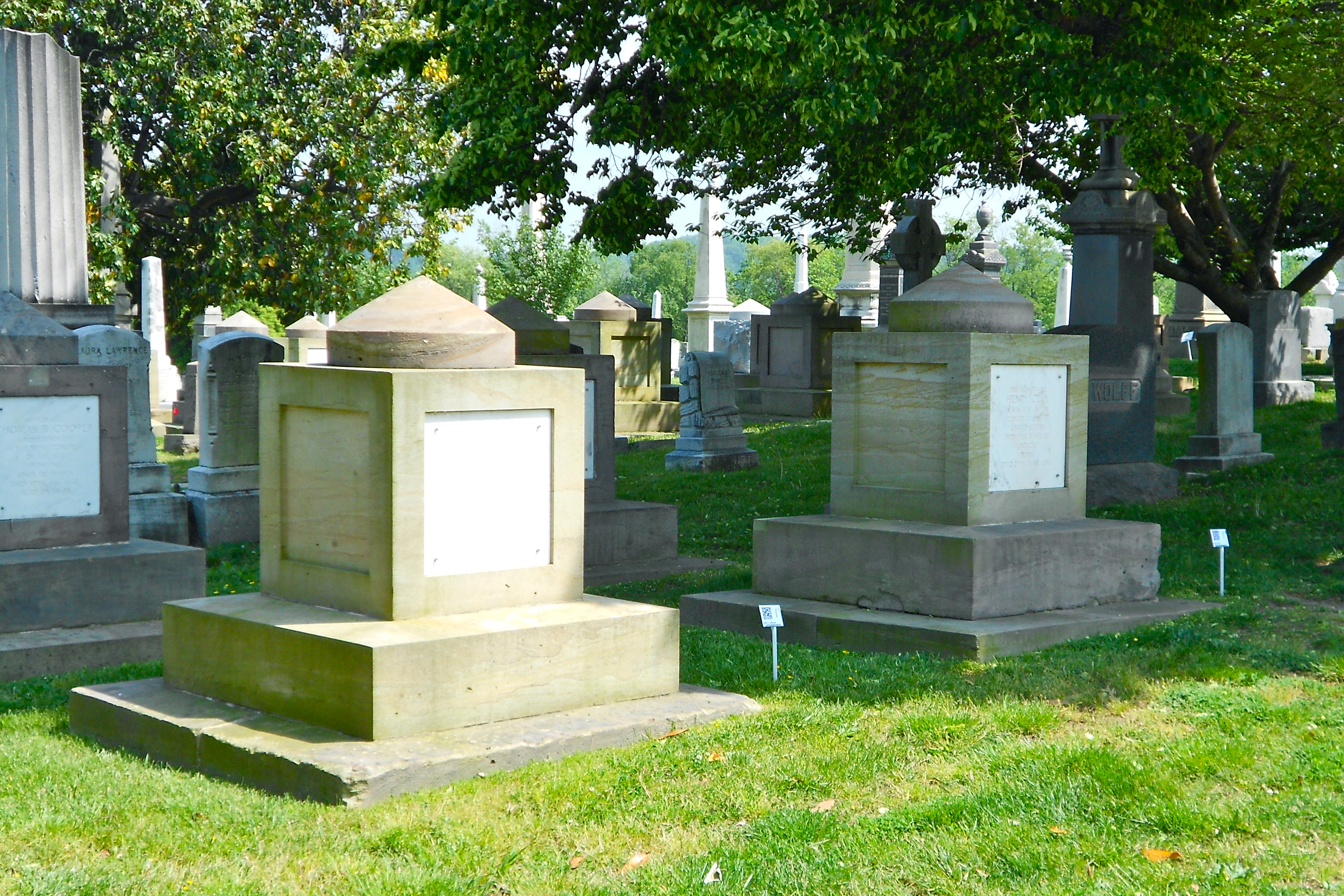
By 1817, Congress had set aside sections of the cemetery for legislators and government officials. For those buried elsewhere, identical cenotaphs were erected -- 168 of them, designed by Benjamin Latrobe, the architect of the Capitol. Each is a large square block with recessed panels set on a wider plinth and topped with a conical point. They march in rows like stone sentries, memorializing senators, representatives, and one non-congressman: William Thornton, the first Architect of the Capitol. From 1823 to 1876, Congress funded the cemetery's expansion, paving, fencing, and the public vault used for temporary interment. Presidents' funerals passed through here -- William Henry Harrison in 1841, Zachary Taylor in 1850 -- with processions stretching two miles from the White House.
Where Lincoln Mourned
On a summer day in 1864, an explosion ripped through the Washington Arsenal, killing a woman supervisor and twenty teenage girls who had been packing explosives and cartridges. Most were Irish. President Abraham Lincoln led the funeral procession to Congressional Cemetery and attended the graveside ceremonies. A monument was later erected over the graves of sixteen victims -- a marble column topped with a sculpture of a grieving young woman, carved by local artist Lot Flannery. Lincoln's assassination conspirator David Herold is also buried here, as is Lewis Powell, another conspirator believed to have hidden overnight in the cemetery's public vault while fleeing. First Lady Dolley Madison spent two years in that same vault while funds were raised for her reinterment at Montpelier -- the longest known interment in the cemetery's public resting place.
Decline and the K-9 Corps
After Congress stopped funding the cemetery in 1876, decline set in slowly and then all at once. By the 1970s, monuments and burial vaults were crumbling, buildings rotted from deferred maintenance, and drug dealers and prostitutes had taken over the grounds. Christ Church, the cemetery's owner, lacked the resources to intervene. In 1976, management passed to the Association for the Preservation of Historic Congressional Cemetery. Progress was glacial until 1997, when the K-9 Corps was organized -- a group of dog owners who paid membership fees for the privilege of walking their dogs off-leash on the grounds. Their presence drove out the drug trade. Today the K-9 Corps provides roughly twenty percent of the cemetery's operating income, and the program has been nationally recognized for creative use of urban green space.
An Uncommon Democracy of the Dead
Congressional Cemetery holds one vice president, one Supreme Court justice, six Cabinet members, nineteen senators, and seventy-one U.S. Representatives. But the grounds are not exclusively political. Mathew Brady, who documented the Civil War through his camera lens, rests near Belva Ann Lockwood, the first woman attorney permitted to practice before the Supreme Court. Tom Lantos, the only Holocaust survivor elected to Congress, lies near Leonard Matlovich, the Air Force veteran and gay rights activist whose gravestone reads, "When I was in the military, they gave me a medal for killing two men and a discharge for loving one." The cemetery claims to be the only one in the world with a dedicated LGBTQ section. In 2013, fifty-eight eco-goats were brought in to clear poison ivy from the surrounding woods -- the first use of goats inside the Beltway, an event that drew coverage from the BBC, Al-Jazeera, and Tokyo TV. At Congressional Cemetery, American history is not curated. It simply accumulates.
From the Air
Located at 38.881N, 76.978W in the Hill East neighborhood of Washington, D.C., on the west bank of the Anacostia River. The cemetery appears as a distinctive green rectangle bordered by urban development, visible at lower altitudes. Recommended viewing altitude: 2,000-3,000 feet AGL. CAUTION: This location is within the Washington D.C. Special Flight Rules Area (SFRA) and very close to the Flight Restricted Zone (FRZ). Nearby airports: KDCA (Ronald Reagan National), approximately 4 nm southwest; KADW (Joint Base Andrews), approximately 8 nm southeast. Visual landmarks include RFK Stadium site to the east and the Anacostia River.