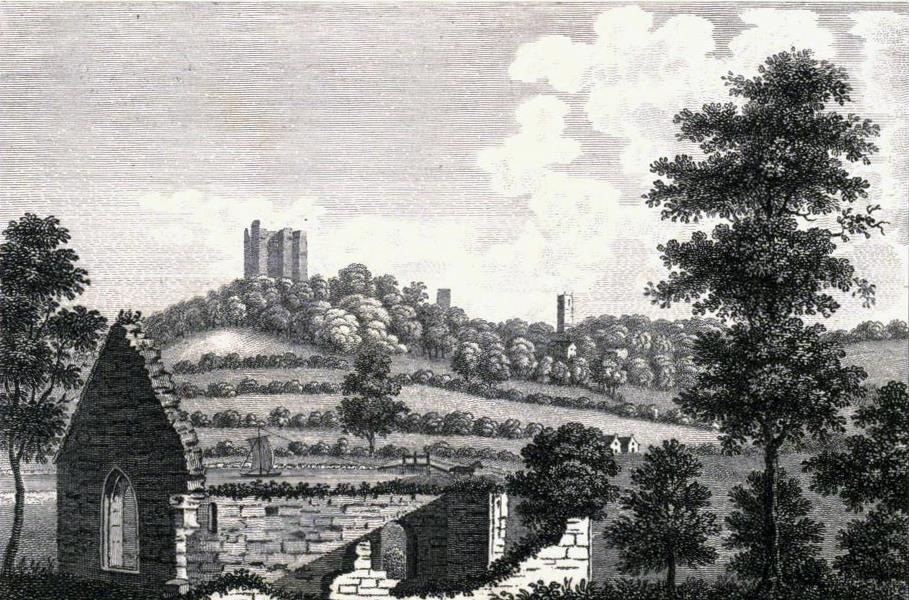
Conisbrough Castle
In 1811, Sir Walter Scott rode past Conisbrough Castle and saw enough from the road to fuel a novel. He caught only a partial glimpse, but the circular keep rising above the Don Valley fired his imagination, and he set his 1819 novel Ivanhoe here, believing the castle to be Saxon in origin. Scott was wrong about the age, but right about the romance. The castle is Norman, not Saxon, and its distinctive circular keep with six massive buttresses is the oldest of its kind in England.
The Keep That Stands Alone
Conisbrough Castle was built in the late 12th century, probably in the 1180s, by Hamelin Plantagenet, the illegitimate half-brother of King Henry II. The keep is its masterpiece: a great circular tower of magnesian limestone, reinforced by six wedge-shaped buttresses that rise the full height of the structure. This design was revolutionary in English military architecture. Circular keeps were harder to undermine than square ones because sappers could not easily dig beneath a corner. The buttresses added strength while also providing space inside for a chapel, a pigeon loft, and an oven. The keep rises 92 feet (28 metres) and the walls are over fifteen feet thick at the base. Inside, the principal rooms would have been comfortable by 12th-century standards, with a fireplace, latrine, and a small oratory. The whole sits atop a natural limestone spur above the River Don, a position that gave it commanding views but would ultimately contribute to its destruction.
A Crown Possession
The castle's ownership reads like a compressed history of medieval England. After Hamelin, it passed through the de Warenne family until Edward II seized it in 1322. When Edward was overthrown by his wife Isabella in 1326, the castle was returned to its previous holders. Richard of York inherited it next, and when he was killed at the Battle of Wakefield in 1460 during the Wars of the Roses, it passed to his son Edward, who seized the English throne as Edward IV in 1461. Conisbrough thus returned to Crown ownership. Henry VIII later gave the ruins to the Carey family. Each transfer of power left the castle a little more neglected, a little further from the center of royal attention.
The Geology of Collapse
By the 16th century, Conisbrough was falling apart, and the cause was literally beneath it. The limestone spur that made the site so defensible was topped by unstable clay and sandstone. Over centuries, rainwater washed away the clay, leaving the sandstone to crack and shift. A royal survey in 1537 and 1538 found that the gates, bridge, and parts of the outer walls had collapsed in a spectacular landslide. One floor of the keep had fallen in. The castle escaped the slighting that destroyed so many fortifications during the English Civil War in the 1640s, but only because nature had already done the work. The outer walls were too ruined to be of military value, so Parliament saw no need to demolish what was already indefensible. It was an inglorious reprieve.
Ivanhoe's Castle
Scott's Ivanhoe gave Conisbrough a second life, not as a fortress but as a literary landmark. The novel, set in the 12th century, features a siege of the castle, though the events are entirely fictional. Scott believed the castle was Saxon, a view shared by many 19th-century commentators who saw in its unusual circular design something older and stranger than the typical Norman rectangle. They were wrong, but the mystery of the architecture fueled fascination. By the 1880s, the surrounding landscape had changed dramatically. Factories crowded the new railway line, and what one antiquarian called a "murky atmosphere" from industrial works replaced the picturesque views that earlier writers had praised. The castle is now managed by English Heritage, and visitors can climb the keep to take in views that, on clear days, stretch across the South Yorkshire countryside. The circular tower still stands, as it has for over eight centuries, outlasting the geology that tried to bring it down.
From the Air
Located at 53.48N, 1.23W in the Don Valley near Doncaster, South Yorkshire. The distinctive circular keep with its six buttresses is visible from moderate altitude, sitting on a raised limestone spur above the River Don. Nearest airport is EGCN (Doncaster Sheffield/Robin Hood), approximately 5 miles east. The M1 and M18 motorways intersect nearby. The town of Conisbrough sits immediately below the castle.