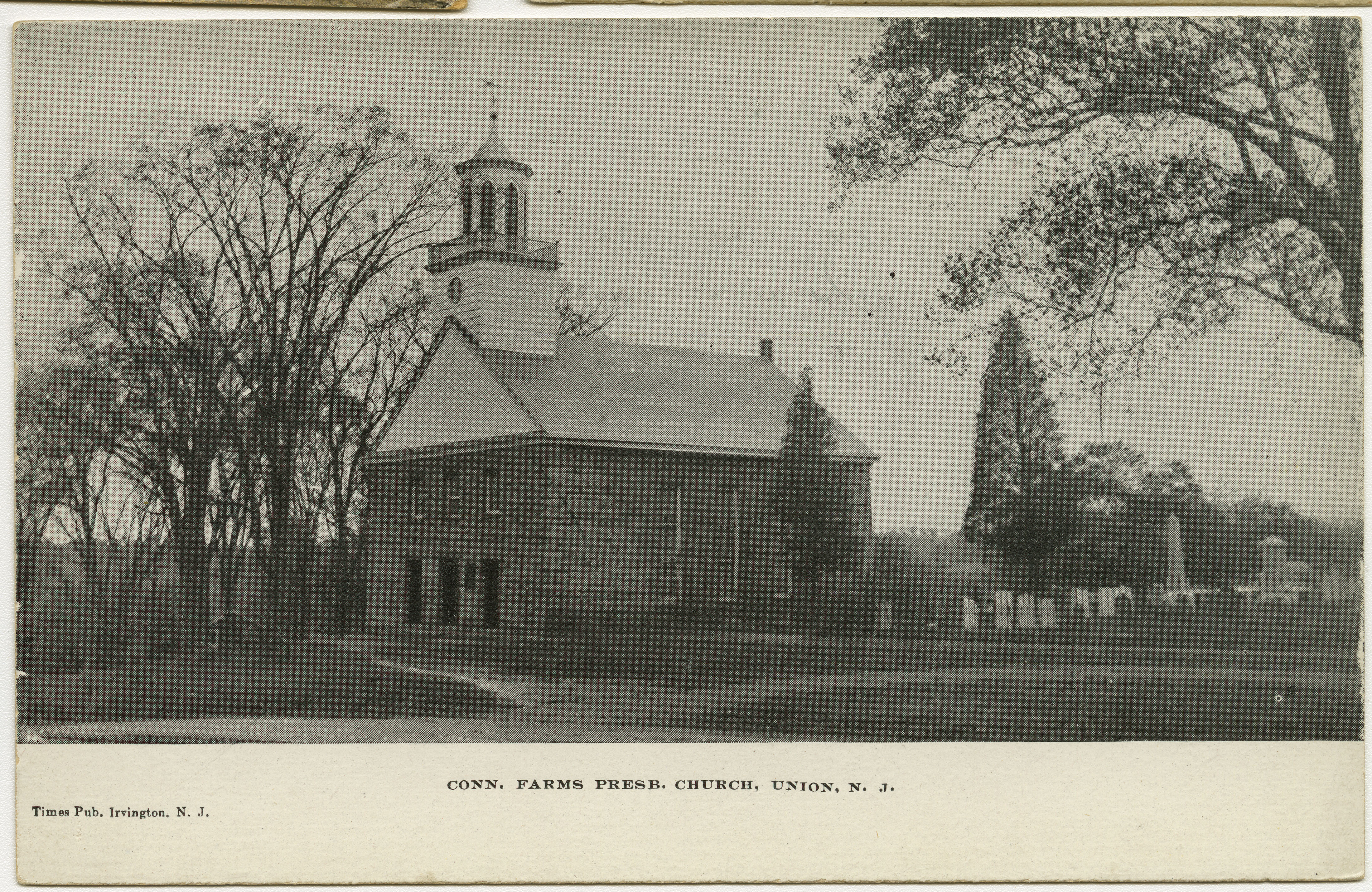
Connecticut Farms Presbyterian Church
Hannah Caldwell was sitting on a bed with her baby and three-year-old when a musket ball came through the window. It was June 1780, and Hessian soldiers under General Wilhelm von Knyphausen were burning their way through the village of Connecticut Farms in what is now Union Township, New Jersey. Her husband, Continental Army chaplain James Caldwell, was away. The church where he preached, the parsonage where his family lived, and nearly every structure in town were reduced to ashes that day. The brick church that stands at Stuyvesant and Chestnut avenues today is what the community built from those ashes -- and it has stood for nearly two and a half centuries.
Five Miles to Sunday Service
Connecticut Farms was settled in 1667 by emigrants from the colony of Connecticut. For more than sixty years, attending church meant a four-to-five-mile trek over rough roads to Elizabethtown, the nearest congregation. By 1730, the residents had had enough. They pooled their resources and raised a wood-frame meetinghouse on a small rise in the center of their village. A parsonage followed soon after. The original building served the community for half a century -- a modest wooden structure that anchored the spiritual and social life of a farming settlement tucked between the Watchung Mountains and the coastal plain. It was, by all accounts, an unremarkable country church. What made it remarkable was what happened to it.
The Battle That Burned Everything
In the latter years of the Revolutionary War, British forces launched an assault from Staten Island aimed at recapturing the Continental Army's stronghold at Morristown. On June 7, 1780, Hessian and Loyalist troops under General von Knyphausen swept through Connecticut Farms, torching the church, the parsonage, and much of the surrounding village. The attack failed in its strategic objective -- the British never reached Morristown -- but its human cost was searing. Hannah Caldwell's death became a rallying cry for the Patriot cause. The parsonage where she was killed was later preserved and renamed the Caldwell Parsonage, serving today as a local history museum. Her husband James, known as the "Fighting Parson," continued to serve the Continental Army until he himself was killed by an American sentry in 1781 under circumstances that remain disputed.
Rising from Brick and Orchard
Two years after the war ended, the citizens of Connecticut Farms rebuilt their church. The 1782 structure was built of brick rather than wood -- a choice that reflected both the community's determination and perhaps a practical lesson about fire. That brick building still stands. Over the centuries it has been sustained in part through the sale of grass and apples from its orchards, a detail that says something about the rural character of the congregation well into the modern era. In 1901, a new manse replaced the original parsonage next to the church. Expansions followed in 1920 and 1949, adding wings that maintained the Colonial style of the original structure.
First in the State
In 1970, Connecticut Farms Presbyterian Church earned a distinction that reflected the depth of its history: it became the first church in New Jersey to be listed on the National Register of Historic Places. The listing recognized not just the building's age but its layered significance -- as a witness to the Revolution, a memorial to Hannah Caldwell, and an example of continuous worship spanning nearly three centuries. A vintage postcard of the church survives, showing it much as it appears today: a solid brick building on a slight rise, its Colonial proportions unchanged, surrounded by the suburban landscape that long ago replaced the farming village. The church remains an active Presbyterian congregation, holding services in a space where the walls themselves carry the weight of American history.
From the Air
Located at 40.69°N, 74.27°W in Union Township, Union County, New Jersey, near the intersection of Stuyvesant and Chestnut avenues alongside U.S. Route 22. Newark Liberty International Airport (KEWR) is approximately 6 miles to the east. The church sits on a small rise visible in the suburban landscape. Best viewed at 1,500-2,500 feet AGL. The Watchung Reservation and first ridge of the Watchung Mountains are visible to the west.