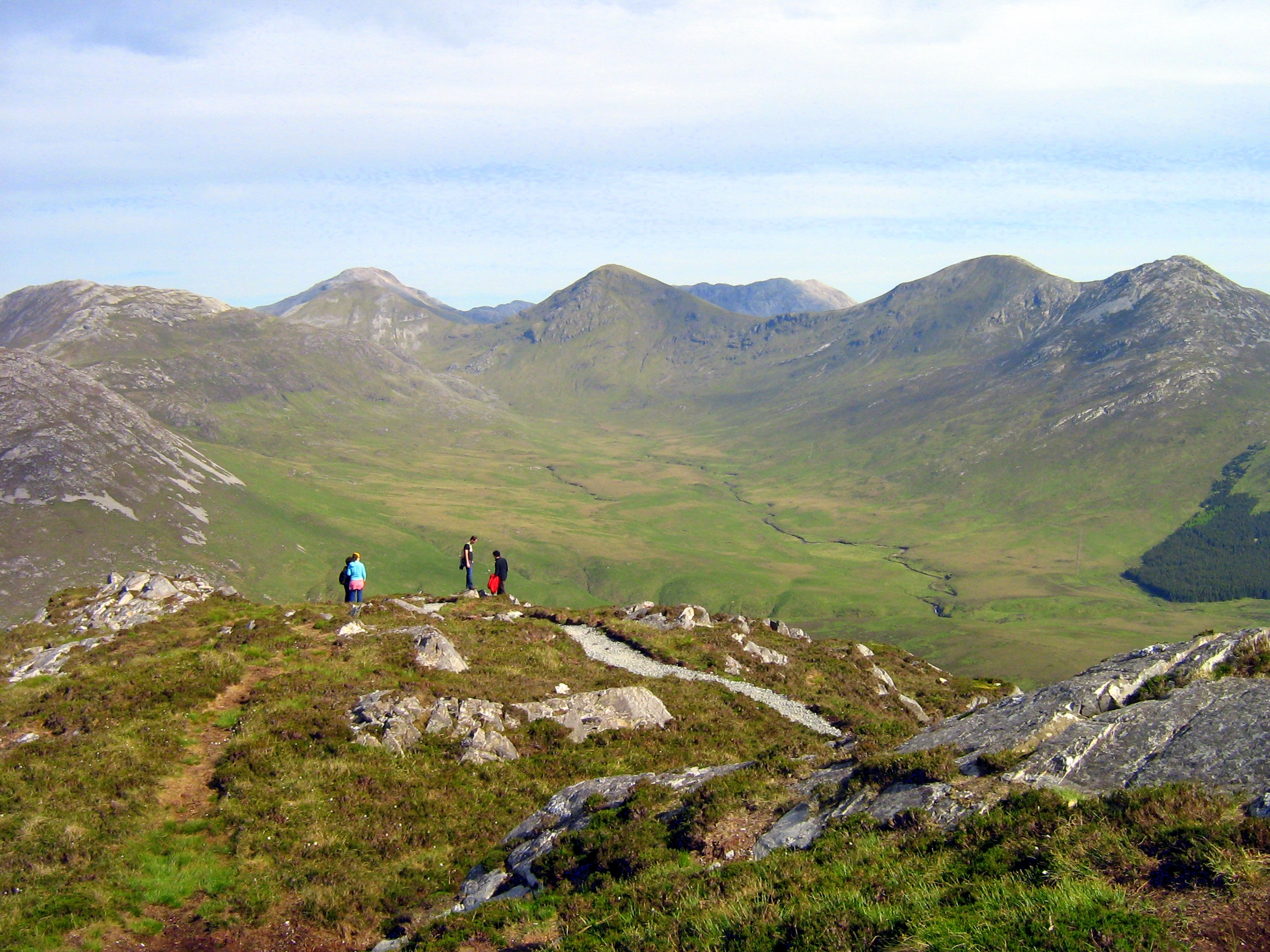
Connemara National Park
The sundew does not wait for its prey. Its sticky tentacles glisten in the bog like drops of morning dew, and when an insect lands, the leaf slowly curls inward. In Connemara National Park, even the plants are predators -- a necessity in soil so nutrient-poor that evolution favored digestion over photosynthesis. This is a landscape that demands adaptation from everything that lives here, and the park's 2,000 hectares of mountain, bog, and heath tell that story at every altitude.
Deep Roots in Thin Soil
Humans have been adapting to this landscape for millennia. Megalithic court tombs dating back 4,000 years stand within the park boundaries, their builders drawn to this remote corner of Galway by reasons lost to prehistory. A 19th-century graveyard offers more recent evidence of habitation, its headstones weathered by Atlantic winds. The land itself once belonged to the Kylemore Abbey estate before the Irish state established the national park in 1980, opening it to the public near the village of Letterfrack on the Clifden side of the Twelve Bens mountain range.
The Bog's Hidden Economy
Western blanket bog and heathland dominate the park's lower elevations, and their ecology is stranger than it appears. Purple moorgrass carpets vast stretches, turning the landscape violet in season. Beneath the grass, the bog is alive with specialists. Sundews and butterworts trap insects on sticky leaves, supplementing the meager nutrients available in the acidic peat. Bog cotton waves white in the wind like tiny surrender flags. Orchids, bog asphodel, and bog myrtle crowd the margins of pools and streams. Lichens and mosses colonize every surface, from rocks to rotting wood, building their own miniature forests at ground level. The bog itself is a carbon archive -- thousands of years of compressed vegetation, a record of climate and ecology written in peat.
Wings and Hooves
Connemara's bird diversity is remarkable for a landscape that appears, at first glance, to offer little. Meadow pipits and skylarks fill the air with song. European stonechats perch on gorse. Kestrels hover above the heath, while sparrowhawks hunt the woodland edges. Less commonly, merlins and peregrine falcons patrol the higher ground. Winter brings migrant thrushes, redwings, fieldfares, and woodcock to shelter in the park's valleys. On the ground, the mammals are harder to spot but no less present. Badgers, foxes, and pine martens emerge after dark. Red deer, once extirpated from Connemara, have been reintroduced and now browse the park's margins. But the most iconic resident is the Connemara pony -- the sturdy, sure-footed breed native to this region, now the park's largest mammal.
Quartzite and Cloud
From above, Connemara National Park is a study in contrasts. The peaks of the Twelve Bens thrust upward in pale quartzite, their bare ridges catching the light above a darker canvas of bog and heath. Cloud shadows race across the landscape, turning green to black and back again in seconds. The mountains rise sharply from sea level, and the park's terrain moves quickly from coastal grassland through blanket bog to exposed alpine heath. After rain -- which is frequent -- streams appear everywhere, silver threads stitching the hillsides together. On clear days, the Atlantic is visible to the west, its horizon line a reminder that this is the edge of Europe, the last land before three thousand miles of open ocean.
From the Air
Located at 53.55°N, 9.94°W in northwest Connemara, County Galway. The park encompasses portions of the Twelve Bens mountain range, visible as pale quartzite peaks from altitude. Nearest airport: Connemara Regional Airport (NNR), approximately 10 km south. Galway Airport (EICM) lies approximately 65 km southeast. The park is bordered by Letterfrack village to the north and Clifden to the south. From altitude, look for the contrast between the dark bogland and the bright quartzite summits.