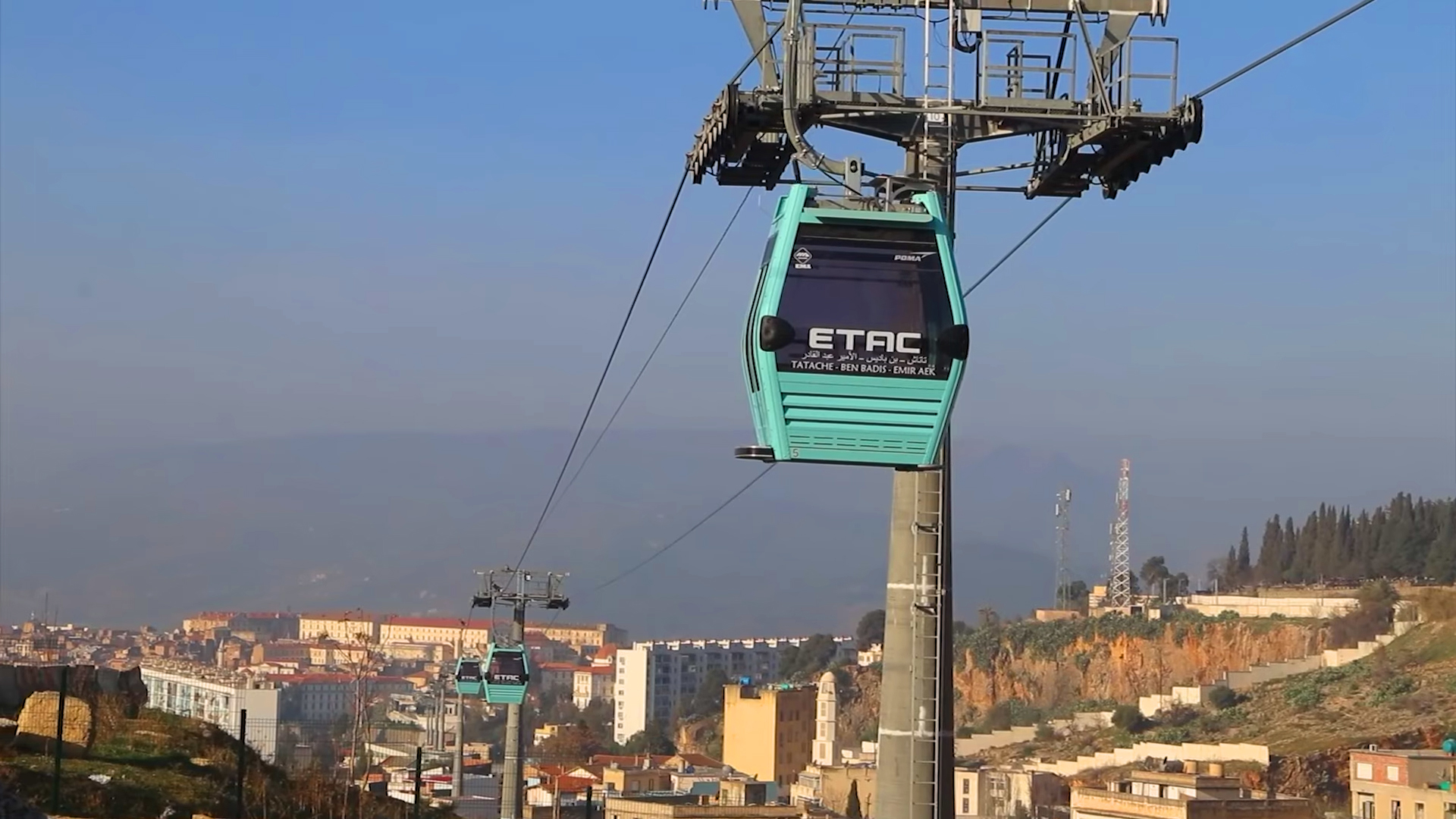
Constantine Cable Car
In a city that has spent two millennia building bridges across its gorge, someone finally decided to go over it instead. The Constantine Gondola Lift, opened in June 2008, carries passengers in 33 detachable cabins above the Rhumel River gorge, connecting the eastern and western halves of a city that geography has always tried to keep apart. The ride takes eight minutes. The view takes considerably longer to forget.
Crossing the Gorge by Air
Constantine's problem has always been topography. The city sits atop a rocky plateau split by the deep Rhumel gorge, and every connection between its districts requires some feat of engineering. Eight bridges already span the chasm at various heights, but traffic congestion and the limitations of surface routes led city planners to look upward. The gondola lift links the eastern city at Tatache Belkacem square, formerly rue Thiers, with the western districts around Emir Abdelkader and the University Hospital Ben Badis. Built by Doppelmayr, the Austrian firm that constructs gondola systems worldwide, the line was designed as a genuine mass transit solution, not a tourist attraction. With 15 seats per cabin and a capacity of 2,000 passengers per hour, it moves commuters at a pace that Constantine's congested streets cannot match.
Three Stations, Two Lines
The system operates as two connected segments. The lower segment runs 425 meters from Tatache Station, at an altitude of 619 meters, to the CHU middle station at 675 meters. The upper segment stretches 1,092 meters from CHU to Station Tannoudji in the AEK City district, the driving station, which sits at 707 meters. Together, the two lines carry passengers across nearly 90 meters of altitude change and more than 1.5 kilometers of horizontal distance. Parking areas at the terminal stations accommodate drivers who use the gondola to avoid the winding roads through the gorge. For a city built on cliffs, the vertical commute makes a peculiar kind of sense.
A City of Vertical Solutions
The gondola lift fits into Constantine's long tradition of inventive responses to difficult terrain. Where the Romans built stone bridges and the French erected iron and suspension spans, the 21st century brought cables and cabins. Similar systems have since been installed in the Algerian cities of Tlemcen and Skikda, but Constantine's remains the most dramatic, threading above the same gorge that has challenged builders since antiquity. Below the cabins, the Rhumel River runs through ravines that plunge hundreds of meters. The bridges of Sidi M'Cid, Sidi Rached, and Bab El Kantra are visible from the gondola windows, each representing a different era's engineering ambition. Riding above them all, the cable car offers something none of the bridges can: a slow, unobstructed panorama of a city whose vertical geography has always been its most defining feature and its most persistent obstacle.
From the Air
Located at 36.37N, 6.61E in Constantine, Algeria. The gondola line is visible as a cable system crossing the Rhumel River gorge, with stations on both sides of the canyon. The cables and cabins may be visible at lower altitudes. Best viewed at 2,000-4,000 feet AGL alongside the city's famous bridges. Nearest airport: Mohamed Boudiaf International Airport (DABC) approximately 10 km south. City elevation approximately 640 meters.