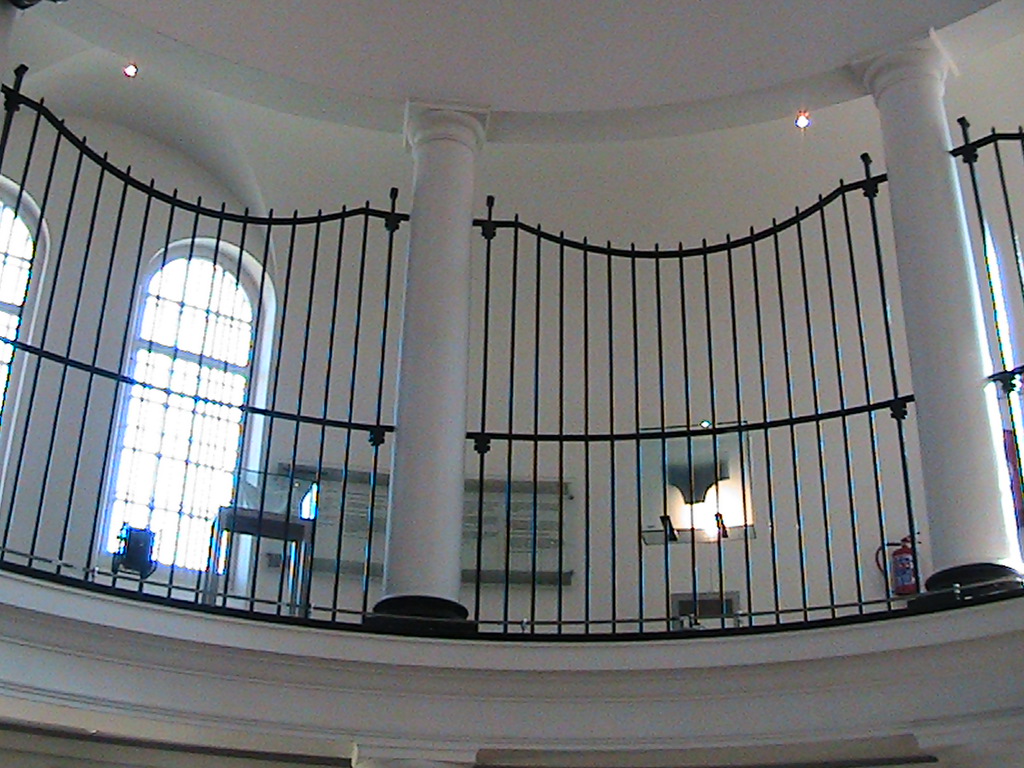
Constitution Hill, Johannesburg
The bricks are the same. When South Africa's Constitutional Court justices chose a permanent home for the new court in 1995, they selected the site of the Old Fort Prison on a hill overlooking Johannesburg -- and then they built the court using bricks salvaged from the demolished awaiting-trial wing. The stairwells of the old prison were kept and incorporated into the new building. It is architecture as argument: that a nation can dismantle its instruments of oppression and reassemble the pieces into something that serves justice instead. In 2024, Constitution Hill was inscribed as a UNESCO World Heritage Site under the name Nelson Mandela Legacy Sites.
A Fort That Became a Cage
The original prison on this hill was built in 1892 to house white male prisoners. Between 1896 and 1899, President Paul Kruger of the South African Republic built the Old Fort around it, intending to protect Johannesburg from British invasion. The irony arrived swiftly. During the Anglo-Boer War, the British seized the city and turned Kruger's fort into a prison for captured Boers -- some of whom were executed within its walls. Over the decades that followed, the complex expanded: Section 4 and Section 5 for Black men, a Women's Gaol added in 1907, an awaiting-trial block in the 1920s. By the apartheid era, the prison held political dissidents, pass law violators, striking mineworkers, people arrested for brewing beer while Black, and people jailed for having sexual relationships across the color bar.
The Weight of Famous Names
The prisoner roll call at Constitution Hill reads like a chronicle of South Africa's struggle for justice. Mahatma Gandhi was imprisoned here in 1906, decades before he led India's independence movement, jailed for his resistance to discriminatory laws against South Africa's Indian community. Nelson Mandela was held in the Old Fort's hospital section in 1962, an awaiting-trial prisoner before the Rivonia Trial that would send him to Robben Island for twenty-seven years. Joe Slovo, Bram Fischer, Albert Lutuli, Robert Sobukwe -- the roster of political prisoners earned the complex its grim nickname: "the Robben Island of Johannesburg." In the Women's Gaol, Winnie Mandela and Albertina Sisulu were detained for their activism with the African National Congress. The site housed prisoners until 1983, though the Old Fort continued functioning until 1987.
Number Four
The section reserved for Black men was called Number Four, a name that became synonymous with brutality. Detainees endured the humiliating "Tauza" dance -- a forced, degrading strip search performed upon entry. Beatings were routine. Overcrowding was deliberate. Men were held for months in filthy conditions in the Awaiting Trial Block, packed into cells designed for a fraction of their number. The students arrested during the 1976 Soweto Uprising passed through Number Four. So did countless ordinary people whose only crime was existing in the wrong place without the right papers. The prison was declared a National Monument in 1964, even as it continued to function as a site of systematic dehumanization for another two decades.
Justice Built from Rubble
Constitution Hill opened as a museum in 2004, with tours through three prison sections: Number Four, the Women's Gaol, and the Old Fort. The Constitutional Court held its first session in the new building that same February, establishing its home in the very place where the rights it now protects had been most systematically violated. The court houses a gallery of more than 200 contemporary South African artworks, curated by Justice Albie Sachs, with works by Gerard Sekoto, William Kentridge, and Cecil Skotnes. Outside the court's wooden doors, built into one of the preserved prison stairwells, burns the Flame of Democracy, lit on December 10, 2011, the fifteenth anniversary of the signing of South Africa's constitution.
The View from the Hill
Constitution Hill sits in Braamfontein, near the western edge of the suburb of Hillbrow, commanding views in two directions that tell the story of Johannesburg's divisions. To the south lies downtown Johannesburg, dense and vertical. To the north stretch the wealthy suburbs -- Houghton Estate, Parktown, Sandton -- where much of the country's economic power remains concentrated. The hill occupies the space between these worlds, as it always has. Today, visitors walk through the permanent exhibitions that include personal testimonies from former prisoners and warders, the physical evidence of what people endured here, and the architectural evidence of what the country chose to build in its place. The stairwells remain. The bricks remain. They simply serve a different purpose now.
From the Air
Constitution Hill is located at 26.189°S, 28.043°E in the Braamfontein area of Johannesburg, on a hill overlooking the CBD. From 3,000-5,000 feet AGL, the hilltop precinct is identifiable near the distinctive Hillbrow Tower to its east. O.R. Tambo International Airport (FAOR/JNB) is approximately 15 nm east-southeast. Lanseria International Airport (FALA) is about 22 nm northwest. Rand Airport (FAGM) lies to the south. The Johannesburg skyline and the distinctive Ponte City cylindrical tower in Hillbrow serve as prominent visual references. Highveld weather is typically clear mornings with afternoon convective buildup in summer.