Construction of Rockefeller Center
It started with an opera house that never got built. In the late 1920s, the Metropolitan Opera wanted a new home, and architect Benjamin Wistar Morris identified a prime site: a tract of land Columbia University owned in Midtown Manhattan, between 48th and 51st Streets from Fifth to Sixth Avenue. John D. Rockefeller Jr. signed an 87-year lease on the Columbia land in 1928 to anchor the project. Then the stock market crashed, the Met pulled out, and Rockefeller found himself holding a ruinously expensive lease on 22 acres of Manhattan with no plan. What he did next was build anyway -- and the result redefined what an American city could look like.
From Botanical Garden to Billion-Dollar Bet
The land had a pedigree. In 1801, physician David Hosack purchased the parcel for $5,000 and opened the Elgin Botanic Garden, the country's first public botanical garden. When Hosack could not find a buyer, the New York State Legislature acquired the land for $75,000 and unexpectedly gave it to Columbia College in 1814. For more than a century, Columbia leased the property to tenants operating brownstones, speakeasies, and small businesses -- a genteel decay that belied the location's potential. By the time Rockefeller arrived, the site housed 228 buildings and some 4,000 tenants, all of whom had to be relocated. The estimated aggregate worth of the cleared property would eventually exceed $7 billion. Acquiring the remaining parcels along Sixth Avenue required covert negotiations conducted by different brokers and law firms to conceal the Rockefeller family's involvement.
Building Through the Depression
Construction began in the depths of the Great Depression, a decision that seemed either visionary or reckless depending on whom you asked. Rockefeller hired Todd, Robertson, and Todd as managing agents and assembled an architectural team that included Raymond Hood, who shaped the complex's distinctive Art Deco aesthetic. The first building in the complex, the RKO Building, opened in September 1932. Work on the steel structure of the 66-story RCA Building -- the complex's centerpiece, later renamed 30 Rockefeller Plaza -- started in March 1932. The Music Hall opened on December 27, 1932, followed by the RKO Roxy Theatre two days later. The British and French governments signed on to occupy the first two internationally themed buildings, lending the project a cosmopolitan ambiance that would become its signature. At the peak of construction, the project employed roughly 75,000 workers -- an economic engine in a city devastated by unemployment.
The Underground City
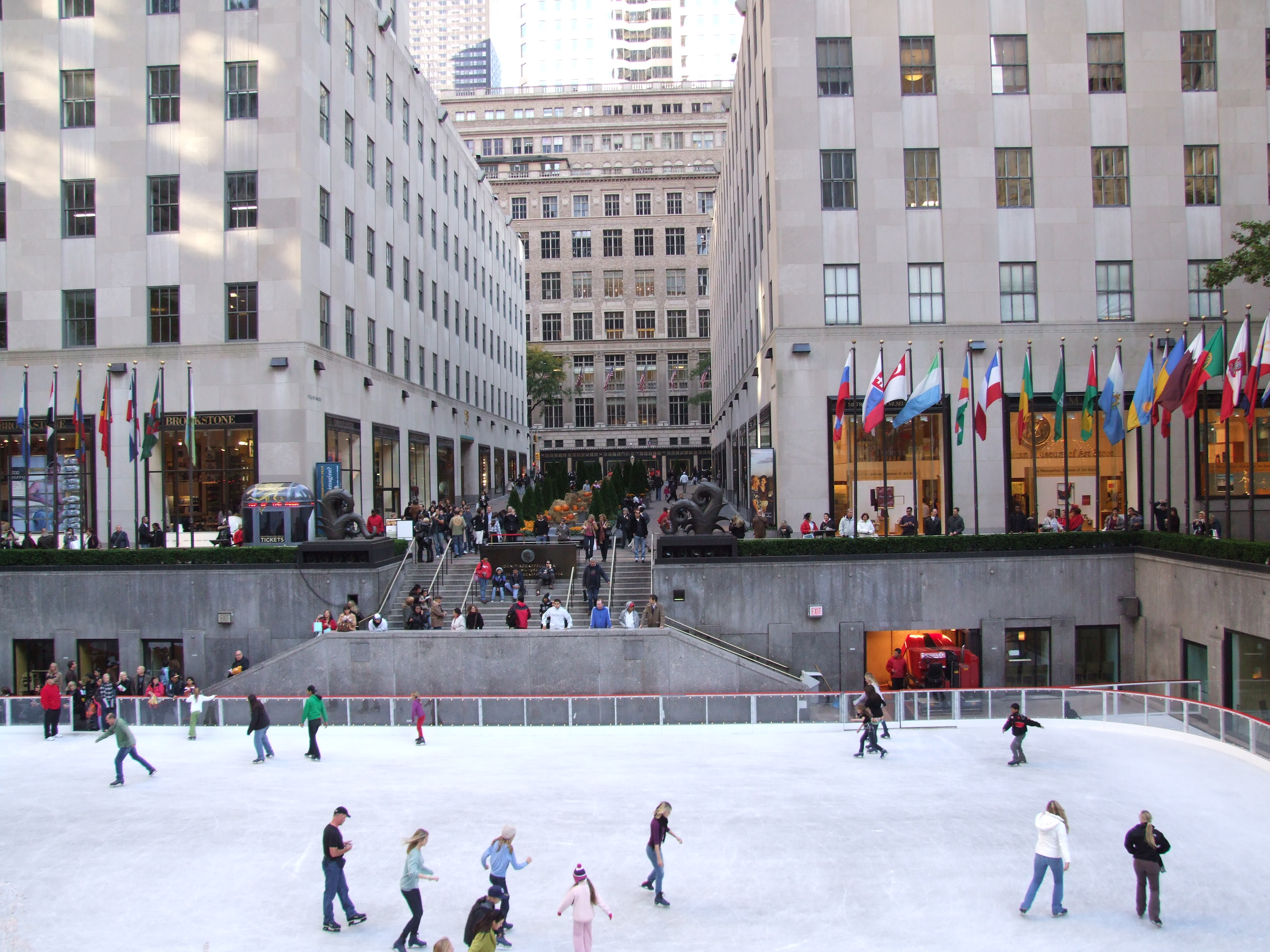
What made Rockefeller Center revolutionary was not just what rose above the street but what was engineered below it. The managers envisioned a complex connected by underground pedestrian concourses lined with shops and restaurants, linking the buildings to each other and to the subway system. They lobbied for new transit connections, proposing a subway shuttle under 50th Street and even a rail terminal for commuters from northern New Jersey. While the grandest transit plans fell through, the underground mall and concourse system that was built created a second city beneath the sidewalks -- a model that urban planners would study and replicate for decades. Above ground, the sunken central plaza between 49th and 50th Streets, originally designed around a large fountain, became the iconic skating rink that remains one of New York's most recognizable public spaces.
A City Within the City
The original complex comprised 14 Art Deco buildings across 22 acres, containing some 17 million square feet of office space. For the project, 228 buildings were razed, and the estimated cost ballooned well beyond initial projections. The oval-shaped retail building originally planned for Fifth Avenue was scrapped after Chase National Bank could not secure exclusive banking rights, leading to a redesign that produced the two smaller buildings flanking the famous Channel Gardens promenade. The complex wove together commercial office towers, theaters, retail spaces, rooftop gardens, and public plazas into a unified whole that had no real precedent in urban design. Rockefeller Center proved that a private development could function as genuine public infrastructure -- a place where people came not just to work but to gather, to skate, to watch a Christmas tree lighting, to feel the pulse of the city itself.
From the Air
Located at approximately 40.759N, 73.979W in Midtown Manhattan, bounded by Fifth Avenue (east), Sixth Avenue (west), 48th Street (south), and 51st Street (north). The complex is immediately recognizable from altitude by the cluster of Art Deco towers centered on the tall slab of 30 Rockefeller Plaza (originally the RCA Building). The sunken plaza and Channel Gardens are visible between 49th and 50th Streets. St. Patrick's Cathedral sits directly across Fifth Avenue to the east. Nearby airports: KJFK, KLGA, KEWR. Best viewed at 3,000-5,000 ft AGL.