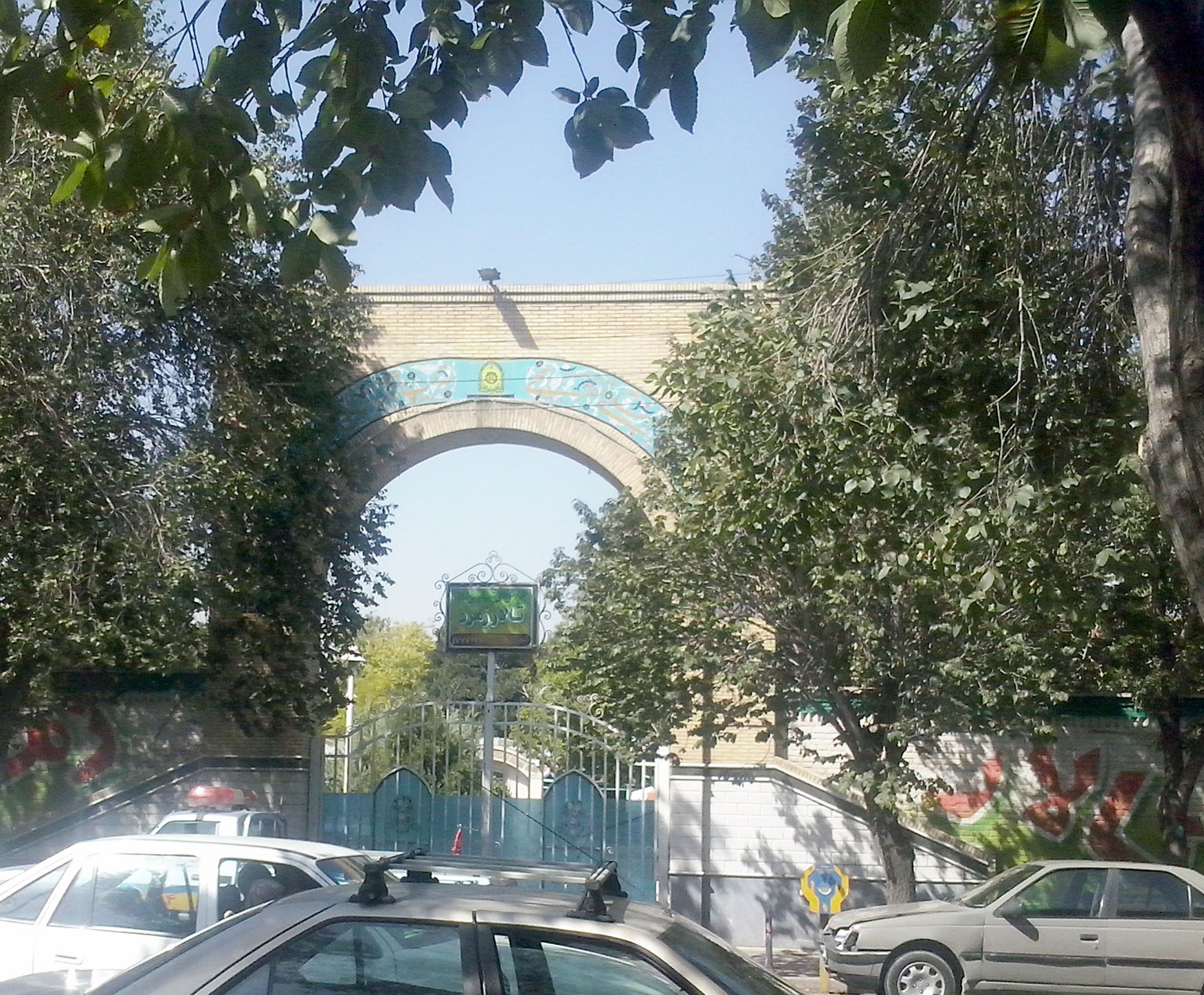
The Former US Consulate in Tabriz
The building on South Shariati Street in Tabriz is now a restaurant and reception hall owned by the Iranian police. Nothing about it announces what it once was: a diplomatic outpost where the United States watched the Soviet Union's every move in Iranian Azerbaijan, where coded cables carried intelligence to Washington, and where, for one brief period, a piece of the Moon sat on display in a hall and the people of Tabriz were invited to come see it. The consulate opened in 1906 and closed when revolutionaries pulled down the American flag in February 1979. Its seventy-three-year story mirrors the entire arc of US-Iran relations, from cautious engagement to Cold War alliance to irreparable rupture.
The Garden That Became a Consulate
The consulate's final location has a peculiar origin. The plot of land was once an abandoned garden called the Armenian Desert, owned by a man named Haj Ali Akbar Dabbagh. When the Red Army entered Tabriz on August 26, 1941, Soviet tanks parked on the barren ground. Three years later, an Austrian engineer named Sigmund, who worked at the Khosravi leather factory, bought the land for ten thousand tomans and transformed it into a garden. The US government then purchased the garden from the engineer and established its new consulate there in 1944, replacing an earlier facility in an unsuitable location.
Watching the Soviets
The consulate's most critical years came between 1945 and 1946. The Soviet Union had occupied Iranian Azerbaijan and backed the formation of the Azerbaijani Democratic Party, a separatist government in Tabriz. The US Deputy Consul, Robert Rossow Jr., stationed himself at the consulate and meticulously tracked every movement of the Red Army in the city. His dispatches to Washington provided real-time intelligence on Soviet operations -- troop positions, political maneuvers, the strength of the separatist movement. The crisis ended in June 1946 when Soviet forces withdrew, and by December the Azerbaijani Democratic Party collapsed before the advancing Iranian army. The consulate had served as America's eyes in a theater where the Cold War was taking shape.
A Moonstone in Tabriz
In one of the more unusual chapters of cultural diplomacy, the Americans displayed a piece of lunar rock in the consulate's main hall. The moonstone, brought back by American astronauts, was shown to the people of Tabriz as a gesture of openness, a way of sharing the achievement of the Apollo program with an allied nation. Residents were invited in to see the stone. The image is striking in hindsight -- Iranian citizens walking into an American consulate to gaze at a fragment of the Moon, in a building that had doubled as an intelligence station. The consulate continued its work through the decades, spreading American cultural influence and countering communist ideology in the region.
The Flag Comes Down
Michael Metrinko served as the US Consul in Tabriz from 1977 to 1979, witnessing the final chapter. As the Iranian Revolution gained momentum, revolutionaries attacked American institutions in the city -- the John F. Kennedy Library, the Iran-US Cultural Center, and the Point Four Program office were all destroyed. The consulate survived initially because of diplomatic immunity. But in February 1979, revolutionaries led by Mohammad Ali Qazi Tabatabaei marched to the building, pulled down the consulate sign and the American flag, and ended the American diplomatic presence in Tabriz. When the US Embassy in Tehran was seized later that year, the Tabriz consulate was occupied as well. After the revolution, the building passed to the Islamic Revolution Committees, then to the police criminal investigation department, and finally, in 1999, became the restaurant and reception hall it is today.
From the Air
Located at 38.06N, 46.28E on South Shariati Street in central Tabriz, East Azerbaijan Province, northwestern Iran. The former consulate site is in the urban core, not far from the Arg of Tabriz (the ancient citadel). Tabriz International Airport (OITT) lies roughly 15 km to the northwest. From altitude, Tabriz fills its mountain basin, the grid of streets and the historic bazaar visible in the city center.