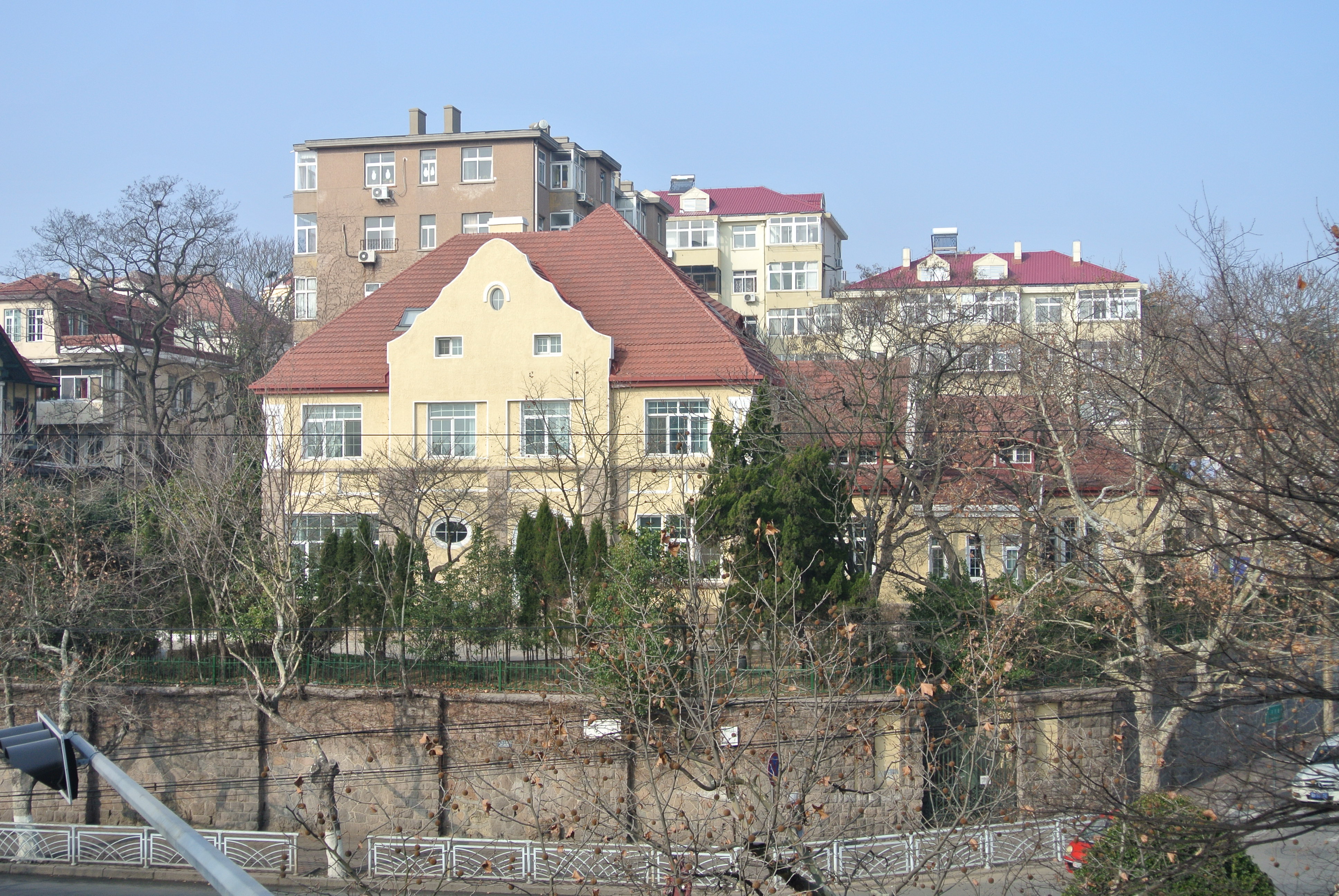
Consulate General of the United States, Tsingtao
The building at No. 1 Yishui Road sits nearly five meters above the street below, its granite retaining walls holding the hillside as firmly now as they did when a German architect first drew them in 1911. For more than four decades, this villa was America's window onto one of China's most contested cities. Consuls arrived to find a colonial port built by Germans, occupied by Japanese, reclaimed by Chinese nationalists, and finally absorbed into a new People's Republic. Through each transformation, the beige-walled building with its Mansard roof and bull's-eye windows kept its post, a quiet witness to the century's upheavals playing out in the streets of Qingdao.
Bismarck Street to Yishui Road
The United States established its consulate in Qingdao on September 16, 1906, nine years into the German lease of Jiaozhou Bay. The first office occupied a Presbyterian residence on Bismarck Street, now Jiangsu Road, an address that captures the colonial geography of the era. In 1912, the consulate moved to its permanent home, a building originally constructed as the private residence of German architect Paul Friedrich Richter. The villa's European pragmatism is written into every surface: brick and stone walls, herringbone wooden floors, carved wainscoting, and fireplaces that speak to Baltic winters rather than Shandong summers. Ceilings rise four meters high, and the central facade features a triangular gable crowned by a decorative ox-eye window. It was, in every respect, a piece of early twentieth-century Europe transplanted to the coast of China.
Wartime Closures and Cold War Endings
In 1919, Clarence E. Gauss, the U.S. Consul in Jinan, recommended merging the Qingdao and Jinan consulates. The consolidation was brief, quickly reversed when Qingdao's strategic importance reasserted itself. Then came the Pacific War. When Japan attacked in 1941, the consulate was shuttered and its interests handed to a Swiss representative named Eger. Four years of occupation followed before the doors reopened on December 1, 1945. The consulate was upgraded to a Consulate General on September 1, 1946, reflecting America's deepening engagement with postwar China. But the Chinese Civil War was already reshaping the map. In January 1949, the building was sold to the Bank of China, and the consulate relocated to a former U.S. Navy Seventh Fleet facility on Lan Shan Road. After the People's Republic was founded, the Chinese government closed the Consulate General on October 15, 1949. The last American staff departed Qingdao on January 23, 1950.
Missionaries, Bankers, and Kindergartners
The building's post-diplomatic life reveals the layered history of modern China. American Methodist missionaries Perry Oliver Hanson and his wife once lived within its walls. After 1949, the villa became a kindergarten for the People's Bank of China, its four-meter ceilings echoing with children's voices rather than diplomatic cables. Today it serves as a guesthouse for the Qingdao Central Branch of the People's Bank. In 2000, the building earned designation as one of the first Historically Significant Buildings of Qingdao, followed by renovations in 2004. The granite mushroom stones that decorate its corners, the red tongue tiles on its Mansard roof, and the simple facade that reflects early-1910s European pragmatism have all been carefully preserved, ensuring that this small piece of diplomatic history endures on its hillside perch above Yishui Road.
From the Air
Located at 36.065N, 120.322E in the Shinan District of Qingdao, on a hillside above Yishui Road. The building sits within the historic German-built district of the city's southern waterfront. Nearest airport is Qingdao Jiaodong International Airport (ZSQD). Best viewed at 2,000-4,000 feet altitude; the historic Shinan District's European architectural character is visible from the air along the southern coastline.