Contemporary Jewish Museum
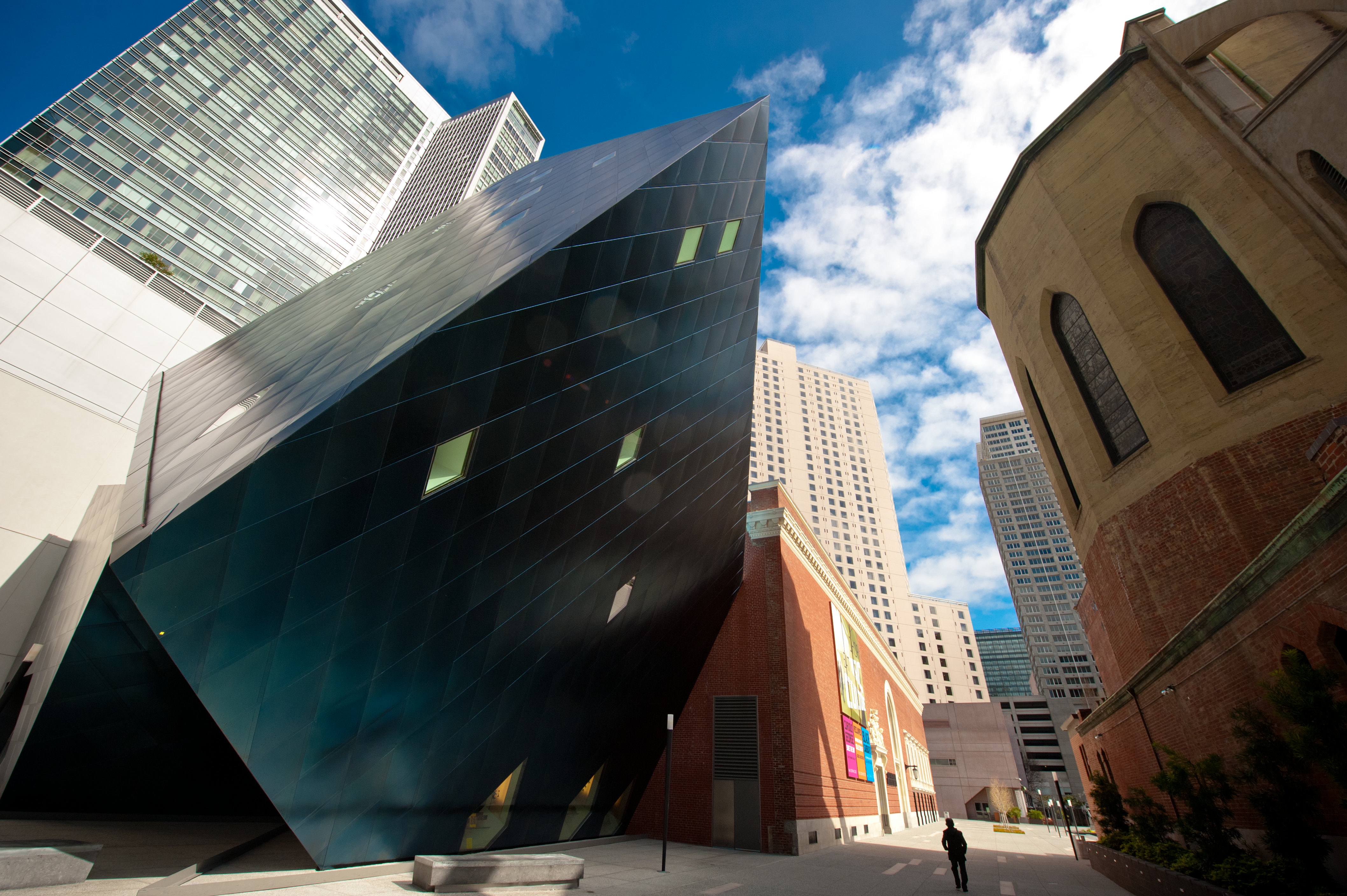
The Contemporary Jewish Museum announces itself from the street as a collision of centuries. Daniel Libeskind's angular blue steel addition erupts from the brick walls of the Jessie Street Substation, a 1907 power facility that once supplied electricity to the surrounding blocks. The architectural contrast is deliberate and theological: the Hebrew letters chet and yud, spelling chai -- life -- inspired the geometry of Libeskind's design, a declaration that Jewish culture is not a museum piece but a living, disruptive force. Founded in 1984 and reopened in this transformed space in 2008, the CJM has no permanent collection. Every exhibition is temporary, every encounter with the building an argument that relevance matters more than accumulation.
From Power Station to Cultural Station
The Jessie Street Substation, built by Pacific Gas and Electric in 1907, survived the great earthquake of that year and continued generating power for decades. When the CJM acquired the building, the interior was gutted, leaving only the handsome brick shell. Libeskind's design fills the emptied space with geometric steel volumes that push through and beyond the original walls, creating a visual tension between the utilitarian past and the expressive present. The substation's location on Mission Street at Yerba Buena Lane places the museum in the heart of SoMa's cultural corridor, surrounded by the San Francisco Museum of Modern Art, the Yerba Buena Center for the Arts, and the Cartoon Art Museum.
A Museum That Doesn't Collect
The CJM's decision not to maintain a permanent collection is its most radical curatorial choice. Every exhibition is conceived, installed, and eventually removed. This approach means the museum must constantly prove its relevance -- each show is a new argument for why visitors should walk through the door. The mission is to make the diversity of the Jewish experience relevant for a 21st-century audience, which in practice means exhibitions that range from contemporary art to design, photography, film, and music. Jewish identity is the lens, not the boundary: shows have explored topics from punk rock to immigrant foodways to the architecture of synagogues.
Life in Hebrew Letters
Libeskind's design translates a Hebrew concept into built form. The letters chet and yud -- which together form the word chai, meaning life -- generated the geometric volumes that define the museum's addition. The blue steel forms are not decorative but structural, creating the exhibition spaces that the museum inhabits. For Libeskind, whose portfolio includes the Jewish Museum Berlin and the master plan for the World Trade Center site, the CJM represented an opportunity to express Jewish resilience through architecture: a building that insists on life, on presence, on the refusal to be confined by the past. The result is a museum that looks nothing like any other building on its block -- and that is precisely the point.
From the Air
Located at 37.7858°N, 122.404°W at 736 Mission Street in San Francisco's SoMa (South of Market) district. The building's angular steel addition is visible among the larger structures of the Yerba Buena cultural district. Best viewed at 2,000-3,000 feet AGL. Nearest airports: KSFO (11 nm south), KOAK (10 nm east).