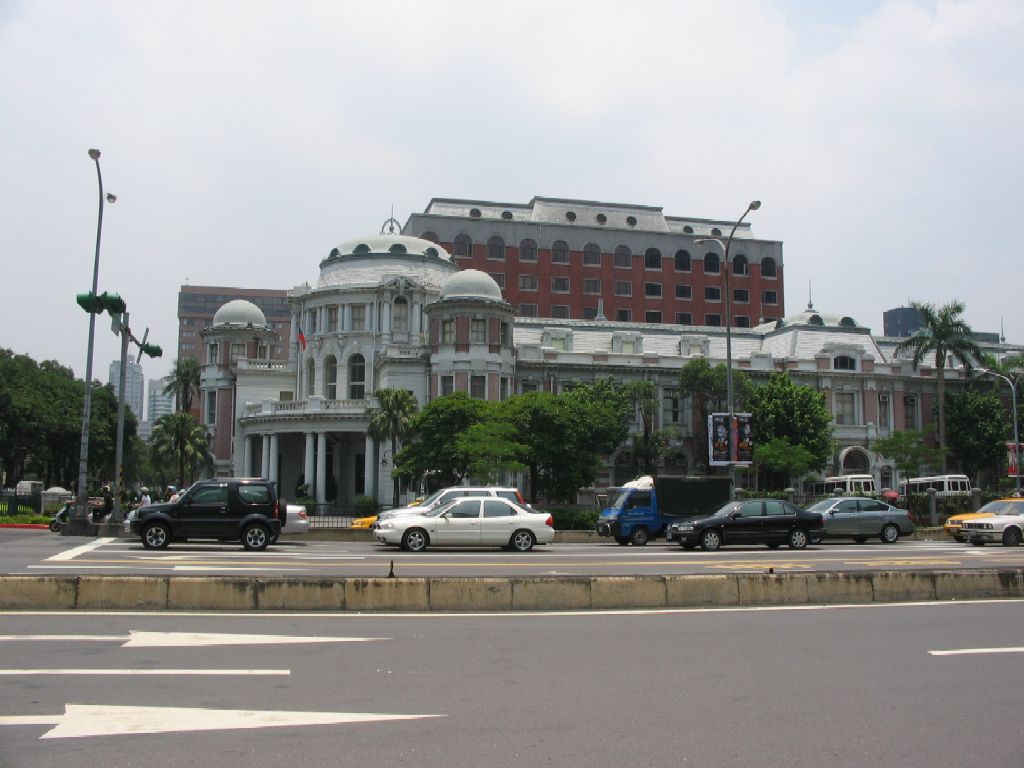
Control Yuan
Most democracies get by with three branches of government. Taiwan has five. The Control Yuan -- part auditor, part ombudsman, part constitutional oddity -- exists because Sun Yat-sen looked at Western separation of powers and decided it was missing something. He found that something in China's own imperial past, where censors had monitored government officials for over two thousand years. Whether the institution he designed still serves a purpose is a question Taiwan has been debating since the 1990s, and in June 2025, legislators formally proposed abolishing it entirely.
The Emperor's Watchmen, Reimagined
Sun Yat-sen's Three Principles of the People proposed dividing government into five branches rather than the Western three. Two of those branches -- the Examination Yuan and the Control Yuan -- drew directly from imperial Chinese tradition. The Control Yuan's lineage traces back to the censors established under the Qin and Han dynasties, officials whose job was to monitor the behavior of the bureaucracy. Successive dynasties refined the system: the Sui and Tang created separate offices for supervising civil servants and counseling the emperor, while the Ming and Qing maintained a Board of Public Censors with forty to fifty members and two presidents, one of Manchu ancestry and one Han Chinese. Sun argued that separating supervisory power from the legislature would prevent the conflicts of interest inherent in asking lawmakers to police themselves. It was an elegant theory. Implementing it proved considerably messier.
From Parliament Chamber to Constitutional Orphan
When the 1947 Constitution of the Republic of China was drafted, the Control Yuan became something Sun had not quite envisioned: a parliamentary chamber. Its 178 senators were indirectly elected by provincial and municipal legislatures, five from each province, functioning as a body comparable to the United States Senate. Together with the National Assembly and the Legislative Yuan, it formed a tricameral parliament. The first senators convened in Nanjing on June 4, 1948. A year later, the government fled to Taiwan. Because the Kuomintang continued claiming sovereignty over mainland China, the original members' terms were extended indefinitely, creating a gerontocratic body whose members held seats for over four decades based on elections held on the mainland. Constitutional reforms in the 1990s stripped the Control Yuan of its parliamentary status, transforming it into an appointed supervisory agency of 29 members nominated by the president and confirmed by the Legislative Yuan.
A Building That Predates Its Tenant
The Control Yuan's headquarters is itself a historical artifact. Built in 1915 during Japanese colonial rule as the governmental building of Taihoku Prefecture, the structure predates the institution it now houses by sixteen years. After the Kuomintang government relocated to Taiwan, the building was repurposed for the Control Yuan and has served that function since. Its classical colonial architecture -- a marked contrast to the modernist government buildings elsewhere in Taipei -- gives physical form to the institution's claim of continuity with older traditions of governance. The building witnessed the political deadlock of 2005 to 2008, when President Chen Shui-bian's nominees were blocked by a Kuomintang-controlled legislature, leaving the Control Yuan entirely non-functional for more than three years.
Watchdog or Relic?
The modern Control Yuan retains considerable formal power. It can impeach government officials, censure misconduct, audit the executive branch's annual budget, and propose corrective measures to government agencies. In 2019, it established a National Human Rights Commission, expanding its mandate to investigate human rights abuses and promote human rights education. Former democracy activist Chen Chu was appointed president in 2020. Yet the institution's legitimacy remains contested. Critics argue that its supervisory functions duplicate those of the legislature and the judiciary, while its appointed members lack the democratic mandate of elected officials. The question of whether Taiwan's five-branch government should slim down to something more conventional has moved from academic debate to legislative action. Whether the Control Yuan survives its next century may depend less on its constitutional design than on whether anyone still believes a government needs a dedicated branch whose sole purpose is watching the other branches.
From the Air
Coordinates: 25.045N, 121.520E. The Control Yuan building is located in central Taipei's Zhongzheng District, near the Presidential Office Building and other government complexes. The 1915 colonial-era building is distinctive for its classical architecture among the surrounding modern structures. Nearby airport: RCSS (Taipei Songshan Airport, ~4 km northeast). Best viewed at 2,000-4,000 feet. The government district cluster is visible as a zone of larger, spaced buildings amid dense urban fabric.