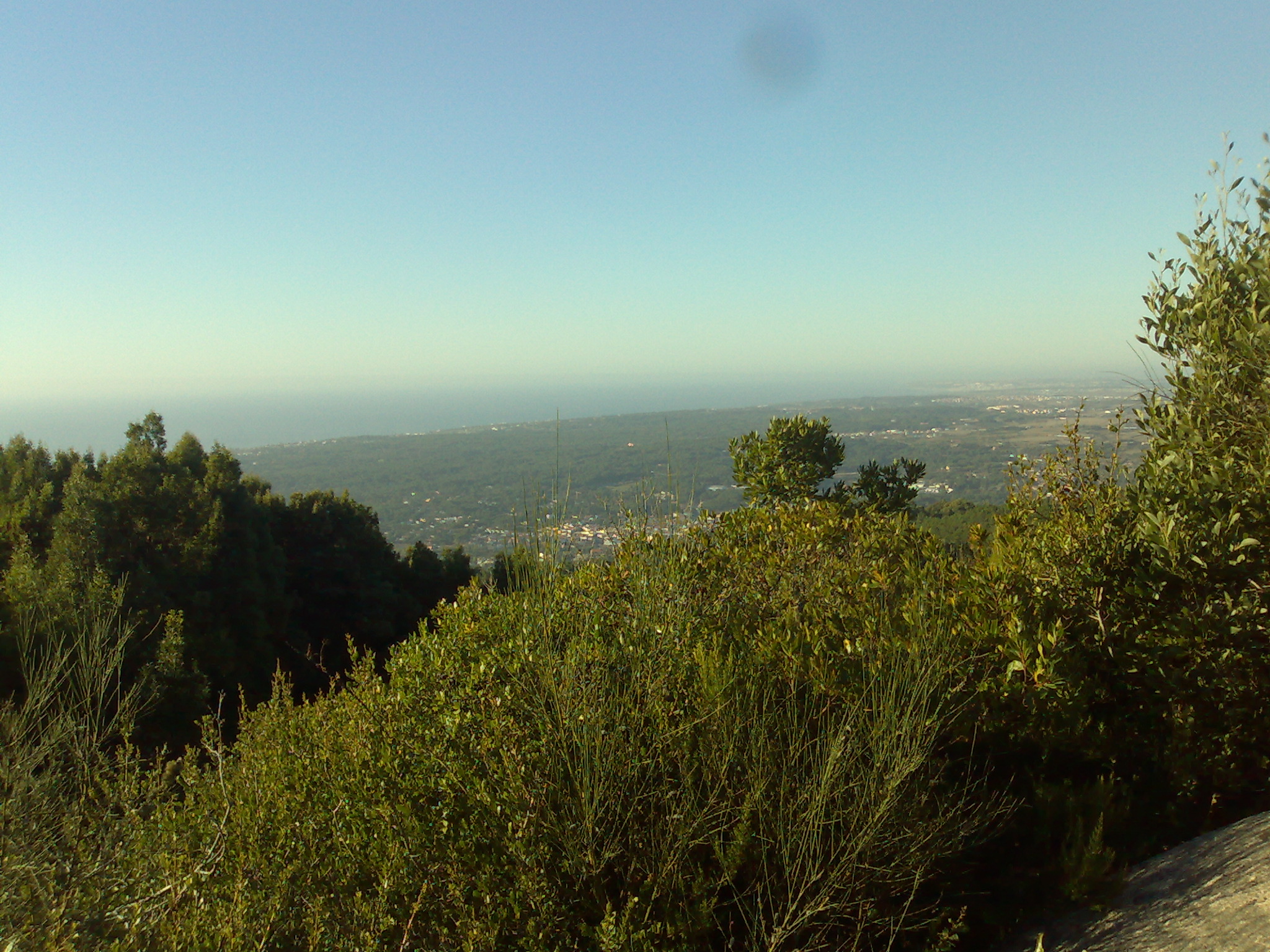
Convent of the Capuchos (Sintra)
Philip I of Portugal -- who was simultaneously Philip II of Spain, ruler of the most powerful empire on Earth -- visited the Convent of the Capuchos in 1581 and offered what may be the most perfectly balanced royal compliment in history: 'Of all my kingdoms, there are two places I estimate especially: El Escorial for being so rich, and the Convent of the Holy Cross for being so poor.' The king who commanded the wealth of the Americas and the palaces of Castile stood in a building whose doors were shorter than a man's height, whose windows were plugged with cork, and whose monks slept in cells so cramped that some had carved extensions into the stone walls to accommodate their feet.
A Dream Against a Rock
The convent's origin story belongs to the realm of legend, but it is a good one. Joao de Castro, the fourth Viceroy of Portuguese India, was hunting in the Sintra Mountains when he lost his way chasing a deer. Exhausted, he fell asleep against a rock and received a divine vision instructing him to build a Christian temple on the spot. Castro died in 1548 before he could fulfill the vision, but his son Alvaro de Castro -- counsellor of state to King Sebastian -- founded the convent in 1560, bringing eight Franciscan monks from the convent of Arrabida. The sanctuary was dedicated to Santa Cruz, the Holy Cross, and followed the Franciscan rule of radical poverty. Every aspect of the construction reflected that principle. The doors were made smaller than a man's height to enforce genuflection upon entry. Decoration was scarce. Cork -- Portugal's most abundant natural material -- served as insulation on walls, ceilings, doors, and windows throughout the complex.
The Architecture of Humility
The convent's plan is deliberately irregular, its various spaces built at different elevations and incorporated into the natural rock and cliffs of the mountainside at approximately 325 meters above sea level. The complex includes a church with its nave carved partly into the rock, eight individual cells for monks, a refectory, kitchen, library, infirmary, a hall of penitence, and a hall of retreat at the highest point. Researchers have noted that the number eight recurs throughout -- eight cells, eight stairs between rooms -- possibly symbolizing infinity. The paths connecting the convent's spaces were themselves symbolic, representing the dichotomy between good and bad roads in spiritual life. Friar Antonio da Piedade, writing in 1728, described the cells as so small that some monks had carved portions of the walls away to make room for their feet when sleeping. The refectory contained a single large stone slab, ordered extracted from the mountains by King Henry of Portugal, that served as the communal table.
Cork, Shells, and Azulejos
Inside the Chapel of Senhor dos Passos, monochromatic blue-on-white azulejo tiles cover the walls, with panels depicting the Flagellation of Christ and the Crowning with Thorns. The vaulted ceiling carries symbols of the Passion alongside painted stars. Throughout the complex, surfaces are decorated with pebbles, ceramic fragments, shells, and cork in combinations that feel less like ornamentation than like the mountain itself asserting its presence through the walls. The church interior preserves the coat of arms of the Castro family carved in stone, along with a Latin inscription dating from 1564 recording the indulgences granted by Pope Pius IV -- prayers to be said for peace between Christian princes, the extirpation of heresies, and the soul of Joao de Castro. Lord Byron visited and was moved to verse: 'Deep in yon cave Honorius long did dwell / In hope to merit heaven, by making earth a hell.' He was referring to the grotto of Honorio de Santa Maria, at the convent's highest point, where a hermit monk lived and died in 1596.
The Road Marker Still Stands
A 17th-century stone marker erected in 1650 still identifies the road to the convent from Sintra's old route connecting the village to Colares, near the Palace of Monserrate. Its inscription reads: 'CAMINHO PARA O CONVENTO DE SANTA CRUZ DA SERRA, VULGO CAPUCHOS' -- the road to the Convent of the Holy Cross of the Mountain, popularly known as the Capuchos. Access leads through the Terreiro das Cruzes, a walled enclosure with a calvary cross, then through the Portico das Fragas -- the Portico of the Rocks -- where two massive boulders form a natural gateway, one topped with a bell-gable. Beyond lies the Terreiro do Fonte, the Terrace of the Fountain, with its octagonal basin where legend says King Sebastian ate his meals during visits. The fountain retains vestiges of 17th-century azulejo tile. The monks lived here until the dissolution of Portugal's religious orders in the 19th century, when the convent fell silent. Conservation efforts beginning in the 1950s have preserved the buildings, and the site now operates as part of the Parques de Sintra heritage network -- a place where the austerity that the Franciscans chose still speaks through every cork-lined doorway and stone-carved cell.
From the Air
Located at 38.78N, 9.44W in the Sintra Mountains, approximately 25 km northwest of Lisbon. The convent is small and nestled in dense forest on the mountain's northeastern flank at about 325 meters elevation, making it difficult to spot from the air. Look for the surrounding cleared areas and paths within the forested mountainside. The nearby Pena Palace and Castle of the Moors on the same mountain range are much more visible landmarks. Recommended viewing altitude: 2,000-3,000 feet. Nearest airports: Lisbon Humberto Delgado (LPPT), about 15 nm southeast; Cascais aerodrome (LPCS) about 8 nm south. Fog is common in the Sintra Mountains.