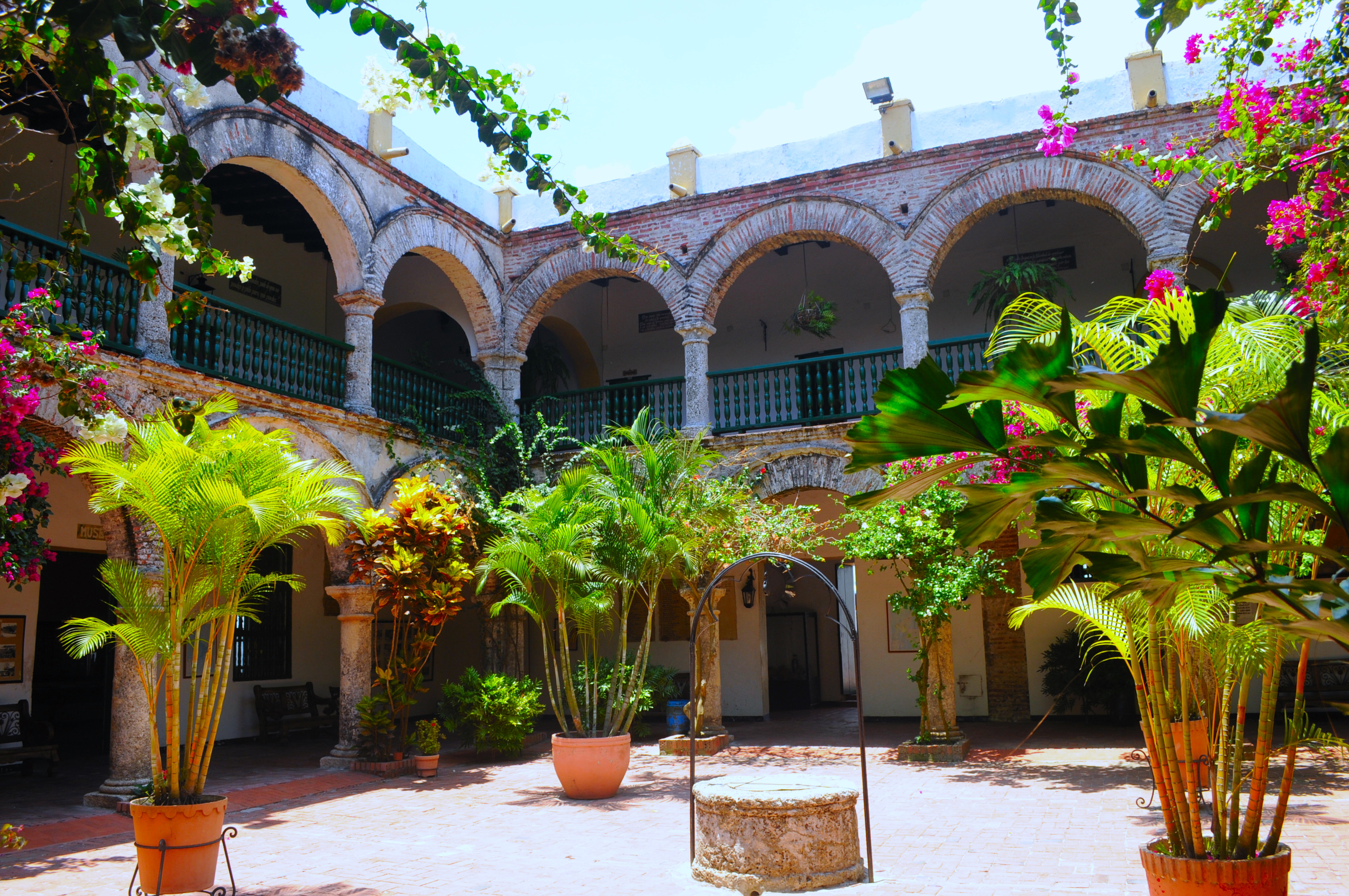
Convento de la Popa
The legend goes like this: Friar Alonso de la Cruz Paredes, an Augustinian monk in the Colombian Andes, received a vision of the Blessed Virgin ordering him to build a church on the highest hill overlooking Cartagena. When he climbed to the summit, he found a cult worshipping a goat -- an evil spirit, according to the chronicles, venerated under the direction of a man named Luis Andrea. The friar did what friars in colonial chronicles tend to do. He threw the goat off the cliff. The Cartagenians still call the precipice the Salto del Cabron -- the Goat's Leap -- and the convent that replaced the pagan shrine has watched over the city for more than four centuries.
A Ship on a Hilltop
The convent takes its name from its shape. La Popa means "the stern" in Spanish, because the hilltop resembles the back end of a galley, with the church occupying the highest point where the stern would rise. Founded in 1607 when the Discalced Augustinian friar Vicente Mallol erected a wooden chapel, the complex was financed by a wealthy Neapolitan named Don Fabricio Sanchez. By 1612, some 15,000 ducats had been invested -- a substantial sum for a colonial outpost constantly under threat. The construction took six or seven years, and Fray Alonso de la Cruz Paredes, of the Augustinian Recollects, was named as the convent's first superior.
The Price of Being Visible
What makes La Popa a superb vantage point also makes it a target. Pirates recognized the hilltop convent as a fortified position worth capturing, and it suffered repeatedly during the raids that plagued Cartagena over the centuries after its founding in 1607. Unlike the walled city below, La Popa had no fortifications beyond its elevation -- its only defense was being difficult to reach. After each assault, the Augustinians invested large sums in repairs, rebuilding what foreign navies destroyed. The convent's historical archives were entirely lost to these invasions, leaving gaps in the record that four centuries have not filled.
Cannonballs and a Liberator
During the wars of independence, La Popa became a battleground. On the night of November 11, 1815, the convent's defenders repelled a surprise assault by Spanish troops under Pablo Morillo, who was besieging Cartagena in a campaign to reclaim New Granada for the crown. After independence, the Augustinians were expelled and the convent served as military barracks. When Simon Bolivar's liberating army entered Cartagena, the Liberator himself took up residence in the convent, establishing his regiment in its rooms. Tradition holds that a cannonball fired from the Castillo San Felipe de Barajas passed within centimeters of Bolivar's head as he leaned from a window on the upper floor -- a near miss that would have changed the history of South America.
Abandonment and Return
For over a century, the convent sat empty or repurposed. The Augustinians did not return until 1961, when the Colombian government restored the complex and its hermitage to the order. Today the convent houses the Religious Museum, and visitors can walk through the formidable cloister that once served as a barracks, a fortress, and a place of prayer. Every February 2, crowds of devotees make a pilgrimage on foot to the summit for the feast of the Virgen de la Candelaria de La Popa, patron saint of Cartagena. The procession begins before dawn, winding up the steep hillside in the dark, and the faithful arrive to find the altarpiece illuminated and the image of the Virgin waiting as she has since the friar threw the goat from the cliff.
From the Air
Located at 10.4192N, 75.5255W atop the highest hill in Cartagena, approximately 150 meters above sea level. The convent is unmistakable from the air -- a white colonial complex crowning a prominent green hill east-southeast of the walled city. Rafael Nunez International Airport (SKCG) is roughly 3 nautical miles to the north. Best viewed at 2,000-3,000 feet AGL. The hill's isolation from the surrounding terrain makes it one of the most recognizable visual landmarks when approaching Cartagena from any direction.