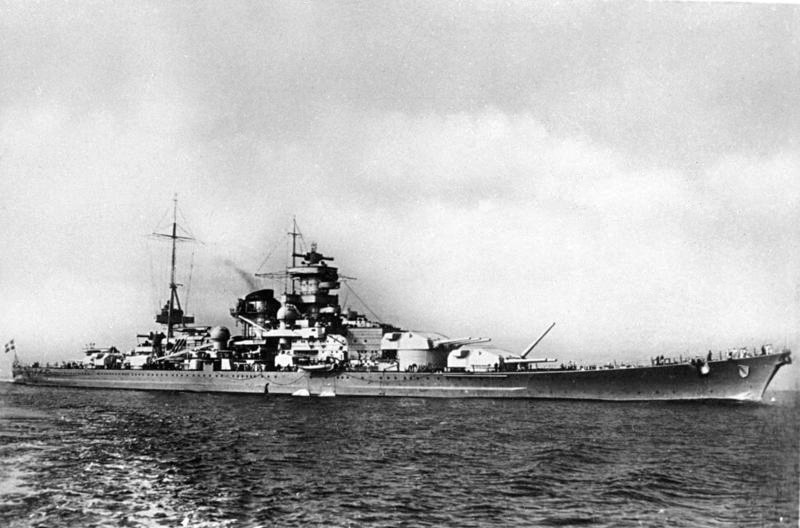
Convoy JW 55B
All nineteen ships made it. That simple fact -- unremarkable for peacetime shipping, extraordinary for an Arctic convoy in 1943 -- is the headline of Convoy JW 55B's story. But the convoy's safe arrival at Murmansk on December 30 was almost incidental to what happened along the way. Its passage through the Norwegian Sea drew out the German battleship Scharnhorst, sprung a trap laid by the Royal Navy, and resulted in the Battle of the North Cape: the last engagement between British and German capital ships, and the end of the Kriegsmarine's surface threat in Arctic waters.
Into the Darkness
Convoy JW 55B departed Loch Ewe, Scotland, on December 20, 1943 -- nineteen merchant ships carrying war supplies bound for the Soviet Union's northern ports. Close escort consisted of two destroyers and three smaller vessels. The ocean escort, led by Captain J. A. McCoy, added another eight Home Fleet destroyers. Beyond these, a cruiser cover force under Vice Admiral Robert Burnett shadowed the convoy, while distant cover came from a Heavy Cover Force built around the battleship Duke of York, commanded by Vice Admiral Bruce Fraser. This layered protection was no accident. Fraser wanted Scharnhorst to come out. The convoy was bait as much as cargo -- a calculated gamble that the German battleship, lurking at Altenfjord with five destroyers, would take the opportunity and sail into a fight on British terms.
The Wolf Pack and the Shadow
The Germans were watching. On December 22, a Luftwaffe patrol aircraft spotted the convoy and began shadowing, reporting course and speed to the surface force at Altenfjord. Thirteen U-boats of the Eisenbart wolfpack formed a patrol line in the Norwegian Sea. The convoy pushed east through winter seas and near-total Arctic darkness, the merchant ships holding formation while their escorts scanned for threats on every bearing. On Christmas Day, an Eisenbart boat made contact with JW 55B. That same day, Admiral Erich Bey aboard Scharnhorst received permission to sortie. The battleship and her five destroyers left Altenfjord and set course for the convoy's reported position, driving into a rising south-westerly gale. A U-boat came close enough to fire on one of the escorts. Meanwhile, Fraser, sensing the moment was near, ordered JW 55B to reverse course and slow to 8 knots -- buying time for his own heavy units to close the distance.
The Trap Springs
Scharnhorst never reached the convoy. On December 26, Burnett's cruisers intercepted the German battleship in what would become the Battle of the North Cape. The details of that engagement belong to another story, but the outcome shaped the rest of the war in the Arctic: Scharnhorst was sunk with the loss of all but 36 of her 1,968 crew. Bey's destroyers, sent separately to search for the convoy, attacked at a position reported hours earlier by a U-boat -- but the information was stale, and they found nothing. The Eisenbart wolfpack lost contact entirely. JW 55B sailed on unmolested. On December 28, three Soviet destroyers and two minesweepers met the convoy as an eastern local escort, and on December 30, all nineteen ships arrived at Kola Inlet without a single loss.
The Last Capital Ship
The significance of JW 55B extends beyond its safe arrival. The convoy's passage triggered the destruction of Germany's last operational capital ship in Norway. With Scharnhorst gone and the battleship Tirpitz already crippled by Operation Source's midget submarine attack months earlier, the Kriegsmarine had no surface force capable of threatening the Arctic convoys. For the first time since 1941, the Royal Navy could plan convoy routes without accounting for the possibility of a battleship sortie. The supplies kept moving -- food, fuel, ammunition, vehicles -- sustaining the Soviet war effort through the final year and a half of the European war. JW 55B carried no famous cargo, bore no celebrated name. It was one convoy among dozens. But its safe passage came at a cost that reshaped the naval balance of the entire Arctic theater.
From the Air
Convoy JW 55B's route ran from Loch Ewe, Scotland, northeast through the Norwegian Sea to Kola Inlet near Murmansk. The nominal position (72.26N, 28.68E) marks the general area in the Norwegian Sea where the convoy operated. The Battle of the North Cape occurred nearby. No land-based landmarks at this ocean location. Nearest airports: Banak (ENNA) to the south in Norway, Murmansk (ULMM) to the east. Open ocean -- expect rough seas and limited visibility, especially in winter.