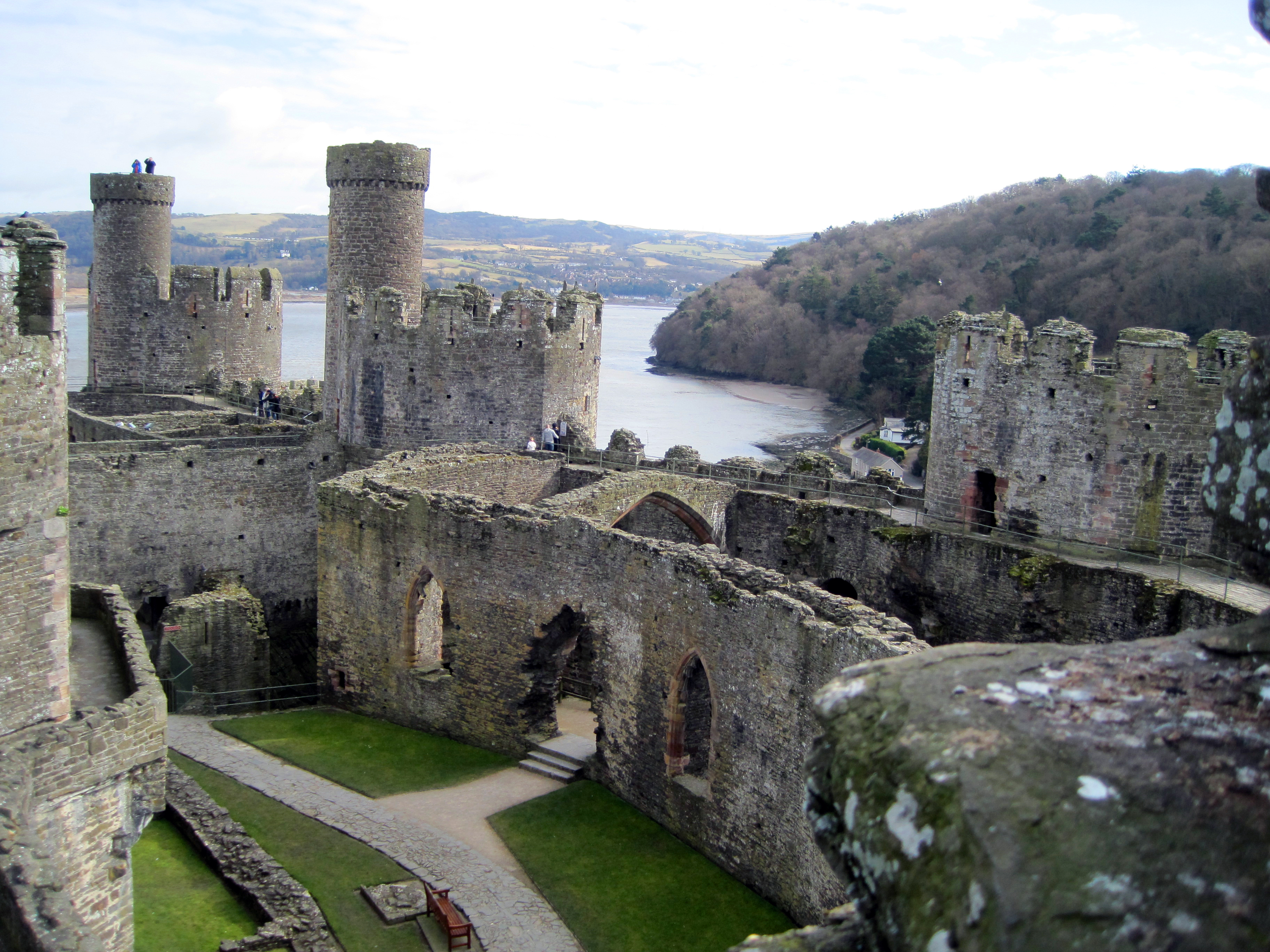
Conwy Castle
The castle well in Conwy's Inner Ward is ninety-one feet deep, cut straight down through solid rock. It was spring-fed, ensuring the garrison could withstand a siege, and it survives today, still plunging into darkness beneath the feet of visitors who lean over its rim. That well is a useful metaphor for Conwy Castle itself: beneath the tourist-friendly surface lies a depth of medieval engineering, political calculation, and raw military power that rewards every level of attention you give it.
Stone from Three Countries
Conwy Castle hugs a rocky coastal ridge of grey sandstone and limestone, and much of its stone was quarried from the ridge itself when the site was first cleared. But local stone was too coarse for detailed carving, so better sandstone was brought from the Creuddyn peninsula, Chester, and the Wirral. This imported stone was more colorful than the local grey, and it was probably chosen deliberately for its appearance -- Edward I's castles were not merely functional; they were designed to impress and intimidate. The outside of the towers still bear putlog holes from the original construction, where timbers were inserted to create spiralling ramps for the builders. The battlements once featured triple finial designs, a decorative touch with Savoyard origins, linking Conwy to the architectural traditions of the County of Savoy, which Edward had encountered on his return from crusade in 1273.
Two Wards, Two Worlds
The castle is divided into an Outer Ward and an Inner Ward, originally separated by an internal wall, a drawbridge, and a ditch cut into the rock. The Outer Ward held the administrative and service buildings: kitchen, brewhouse, bakehouse, great hall, a prison tower with an underground dungeon, and the constable's quarters. The Inner Ward was the royal precinct. Here the king's apartments occupied the first floor of a range of buildings facing an internal courtyard, with the Chapel Tower containing the private royal chapel. The arrangement echoed the thirteenth-century Gloriette at Corfe Castle, balancing privacy with security. Four massive towers guarded the Inner Ward, their rooms connected by passages that allowed movement between towers without exposure to the outside.
The Castle Garden
On the east side of the Inner Ward lies what was once the castle garden, enclosed by a barbican and overlooked by the royal apartments. The garden's character changed with the centuries: a lawn in the early fourteenth century, grapevines in the late fourteenth, crab-apple trees and a lawn in the sixteenth, and formal ornamental flowers in the seventeenth. A postern gate once led down to the River Conwy where a small dock allowed important visitors to arrive by boat and the fortress to be resupplied by water. That dock is now concealed by the bridges built across the river in later centuries, but the gate itself still exists in the stonework.
Siege, Ruin, and the Painters
Conwy saw action during the English Civil War. The town fell to Parliament in August 1646, and in November General Thomas Mytton took the castle after a substantial siege. In the aftermath, the castle was deliberately reduced to ruin. By the end of the eighteenth century, those ruins had become objects of aesthetic admiration. Thomas Girtin, Paul Sandby, and J. M. W. Turner all painted Conwy, drawn by the Romantic fascination with decay and the sublime. In 1865, civic leadership took ownership, and restoration began, including reconstruction of the damaged Bakehouse Tower. A road bridge was added in 1958.
Twin Castles, Two Continents
In October 2019, Conwy Castle was formally twinned with Himeji Castle in Japan, a pairing that links two of the world's most celebrated medieval fortifications across cultures and continents. In December 2023, Conde Nast voted Conwy the most stunning castle in Europe, placing it ahead of Scotland's Eilean Donan and Ireland's Kylemore Abbey. Nearly 187,000 tourists visited in 2010, and a new visitor center opened in 2012. Managed by Cadw, the castle requires ongoing maintenance: repairs cost 30,000 pounds in the 2002-03 financial year alone. Eight towers still stand on the ridge above the river, their stonework layered in the greys and reds of three different quarries, the walls still pierced by arrow slits that have not needed to be used for centuries.
From the Air
Conwy Castle is located at 53.2801N, 3.8256W, on the west bank of the River Conwy where it meets the coast. From the air, the eight round towers on the rocky ridge are unmistakable, with the walled town stretching behind the castle. Three bridges cross the river at this point: Telford's 1826 suspension bridge, Robert Stephenson's 1848 tubular rail bridge, and the 1958 road bridge. Nearest airports: RAF Valley (EGOV), Caernarfon (EGCK), Hawarden (Chester, EGNR). Recommended altitude: 1,500-2,500 ft AGL for the best view of the castle, walled town, and river estuary together.