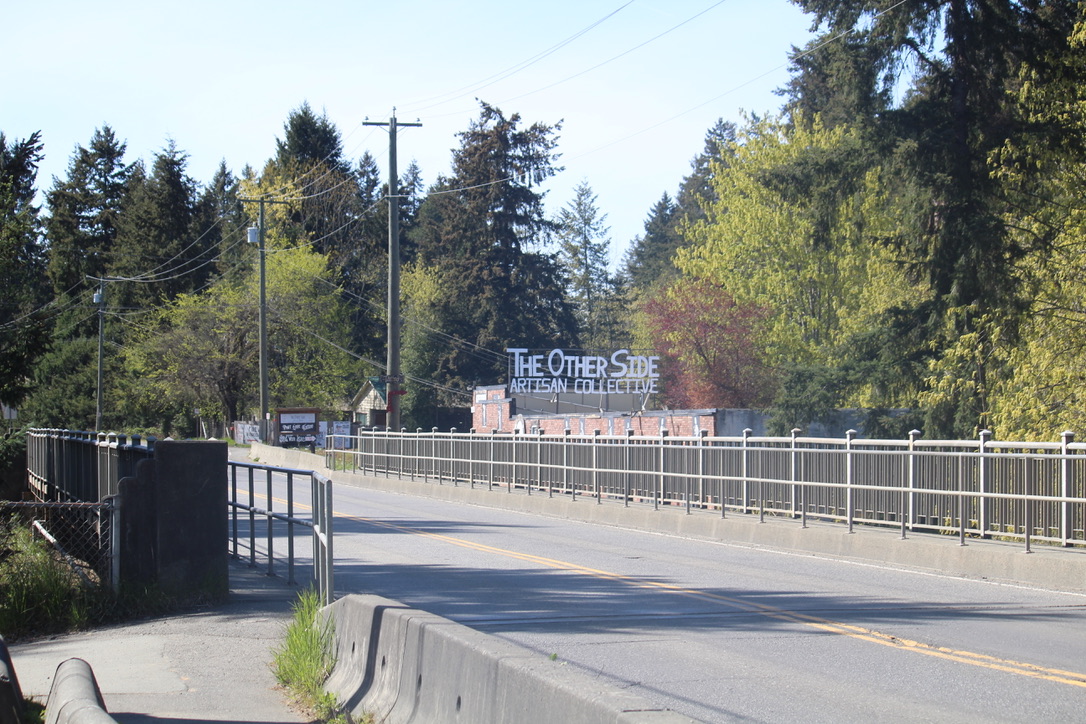
Coombs, British Columbia
There are goats on the roof. That is the first thing anyone tells you about Coombs, British Columbia, and it is usually enough to get you off Highway 4A. The Old Country Market, also known as Goats on the Roof, keeps a family of goats grazing on its sod-covered rooftop, a sight absurd enough to have turned a roadside stop into Vancouver Island's most photographed curiosity. But Coombs has a story that predates the goats by decades, one that involves the Salvation Army, a retired commissioner who never visited the place named for him, and a group of English families who crossed an ocean to start over in the forests of central Vancouver Island.
The Commissioner Who Never Came
Coombs takes its name from Commissioner Thomas Bales Coombs, who headed the Salvation Army movement in Canada in the early 1900s. When Coombs retired in 1911, the Army honored him by naming their newest colony after him. The commissioner never visited the community that bore his name. It was a common enough practice in the colonial era: places were named for administrators, benefactors, and officials whose connection to the landscape was entirely abstract. The people who actually lived in Coombs had a more immediate relationship with the land, namely the hard work of clearing it.
An Army of Settlers
The community was established in 1910 under a Salvation Army emigration plan that relocated families from overcrowded British cities to rural Canada. Walter Ford and his brother-in-law John West were sent ahead to prepare the land, and Ensign Crego, trained in farming, led the newcomers from England to their new home. What the settlers found was Vancouver Island forest: dense, damp, and nothing like the English countryside they had left behind. They cleared stumps, built a log schoolhouse in 1910, and raised a General Store in 1911 that also served as the post office. That building functioned as a general store for 110 years, finally closing in 2021 and reopening as a shop selling Dutch products.
Deeper Roots
The Salvation Army settlers were not the first people on this land. The area was historically inhabited by the Coast Salish peoples, including the Snuneymuxw First Nation, who have lived in the region for more than 5,000 years. European settlement, with its logging, road-building, and farming, overlaid itself on a landscape that already had a deep human history. The Snuneymuxw presence predates the English newcomers by millennia, a fact that the Coombs origin story sometimes eclipses but does not erase.
Goats, Bluegrass, and the Fall Fair
Modern Coombs, with its population of about 1,672, has leaned into its eccentricity. The Old Country Market draws tourists by the busload, and the goats have become unofficial ambassadors for the entire Parksville-Qualicum region. Butterfly World offers a small indoor tropical rainforest. Every B.C. Day weekend, the Coombs Rodeo Grounds host the Coombs Bluegrass Festival, filling the valley with banjos and mandolins. The Coombs Fall Fair, first held in neighboring Hilliers in 1913 and moved to Coombs in 1923, has been running for over a century. For a community that exists because the Salvation Army needed somewhere to send surplus Londoners, Coombs has done remarkably well at finding its own identity.
Mediterranean Climate, Rainforest Soul
Coombs sits at the northernmost edge of the cool-summer Mediterranean climate zone, which means warm, dry summers and mild, wet winters. The combination makes for lush vegetation and a long growing season unusual for this latitude. Surrounding forests of Douglas fir, cedar, and hemlock remind you that this is still the Pacific Northwest, even if the summer weather feels almost southern European. From the air, Coombs is a small clearing in the green canopy west of Parksville, Highway 4A cutting through as a thin line connecting the coast to the island's interior and the road to Tofino.
From the Air
Coombs is located at 49.30°N, 124.42°W on Vancouver Island, approximately 10 km west of Parksville along Highway 4A. The community appears from altitude as a small cluster of buildings in a clearing amid forested hills. Qualicum Beach Airport (CAT4) is the nearest airstrip, about 10 km to the northeast. Nanaimo Airport (CYCD) is approximately 30 km to the southeast. The junction of Highway 4A and the road to Port Alberni and Tofino is visible nearby.