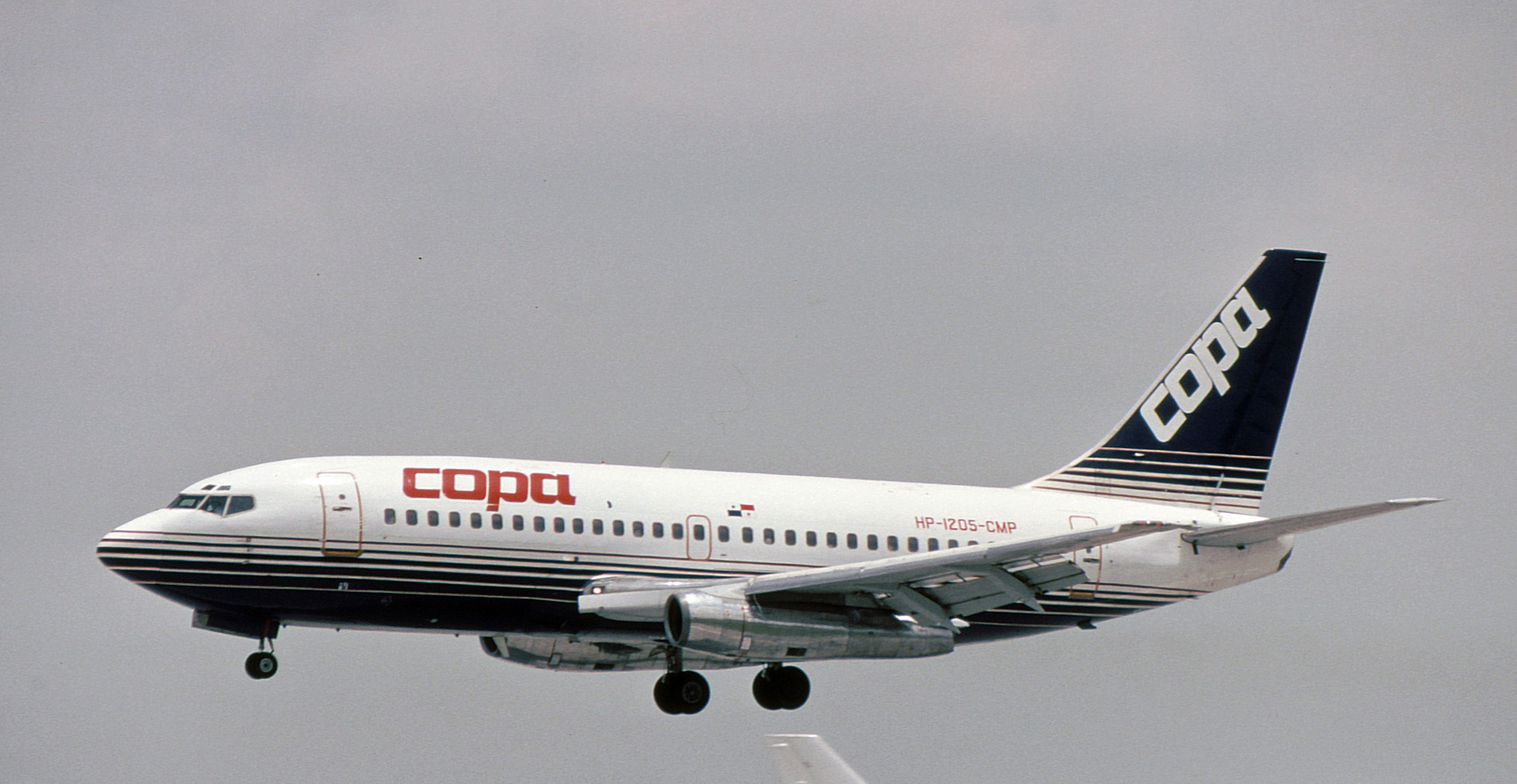
Copa Airlines Flight 201
Twenty minutes into Copa Airlines Flight 201, the instruments began to lie. The Attitude Director Indicator on the captain's panel -- the instrument that tells a pilot whether the wings are level -- suffered an intermittent short circuit in its roll synchronization coil, feeding false bank angle data to the crew. Captain Rafael Carlos Chial, 53, and First Officer Cesareo Tejada, 25, did not catch the discrepancy in time. On the morning of June 6, 1992, their Boeing 737-204 Advanced rolled, entered a steep dive, broke apart in midair, and scattered across the jungle canopy of the Darien Gap. All 47 people aboard -- 40 passengers and 7 crew -- died in what remains Panama's worst aviation disaster and the only fatal crash in Copa Airlines' history.
A Routine Morning
Flight 201 departed runway 21L at Tocumen International Airport in Panama City at 8:37 local time, bound for Alfonso Bonilla Aragon International Airport in Cali, Colombia. It was a short, routine hop -- the kind of flight that fills the schedules of Central and South American carriers every day. The passenger manifest reflected that ordinariness: 36 Colombians heading home, 8 Panamanians, 2 Americans, and 1 Italian. The crew of seven included five flight attendants. Nothing in the preflight preparation suggested what was coming. The weather was unremarkable. The aircraft, registered as HP-1205CMP, had been flying since the 1970s, first with Britannia Airways in the United Kingdom before joining the Copa fleet.
Twenty Minutes of Confusion
At 8:57, Tocumen Air Traffic Control attempted to contact Flight 201 and received no response. Minutes later, a KLM DC-10 approaching the airport relayed an alarming message: it had intercepted a distress signal from Flight 201's transponder, placing the aircraft somewhere between the Colombian border and Panama's Darien Province. Tocumen declared a full emergency and notified Colombian air traffic control in Bogota. What had happened in those twenty minutes was a cascade of failures. The captain's ADI, malfunctioning intermittently due to the short circuit, displayed bank angle information that only occasionally updated. A backup standby ADI was available, but investigators later concluded the crew did not cross-check it effectively. The pilots, disoriented by conflicting instrument readings, lost spatial awareness. The aircraft rolled, dove, and exceeded its structural limits. It broke apart before hitting the ground.
Lost in the Gap
The crash site could hardly have been more inaccessible. The Darien Gap -- the roadless, swamp-and-jungle barrier between Panama and Colombia -- swallowed the wreckage. Search aircraft spotted the first debris eight hours after contact was lost. Rescue personnel needed another twelve hours to reach the site on foot through some of the most impenetrable terrain in the Western Hemisphere. Bodies and aircraft fragments were scattered across a ten-kilometer radius, testimony to the violence of the midair breakup. Residents of the nearby village of Tucuti told radio stations they had heard a powerful explosion the previous night; others described a burning object falling from the sky. Panama's civil aviation chief, Zosimo Guardia, dismissed the explosion theory, but the eyewitness accounts painted a vivid picture of the aircraft's final moments.
The Verdict and Its Echoes
The cockpit voice recorder was recovered from the jungle and sent to the National Transportation Safety Board in the United States for analysis. Investigators determined the probable cause was the crew's loss of control due to reliance on erroneous ADI data, compounded by non-standard cockpit configurations across Copa's 737 fleet. Different aircraft had different switch layouts, and the simulators used for training did not match the planes being flown -- a dangerous inconsistency that left pilots unsure which instruments to trust in a crisis. The crash bore surface similarities to other Boeing 737 incidents of the 1990s, including United Airlines Flight 585, and was cataloged among accidents involving "suspicious rudder deflection," though rudder failure was ultimately ruled out. In 1993, PBS NOVA aired Mysterious Crash of Flight 201, and in 2015, the Mayday series revisited the disaster in an episode titled Sideswiped. For Copa Airlines, which has not suffered another fatal accident in the decades since, Flight 201 remains a defining tragedy -- a reminder that the gap between a correct instrument reading and a false one can be measured in seconds, but its consequences last forever.
From the Air
Crash site located at approximately 7.98N, 77.93W in the Darien Gap jungle, near the Colombia-Panama border. The terrain below is dense, roadless tropical rainforest with no visible infrastructure. Nearest major airport is Tocumen International (PTY/MPTO) in Panama City, approximately 200 km to the northwest. The area is remote and largely uninhabited; the village of Tucuti is the nearest settlement. Expect heavy vegetation canopy with no visible ground references. Cloud cover is common over the Darien region.