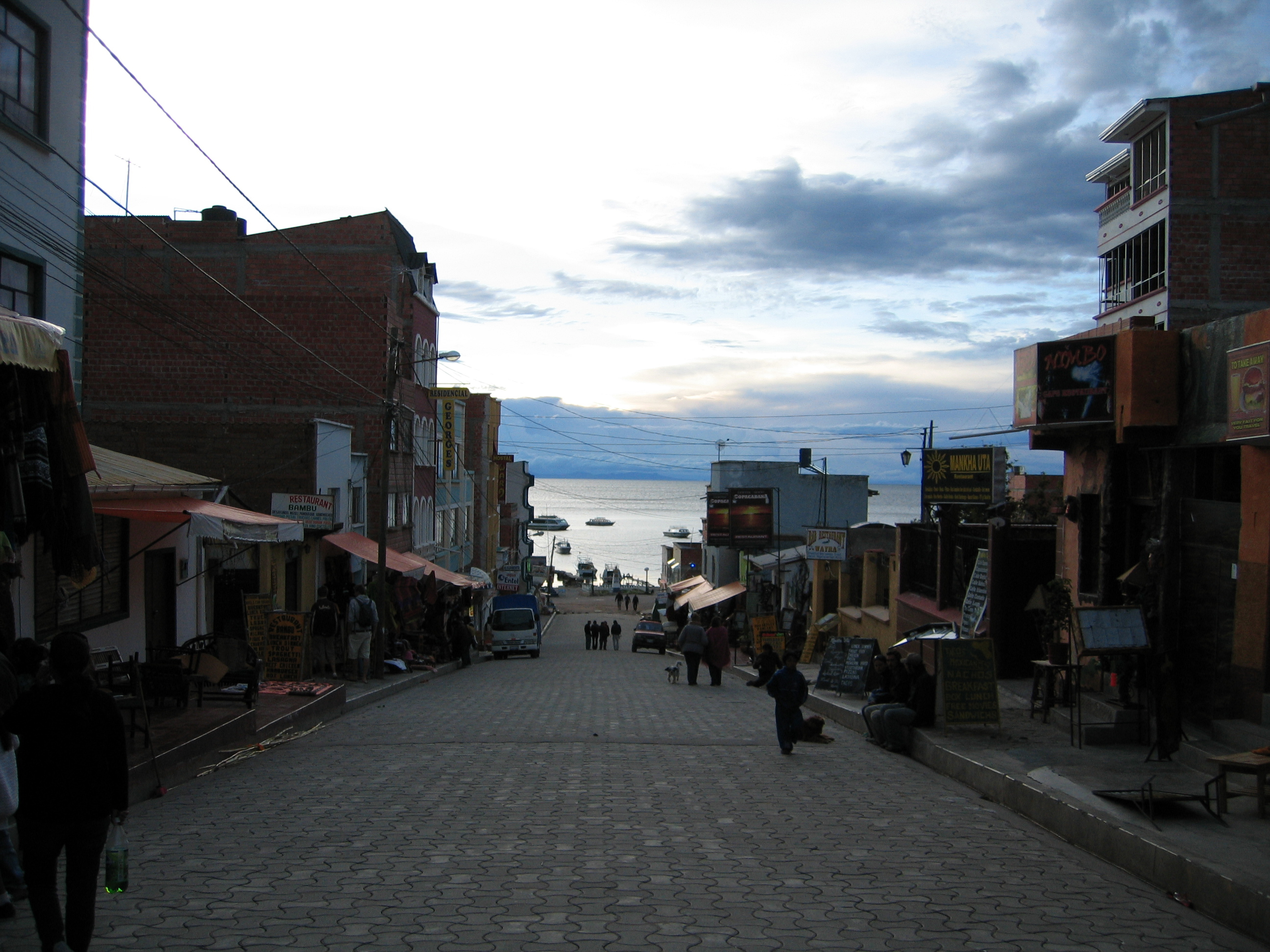
Copacabana
Before there was a beach in Rio de Janeiro, there was this place. Copacabana -- the original -- sits on the Bolivian shore of Lake Titicaca, a small town whose name comes from the Aymara words kota kawana, meaning "view of the lake." The Inca revered this stretch of shoreline long before the Spanish arrived and built a chapel to the Virgin Mary on ground already considered sacred. That layering of belief -- Andean reverence beneath Catholic devotion -- still defines the town, where pilgrims and backpackers share the same narrow streets sloping down to the water.
Sacred Ground, Twice Over
Copacabana's religious significance did not begin with Christianity. The Inca considered the Lake Titicaca region a place of origin and power, and the hills surrounding the town held ceremonial importance for centuries before Spanish missionaries arrived. When the colonial church was built, it was placed deliberately on ground the indigenous population already venerated -- a pattern repeated across the Andes, where Catholic sites were layered atop older sacred places. The result is a town where Andean and Catholic traditions coexist without much tension. The Basilica of Our Lady of Copacabana, housing a statue carved by indigenous sculptor Francisco Tito Yupanqui around 1576, draws Bolivian pilgrims from across the country. Our Lady of Copacabana is the patroness saint of Bolivia, and the shrine remains one of two principal sacred sites shared by indigenous and Catholic communities -- the other being the Virgin of Urkupina near Cochabamba.
Avenida 6 de Agosto
The town's geography is simple. Plaza 2 de Febrero serves as the central square, and from there Avenida 6 de Agosto slides downhill toward the lake, lined with souvenir shops, hostels, restaurants, and the particular kind of bustle that forms wherever backpacker trails converge. One block north, Avenida Jaregui has a more local character -- street markets, grocery stores, and the daily commerce of a town that exists for its residents as much as for its visitors. Copacabana is small enough that taxis are unnecessary. Pedicabs haul luggage from the plaza to the hostels. The culinary scene revolves almost entirely around trucha, salmon trout pulled from the lake, served at identical stalls along the waterfront and in every restaurant in town. Bargaining the price down from 25 to 20 bolivianos is practically a local tradition.
The Crossroads Effect
Copacabana sits at a junction of routes that keeps it perpetually in motion. Buses arrive from La Paz in about three and a half hours, crossing the Tiquina Strait by ferry along the way. Others come from Puno, Peru, crossing the border just 7.5 kilometers to the south. The town serves as the primary staging point for boats to Isla del Sol, the sacred island where Inca mythology places the birth of the sun. Most tourists rush through Copacabana on their way to or from the island, which means the town itself is paradoxically quiet during much of the day. Those who linger discover a place with an unhurried rhythm: sunset drinks along the waterfront, the walk to Cerro Calvario for panoramic views, and the particular pleasure of being somewhere that moves at its own pace while the rest of the traveler circuit rushes past.
Between Two Countries, Between Two Worlds
The border crossing south of Copacabana is casual and frequent -- shared cabs leave from Plaza Sucre as soon as they fill, reaching the Peruvian side in thirty minutes. This permeability gives the town a liminal quality, existing between Bolivia and Peru, between Andean spirituality and Catholic pilgrimage, between backpacker economy and local life. Alpaca wool garments hang in shops alongside jewelry made by traveling artisans. A bookstore called The Spitting Llama sells Lonely Planet guides and rents camping gear. On the hills at the edge of town, ancient Inca ruins look out over a lake that stretches 190 kilometers to the northwest. Copacabana gave its name to the most famous beach in the world, but the original remains what it has always been: a small town with a large view, holding its ground between the sacred and the ordinary.
From the Air
Located at 16.17S, 69.08W on the southeastern shore of Lake Titicaca in Bolivia, at approximately 3,841 meters elevation. The town is visible as a small settlement nestled in a bay along the lake's shoreline, with the white Basilica prominent in the town center. Isla del Sol is visible to the northwest across open water. The Peru-Bolivia border lies 7.5 km to the south. Nearest major airport is El Alto International Airport (SLLP) near La Paz, approximately 150 km southeast. The Tiquina Strait narrows are visible along the route from La Paz.