Cophen Campaign
The Greeks called it the Cophen. Today the river is the Kabul, and it still carves its way eastward through some of the most punishing terrain on Earth before joining the Indus. In 327 BC, Alexander the Great marched his army along its banks, pressing into valleys where no Western army had ventured, chasing a goal that was as much mythological as military: to reach the edge of the known world and surpass the deeds of Heracles himself. What followed over the next eleven months was not a single battle but a grinding sequence of sieges, ambushes, and forced surrenders across the Kunar, Swat, and Panjkora valleys -- a campaign that tested Macedonian logistics and mountain warfare to their limits.
An Empire's Eastern Edge
Alexander had inherited a claim as much as a conquest. The Persian Achaemenid Empire, which he had spent years dismantling, had once extracted tribute from the lands beyond the Hindu Kush. Darius the Great had sent his general Skylax to sail down the Indus generations earlier, and the regions of Gandhara had paid 350 Euboic talents annually to Persian coffers. Now Alexander, having replaced Darius III as overlord, considered these eastern valleys his by right. Anyone who resisted was not merely an enemy but a rebel. Before descending into the Cophen valley, he sacrificed to Athena at Nicaea -- his ritual habit before every campaign -- and announced he was following the footsteps of his ancestor Heracles. The army he led was enormous and polyglot: Greeks, Thracians, Agrianians, and soldiers conscripted from newly conquered territories, all marching toward the Indus.
Blood in the Mountain Passes
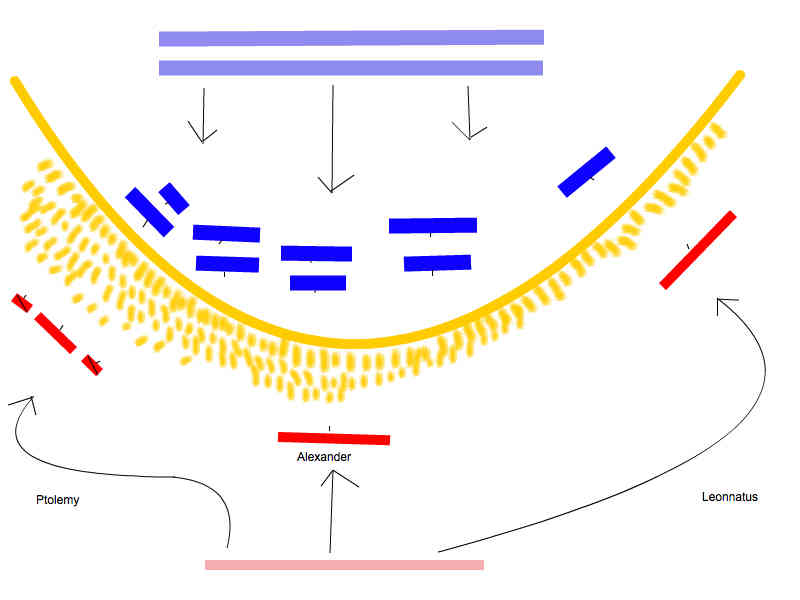
The campaign's opening phase targeted the Aspasians, whose lands Alexander entered first. He split his forces, sending Perdiccas and Hephaestion with three brigades along the southern bank of the Cophen while he took the cavalry and mounted infantry on a rapid strike northward. The speed paid off -- the Macedonians caught the Aspasians before they could fully withdraw behind their walls. But Alexander took a wound during the siege, and his soldiers, enraged at seeing their king injured, razed the city to the ground. The neighboring town of Andaca surrendered without a fight. Ptolemy, the future pharaoh of Egypt, personally killed the Aspasian king in the fighting. Against the Guraeans, Alexander again divided his force, taking the center himself while Craterus brought up the main body at a methodical pace. Ancient sources claim 40,000 Guraeans were captured, though such numbers from antiquity demand skepticism.
The Fortress That Could Not Be Starved
The siege of Aornus was the campaign's climax. Perched on a mountain spur above the upper Indus gorges near modern Pir-Sar in Swat, the fortress sat on a flat summit with natural springs and enough level ground to grow crops. It could not be starved into submission. Alexander's biographer Robin Lane Fox called it "the climax to Alexander's career as the greatest besieger in history." Ptolemy and Alexander's secretary Eumenes reconnoitered a neighboring spur and built a stockade, but their signal fire alerted the defenders. A deep ravine blocked the siege engines from reaching the walls, so Alexander ordered an earthwork mound constructed from carpentry, brush, and soil. Progress was agonizing -- fifty meters on the first day, then slower as the ravine fell away steeply below. After three days of work, the Macedonians reached a low hill connected to Pir-Sar's tip. Boulders rolled from above repulsed the first assault. For three days, drums echoed across the mountains as the defenders celebrated. Then they retreated in the night. Alexander hauled himself up the final rock face on a rope, cleared the summit, and erected altars to Athena Nike.
Where Dionysus Planted the Vine
Not every encounter ended in blood. When Alexander reached the city of Nysa, between the Cophen and Indus rivers, its citizens sent thirty of their most distinguished men as envoys. Their president, Acuphis, prostrated himself before Alexander and then delivered a remarkable speech: the god Dionysus himself had founded their city, naming it after his nurse, and the nearby mountain Meron -- meaning "thigh" -- because Dionysus had grown in the thigh of Zeus. Whether Alexander genuinely believed the story or simply found it politically useful, the result was the same. He left Nysa self-governed, asking only that Acuphis send his son, his grandson, and some horsemen to accompany the army. Afterward, Alexander and his Companions rode to the mountain, wove ivy garlands for their heads, and sang hymns to Dionysus. It was a moment of celebration amid months of siege and slaughter -- Macedonian soldiers crowning themselves with ivy on a mountainside in what is now Pakistan, convinced they stood where a Greek god once walked.
The Road to India
The Cophen campaign was never an end in itself. Every siege, every forced surrender, every garrison left behind served a single strategic purpose: securing the dangerously long supply line that stretched back over the Hindu Kush to Balkh. Without control of these mountain valleys, Alexander's army could not safely proceed into India. The campaign succeeded on those terms. By March 326 BC, the Macedonians had subdued the Aspasians, Guraeans, and Assacenians, reduced the great fortress of Aornus, and reached the banks of the Indus. Ahead lay the confrontation with King Porus and the Battle of the Hydaspes, the last great pitched battle Alexander would ever fight. Behind lay valleys where Greek altars stood on mountain summits and a city called Nysa still governed itself in the name of a god -- monuments to the strangest chapter of a campaign that had begun in Macedonia a decade earlier and would end, for Alexander's exhausted soldiers, only when they finally refused to march any farther.
From the Air
Centered at 35.20N, 72.48E in the Swat Valley region of Khyber Pakhtunkhwa, Pakistan. The campaign spanned from the Kabul Valley (34.5N, 69.2E) eastward to the Indus. Terrain is rugged mountain valleys between 1,000-4,000m elevation. Nearest airports: Saidu Sharif Airport (OPSS) in Swat, Peshawar Bacha Khan International (OPPS). The Hindu Kush mountains and upper Indus gorges are visible landmarks. Best viewed at 15,000-20,000 ft for valley context.