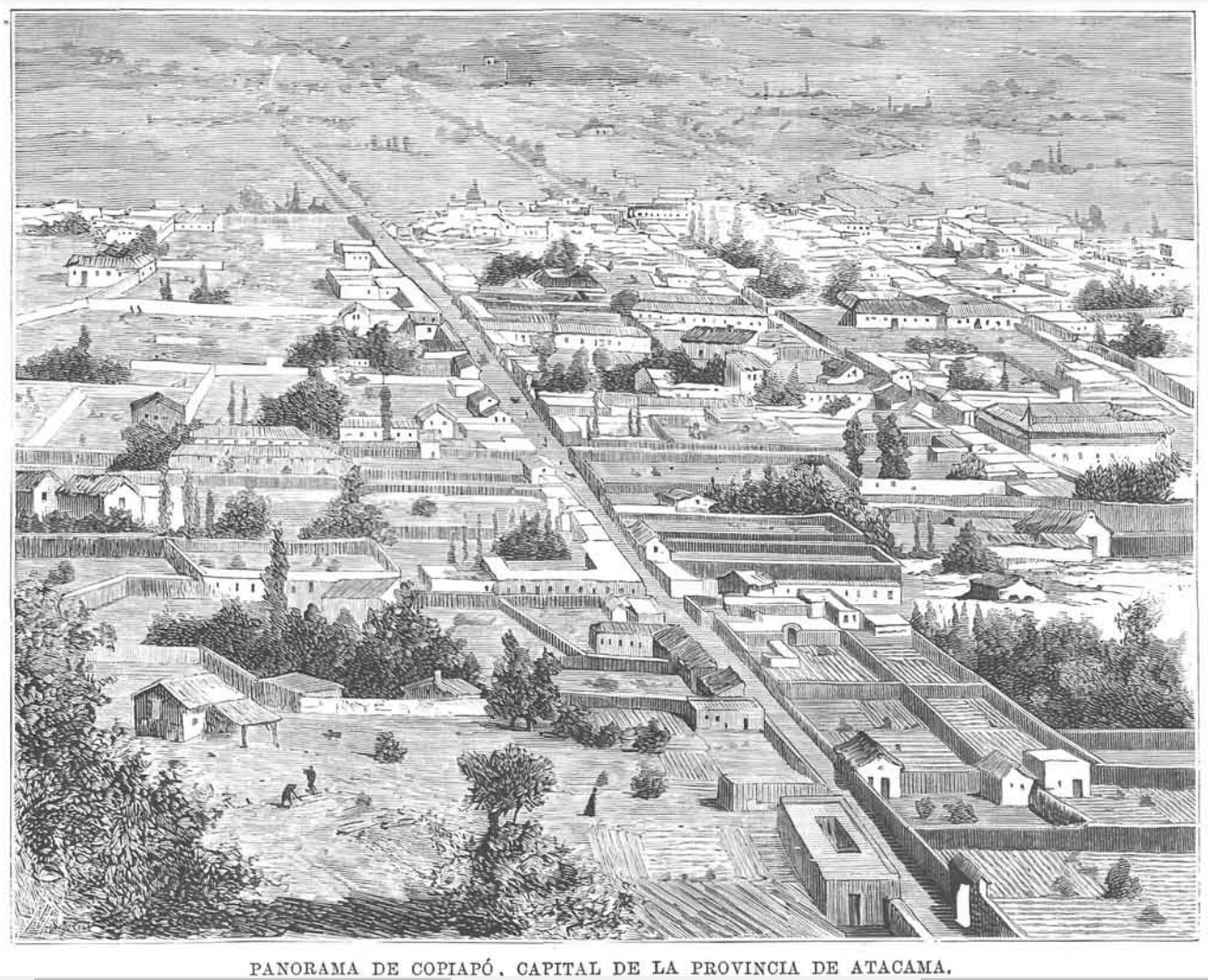
Copiapó
Its first name told a different story. When Spanish colonists christened this settlement San Francisco de la Selva in 1744, the surrounding Atacama was lusher than anyone today would guess. Jungle is a stretch, but the name stuck for a century, until the town became Copiapó and the desert closed in for good. What remained was silver, copper, and a determination to connect this isolated pocket of northern Chile to the wider world. In 1851, the Copiapó-Caldera railway became the first railroad in Chile, its original wooden station now preserved as a National Monument. The trains are gone. The mining endures. And every few years, when rare rains arrive, the desert around Copiapó performs its most improbable trick: it blooms.
Rails Through the Driest Land
The Copiapó-Caldera railway, completed in 1851, was built to haul silver and copper ore 65 kilometers west to the port of Caldera. It was the first railway line in Chile, a distinction that speaks to the mineral wealth concentrated in this otherwise forbidding stretch of the Atacama. The original wooden railway station still stands in the city, designated a Chilean National Monument. By the time Chile's rail network expanded southward and northward, Copiapó had already proven the economic logic of industrial transport in a landscape where pack mules had been the only alternative. The city sits 800 kilometers north of Santiago, connected today by bus routes running to Antofagasta and Iquique in the north and La Serena in the south.
Silver, Copper, and the Underground
Copiapó owes its existence to what lies beneath the Atacama. Rich silver deposits drew miners here in the colonial era, and copper took over as the dominant industry in the modern period. The region's mining heritage gained unexpected international attention in 2010, when the San José copper mine, located outside the city, collapsed and trapped 33 miners underground for 69 days. Their rescue, watched by a global television audience, became one of the most dramatic survival stories of the century. The mine was closed afterward. But mining as an industry never paused in Copiapó. Smaller operations and exploration ventures continue to probe the surrounding desert, a district that has yielded ore for nearly three centuries.
When the Desert Flowers
The phenomenon called the Desierto Florido transforms the barren coastal strip near Totoralillo and Totoral into a carpet of wildflowers. It requires a specific combination of above-average rainfall and the right temperature cycle, conditions that may not align for years at a time. When they do, the effect is staggering. Arid ground that appears incapable of supporting life suddenly produces fields of purple, pink, and yellow blooms stretching to the horizon. The flowering desert has become a draw for Chilean and international tourists, though its unpredictability makes planning difficult. For Copiapó, the Desierto Florido is both an economic opportunity and a reminder that the Atacama, for all its severity, holds seeds waiting for the right moment.
Faith and Festival in Mining Country
Each February, the Festival of the Virgen de la Candelaria fills Copiapó with thousands of pilgrims from across Chile and neighboring countries. The festival honors the patron saint of miners, a fitting dedication for a city whose fortunes have always depended on what workers extract from the earth. Traditional dances from northern Chile, elaborate costumes, and organized dance groups parade through the streets while a trade fair sets up alongside the celebrations. In the city center, the Plaza Arturo Prat offers quieter pleasures: shade trees, comfortable benches, and the slow rhythms of a Chilean town that has learned to pace itself against the heat. The Inca cemetery within the city, investigated since the 1930s, adds another layer, a reminder that people have been drawn to this oasis at the desert's edge for far longer than the colonial record suggests.
From the Air
Copiapó is at 27.37°S, 70.33°W, approximately 65 km inland from the coastal town of Caldera. Desierto de Atacama Airport (SCAT) serves the city. The terrain is arid with hills surrounding the town and the Andes rising sharply to the east. Ojos del Salado, the world's highest volcano at 6,893 m, lies to the east in the high Andes. Clear skies are typical, with minimal weather obstructions.