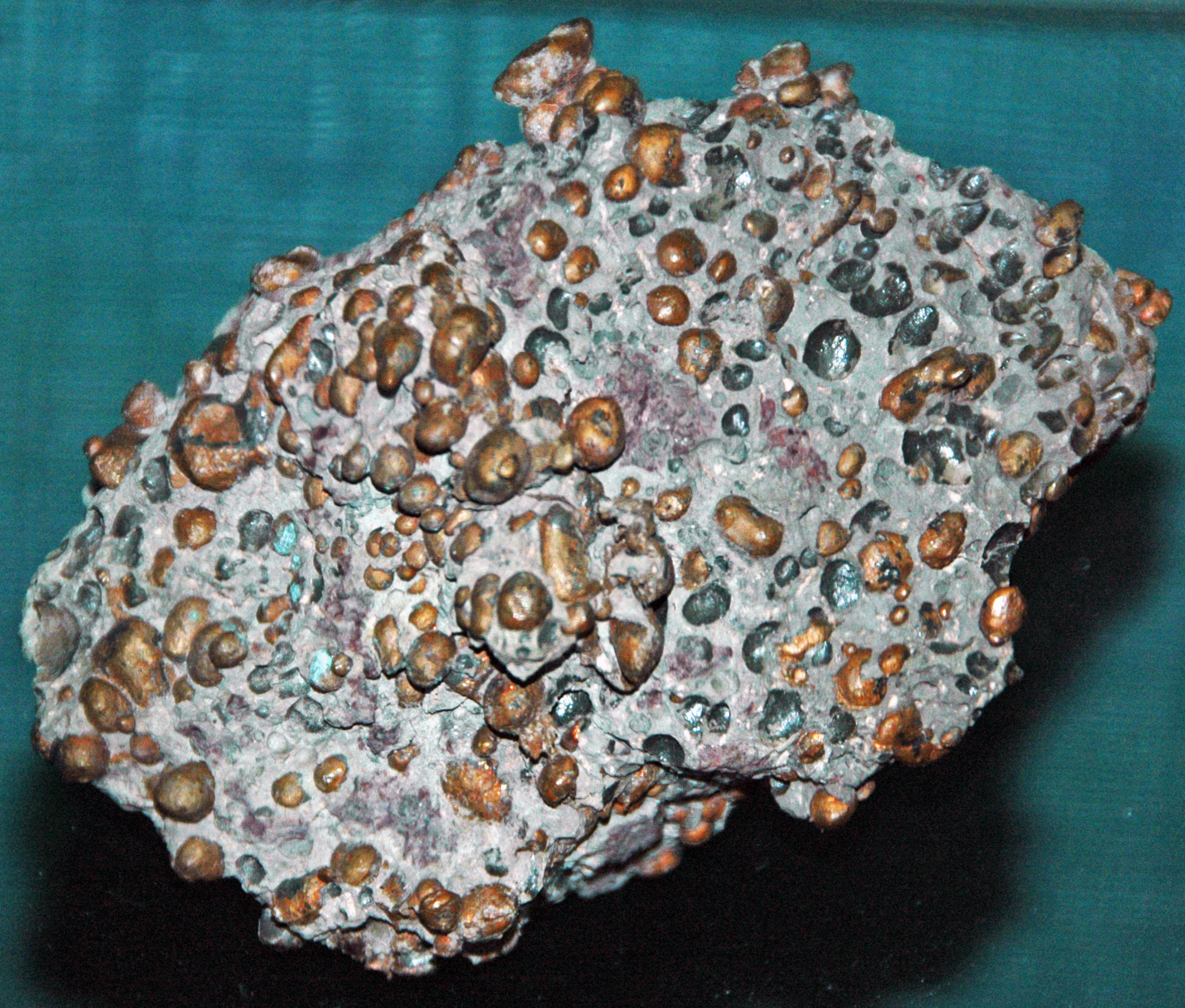
Cupriferous amygdaloidal basalt ("shot copper") from the Precambrian of Michigan, USA. (public display, Seaman Mineral Museum, Michigan Technological University, Houghton, Michigan, USA)
A mineral is a naturally-occurring, solid, inorganic, crystalline substrance having a fairly definite chemical composition and having fairly definite physical properties.  At its simplest, a mineral is a naturally-occurring solid chemical.  Currently, there are over 4900 named and described minerals - about 200 of them are common and about 20 of them are very common.  Mineral classification is based on anion chemistry.  Major categories of minerals are: elements, sulfides, oxides, halides, carbonates, sulfates, phosphates, and silicates.
Elements are fundamental substances of matter - matter that is composed of the same types of atoms.  At present, 118 elements are known (four of them are still unnamed).  Of these, 98 occur naturally on Earth (hydrogen to californium).  Most of these occur in rocks & minerals, although some occur in very small, trace amounts.  Only some elements occur in their native elemental state as minerals.
To find a native element in nature, it must be relatively non-reactive and there must be some concentration process.  Metallic, semimetallic (metalloid), and nonmetallic elements are known in their native state as minerals.
Copper is the only metallic element that has a "reddish" color - it’s actually a metallic orange color.  Most metallic elements, apart from gold & copper, are silvery-gray colored.  Copper tends to form sharp-edged, irregular, twisted masses of moderately high density.  It is moderately soft, but is extremely difficult to break.  It has no cleavage and has a distinctive hackly fracture.
The native copper-bearing rock shown above comes from northern Michigan's Portage Lake Volcanic Series, an extremely thick, Precambrian-aged, flood-basalt deposit that fills up an ancient continental rift valley.  This rift valley, analogous to the present-day East African Rift Valley, extends from Kansas to Minnesota to the Lake Superior area to southern Michigan.  Unlike many flood basalts (e.g., Deccan Traps, Siberian Traps, Columbia River), the Portage Lake only filled up the rift valley.  The unit is exposed throughout Michigan’s Keweenaw Peninsula, in the vicinity of the towns of Houghton & Hancock.
The Portage Lake succession thickens northward through the Keweenaw, up to >5.5 km worth of section in places.  The dominant rock type is basalt - vesicular basalts, for the most part.  Most of the original vesicles (gas bubbles) have since been filled up with a wide variety of different minerals.  A vesicular basalt that has had its vesicles filled up with minerals is called an amygdaloidal basalt (try saying that five times quickly).  Keweenaw amygdaloidal basalts have long had significant economic importance because native copper (Cu) is one of the more common vesicle-filling and fracture-filling minerals.  Native silver (Ag) is sometimes closely associated with copper.  Copper and silver mineralization occurred during the late Mesoproterozoic, at 1.05 to 1.06 billion years ago.  The Portage Lake host rocks are 1.093 to 1.097 billion years old.
This rock is the most amazing cupriferous amygdaloidal basalt sample I've ever seen.  The morphology of each copper-filled vesicle is easily seen.

Locality: Wolverine Mine, Kearsarge, Upper Peninsula of Michigan, USA
Cupriferous amygdaloidal basalt ("shot copper") from the Precambrian of Michigan, USA. (public display, Seaman Mineral Museum, Michigan Technological University, Houghton, Michigan, USA) A mineral is a naturally-occurring, solid, inorganic, crystalline substrance having a fairly definite chemical composition and having fairly definite physical properties. At its simplest, a mineral is a naturally-occurring solid chemical. Currently, there are over 4900 named and described minerals - about 200 of them are common and about 20 of them are very common. Mineral classification is based on anion chemistry. Major categories of minerals are: elements, sulfides, oxides, halides, carbonates, sulfates, phosphates, and silicates. Elements are fundamental substances of matter - matter that is composed of the same types of atoms. At present, 118 elements are known (four of them are still unnamed). Of these, 98 occur naturally on Earth (hydrogen to californium). Most of these occur in rocks & minerals, although some occur in very small, trace amounts. Only some elements occur in their native elemental state as minerals. To find a native element in nature, it must be relatively non-reactive and there must be some concentration process. Metallic, semimetallic (metalloid), and nonmetallic elements are known in their native state as minerals. Copper is the only metallic element that has a "reddish" color - it’s actually a metallic orange color. Most metallic elements, apart from gold & copper, are silvery-gray colored. Copper tends to form sharp-edged, irregular, twisted masses of moderately high density. It is moderately soft, but is extremely difficult to break. It has no cleavage and has a distinctive hackly fracture. The native copper-bearing rock shown above comes from northern Michigan's Portage Lake Volcanic Series, an extremely thick, Precambrian-aged, flood-basalt deposit that fills up an ancient continental rift valley. This rift valley, analogous to the present-day East African Rift Valley, extends from Kansas to Minnesota to the Lake Superior area to southern Michigan. Unlike many flood basalts (e.g., Deccan Traps, Siberian Traps, Columbia River), the Portage Lake only filled up the rift valley. The unit is exposed throughout Michigan’s Keweenaw Peninsula, in the vicinity of the towns of Houghton & Hancock. The Portage Lake succession thickens northward through the Keweenaw, up to >5.5 km worth of section in places. The dominant rock type is basalt - vesicular basalts, for the most part. Most of the original vesicles (gas bubbles) have since been filled up with a wide variety of different minerals. A vesicular basalt that has had its vesicles filled up with minerals is called an amygdaloidal basalt (try saying that five times quickly). Keweenaw amygdaloidal basalts have long had significant economic importance because native copper (Cu) is one of the more common vesicle-filling and fracture-filling minerals. Native silver (Ag) is sometimes closely associated with copper. Copper and silver mineralization occurred during the late Mesoproterozoic, at 1.05 to 1.06 billion years ago. The Portage Lake host rocks are 1.093 to 1.097 billion years old. This rock is the most amazing cupriferous amygdaloidal basalt sample I've ever seen. The morphology of each copper-filled vesicle is easily seen. Locality: Wolverine Mine, Kearsarge, Upper Peninsula of Michigan, USA

Copper Mining in Michigan

miningcopper-countryindustrial-historynative-americanupper-peninsulageology
4 min read

In 1869, one state produced more than 95% of all the copper mined in the United States. It was not Arizona. It was not Montana. It was Michigan, and the copper came from a geological oddity that exists almost nowhere else on Earth: pure metallic copper embedded in billion-year-old volcanic rock, ready to be pulled from the ground in chunks you could hold in your hand. Native Americans had been doing exactly that for more than 6,000 years before Europeans arrived. The Keweenaw Peninsula and the surrounding Copper Country of Michigan's Upper Peninsula became the birthplace of American industrial copper mining, launching a boom that built opera houses in the wilderness, drew immigrants from dozens of nations, and - when the deposits finally gave out - left behind one of the most haunting landscapes of abandonment in the country.

The Oldest Mines in the Americas

Long before European boots touched the Keweenaw, Native Americans were mining copper from pits along Lake Superior and on Isle Royale. Archaeological evidence dates this activity from roughly 5000 BCE to 1200 BCE - making these among the oldest metal-mining operations anywhere in the Western Hemisphere. The miners hammered raw copper from exposed rock using stone tools, shaping it into knives, spear points, awls, and ornamental pieces. The copper traded along networks that stretched across the continent. By the time French missionary Claude Allouez wrote the first European account of Michigan copper in 1667, the Ojibwe people occupied the region, though they did not mine it themselves. Ojibwe oral tradition held that they had supplanted earlier peoples - the original miners. When missionary Claude Dablon was guided to the Ontonagon Boulder, a 1.5-ton mass of pure native copper along the Ontonagon River, the scale of what lay beneath these forests began to register with the outside world.

The Rush That Built an Empire

The modern copper rush ignited in the 1840s. State geologist Douglass Houghton published his copper report in 1841, the Treaty of La Pointe opened the land in 1843, and the Ontonagon Boulder made headlines back east. A federal mineral land office opened at Copper Harbor, and prospectors flooded in. Commercial production began in 1844 at the Phoenix mine. The Cliff mine followed in 1845 and became the first consistently profitable copper mine in the country. What made Michigan unique was the native copper itself - not oxide or sulfide ores requiring smelting, but pure metal that could be cut and shipped directly. From 1845 until 1887, Michigan led the nation in copper production. In most years between 1850 and 1881, the state produced more than three-quarters of all American copper. The wealth transformed the wilderness. The town of Red Jacket - now Calumet - built an opulent opera house, the Calumet Theatre, which hosted acts from around the world. Mine managers erected mansions that still line the streets of towns like Houghton, Hancock, and Ontonagon.

Calumet and Hecla's Reign

No name loomed larger over the Copper Country than the Calumet and Hecla Mining Company. At its peak, Calumet and Hecla was one of the most profitable mining operations in the world, extracting copper from conglomerate rock beds in shafts that plunged thousands of feet underground. The company dominated the region economically and politically, employing thousands of immigrant workers - Finns, Cornish, Italians, Croatians - who built the ethnic neighborhoods and churches that still define these communities. But native copper mining was a waning industry by the early twentieth century. Open-pit mines in Montana and Arizona produced copper sulfide ores more cheaply. Shaft mining grew ever more expensive as the workings went deeper. By 1968, Universal Oil purchased the struggling Calumet and Hecla. That same year, workers struck, and the new owners shut the mines for good. Michigan's native copper industry was dead.

Scars and Monuments

The environmental legacy of 150 years of mining is written across the landscape. Stamp sand - the crushed waste rock from processing mills - formed enormous sterile beaches along the Keweenaw Waterway, some large enough to become hazards to navigation. These are now Superfund sites, slowly being rehabilitated. The mines consumed forests voraciously, for tunnel supports, housing, and steam power, stripping virtually every acre of the Copper Country of timber. Only a few pockets of old-growth forest survive, such as the Estivant Pines near Copper Harbor. But the ruins also became monuments. The Keweenaw National Historical Park now preserves key sites across the district. The Quincy Mine near Hancock, the Adventure mine near Greenland, and the Delaware mine near Copper Harbor welcome visitors underground. The mansions and theaters remain. The immigrant churches still hold services. The Copper Country found a second life as a place people visit precisely because of what was lost.

The Last Chapter at White Pine

Copper mining's final act in Michigan played out not in the Keweenaw but at the southern edge of the Copper Country. The Nonesuch Shale in Ontonagon County had frustrated miners since the 1860s with copper locked in fine particles that no one could economically extract. In 1955, the Copper Range Company opened the White Pine mine and finally solved the problem with modern milling technology. White Pine thrived for four decades, mining copper sulfides rather than native copper, and became the last major copper mine in the state. It shut down in 1995. An attempt at in-situ acid leaching sparked a confrontation when Bad River Band members blockaded rail shipments of sulfuric acid, and regulatory hurdles ultimately made the project uneconomical. The mine closed for good, and Michigan's copper story - stretching from stone-tool pits 7,000 years old to modern industrial operations - finally went quiet.

From the Air

Centered at 46.788N, 89.530W (White Pine area), the broader Copper Country stretches across the Keweenaw Peninsula and western Upper Peninsula of Michigan. Houghton County Memorial Airport (KCMX) near Hancock/Calumet serves as the primary gateway, with a 6,500-foot runway. From altitude, the Keweenaw Peninsula is unmistakable - a finger of land jutting northeast into Lake Superior. Look for the distinctive stamp sand deposits along the shoreline near Gay and Freda, visible as pale beaches against the dark lake water. The mining towns of Calumet, Hancock, and Houghton cluster around Portage Lake and the Keweenaw Waterway. To the south, the White Pine and Nonesuch mine areas sit near the Porcupine Mountains. Ontonagon County Airport (KONM) is closer to the southern mining sites. Expect variable Upper Peninsula weather; lake-effect snow is common from October through April.