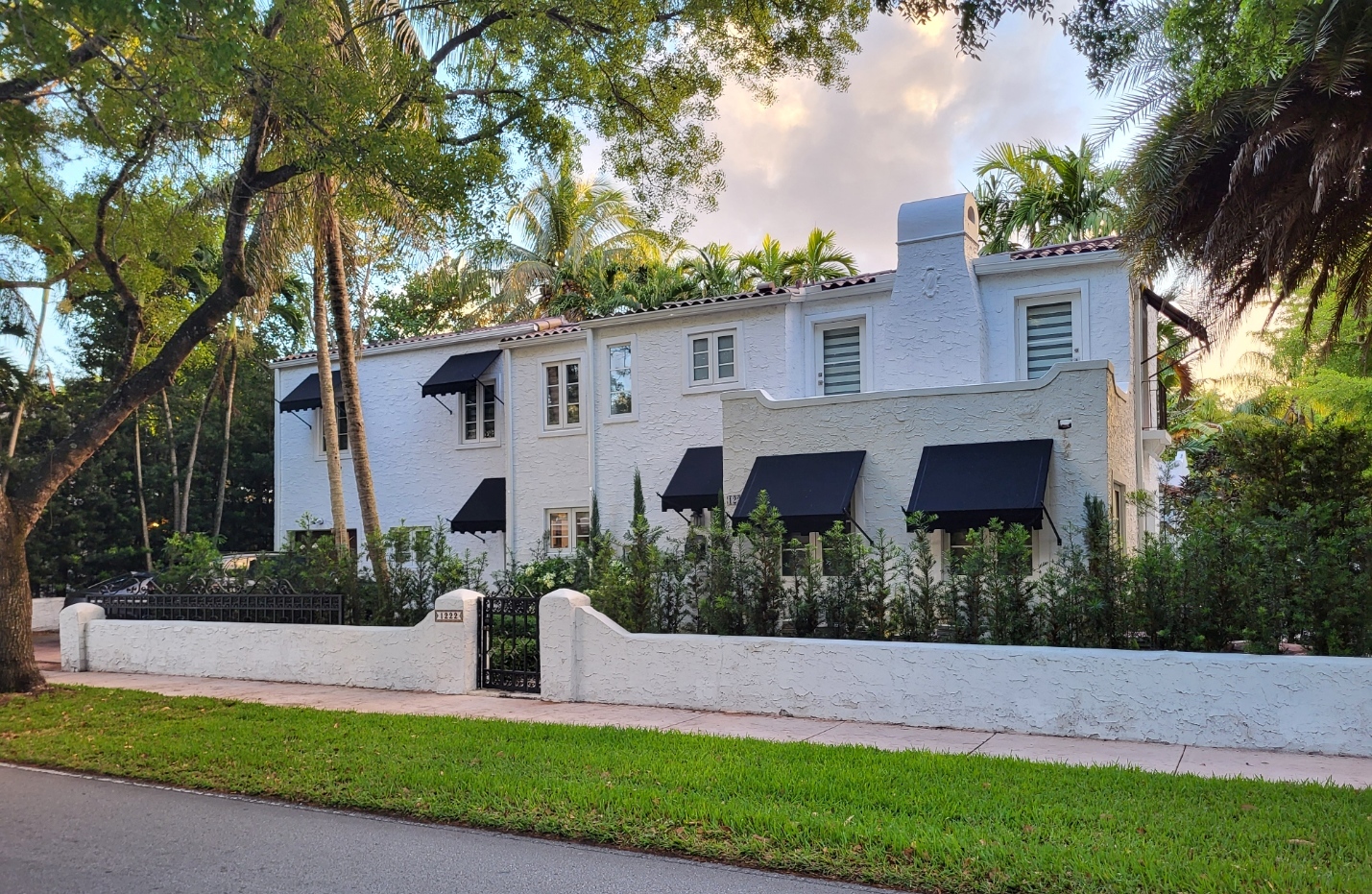
Coral Gables: George Merrick's Castles in Spain
George Merrick had a problem with the name. His family's plantation house, built from local coral limestone and roofed with coral-colored Ludowici tile, had been called "Coral Gables" since the early 1900s. When Merrick began transforming the surrounding land into a planned community during the Florida real estate frenzy of the 1920s, he kept the name - and then built an entire city to match it. Mediterranean Revival architecture was mandated from the start. Streets curved instead of following grids. International villages showcased Italian, French, and Dutch South African styles. A quarry was turned into the Venetian Pool. The vision was so thoroughly Spanish that King Alfonso XIII of Spain awarded Merrick the Order of Isabella the Catholic. By 1926, the city had netted $150 million in sales. Then the boom collapsed. But the city Merrick built survived.
A Developer's Romantic Vision
Merrick was a real estate developer from Pennsylvania who arrived in South Florida and saw not swamp but Spain. Coral Gables historian Arva Moore Parks documented how Merrick described his vision as "a most extraordinary opportunity for the building of 'Castles in Spain.'" Formally incorporated on April 29, 1925, the city was built on the principles of the City Beautiful Movement - the early twentieth-century urban planning philosophy that believed beautiful surroundings created better citizens. Merrick did not leave beauty to chance. The architecture was almost entirely Mediterranean Revival, with particular emphasis on Spanish influence. The Coral Gables Congregational Church, donated by Merrick himself, set the tone. The domed Catholic Church of the Little Flower followed in a similar Spanish Renaissance style. Every building reinforced the illusion that this piece of subtropical Florida was actually a corner of Andalusia.
The City by Design
Merrick planned Coral Gables with a precision unusual for 1920s Florida development. The downtown commercial district was deliberately designed to be only four blocks wide but more than a mile long, with Miracle Mile bisecting the business core. An electric trolley system connected neighborhoods until automobiles rendered it obsolete; a free circulator trolley, launched in November 2003, now runs down Ponce de Leon Boulevard. The themed Coral Gables Villages, dating to the 1920s, expanded the city's architecture beyond Spanish influence to include Italian, French, and Dutch South African styles. By 1926, the city covered thousands of acres with over $100 million spent on development. That same year, the Biltmore Hotel and Golf Course opened - a soaring Mediterranean tower that became the city's most recognizable landmark and remains its visual centerpiece today.
The University and the Economy
In 1925, roughly simultaneous with the city's founding, the University of Miami was built on land west of U.S. Route 1, about two miles south of downtown Coral Gables. By fall 1926, its first class of 372 students enrolled. Today the university is the city's largest employer with over 20,000 faculty and staff, and the second-largest employer in all of Miami-Dade County. The university anchors a surprisingly diverse economy for a city of roughly 49,000 people: Bacardi maintains its U.S. headquarters here, Fresh Del Monte Produce is headquartered in Coral Gables, FIFA operates its North American office from the city, and consulates from nearly a dozen countries line its boulevards. The median household income of $118,203 reflects the affluence that strict zoning and historic preservation have maintained since the 1920s.
Preserving the Dream
Coral Gables passed its first preservation ordinance in 1973, as the city's founding structures from the 1920s began reaching their 50th anniversaries. Further ordinances in the 1980s established the Historic Preservation Board, and the 1990s brought a dedicated Historical Resources and Cultural Arts Department. The strict zoning that defines Coral Gables today is not a modern invention but an inheritance from Merrick's original plan. The result is a city that looks remarkably consistent - terra-cotta roofs, stucco walls, arched windows, and bougainvillea-draped courtyards stretching block after block. During World War II, Navy pilots and mechanics trained here. Nobel Prize-winning poet Juan Ramon Jimenez called it home. Dave Barry wrote his Pulitzer-winning humor columns from Coral Gables. Jeb Bush, the 43rd Governor of Florida, is among the city's notable residents. A century after Merrick's castles in Spain were made real, the city endures exactly as he imagined it.
From the Air
Located at 25.72°N, 80.27°W, Coral Gables sits southwest of downtown Miami and about four miles from Miami International Airport (KMIA). From altitude, the city is distinguishable from surrounding Miami-Dade County by its consistent Mediterranean-style rooflines - terra-cotta and coral-colored roofs stretching across a carefully planned grid that contrasts with the denser, more varied development of Miami proper. The Biltmore Hotel tower is the most prominent visual landmark, rising above the tree canopy. The University of Miami campus is visible along U.S. Route 1. Coral Gables occupies a significant water area (over 64% of its total area), much of it along the Intracoastal Waterway to the south. Nearby airports include Miami International (KMIA), Opa-locka Executive (KOPF), and Tamiami Executive (KTMB) to the southwest.