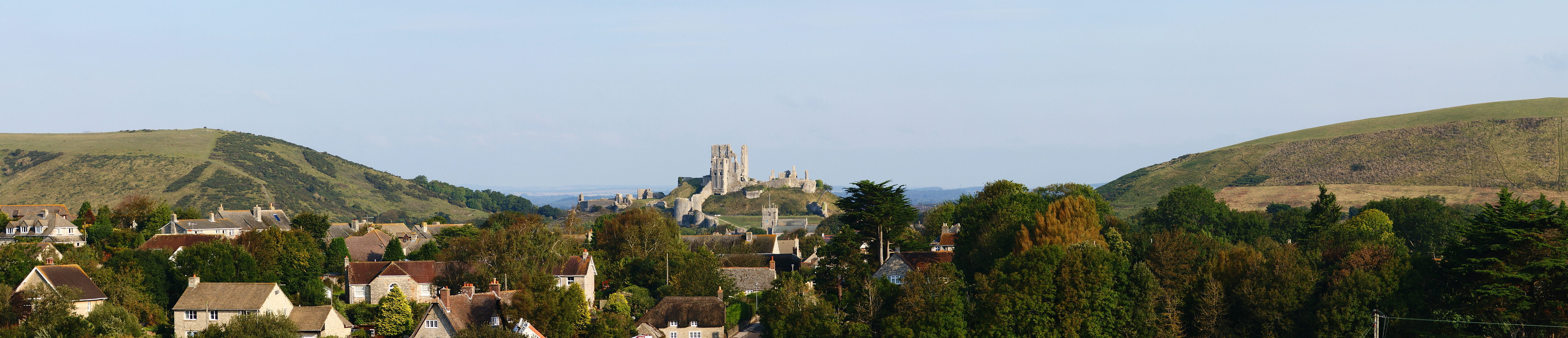
Corfe Castle
The towers lean at angles that defy gravity. Massive blocks of Purbeck limestone, once fitted together with medieval precision, now tilt drunkenly against the Dorset sky, frozen in the moment of their destruction. Corfe Castle was not abandoned or neglected into ruin. It was deliberately and violently blown apart on Parliament's orders in 1646, punishment for holding out too long in the wrong cause. The result is one of England's most dramatically ruined fortresses, a place where destruction itself has become the spectacle.
Murder, Conquest, and Stone
The hill where Corfe stands has drawn power for over a thousand years. The name itself comes from the Old English ceorfan, meaning a cutting, describing the natural gap in the chalk ridge that the castle commands. In 978, the boy-king Edward the Martyr was assassinated here, possibly at the hall of Queen Aelfthryth, stabbed while still mounted on his horse. William the Conqueror built one of his 36 castles on this site after 1066, and unusually for the period, he used stone rather than timber, a mark of Corfe's exceptional status. The Domesday Book of 1086 likely records it as the only castle in Dorset. Henry I added the stone keep around 1100 to 1105, using Purbeck limestone quarried a few miles away, since the chalk of the hilltop itself was useless for building.
A King's Fortress
King John lavished over 1,400 pounds on Corfe, building the elegant Gloriette within the inner bailey and rebuilding the western defenses. The castle served as a royal storehouse of serious scale: in 1224, Henry III sent to Corfe for 15,000 crossbow bolts needed for the siege of Bedford Castle. Henry also spent heavily on the keep and, in 1244, ordered it whitewashed, just as he had done four years earlier to the Tower of London, giving that fortress its famous name, the White Tower. The workers' camp outside the castle walls gradually became a permanent settlement, earning market rights in 1247. During the Wars of the Roses, Henry Beaufort marshaled his army at Corfe before marching north to the Battle of Wakefield in December 1460.
Lady Bankes and the Last Stand
Elizabeth I sold Corfe out of royal hands in 1572. By 1635 it belonged to Sir John Bankes, Attorney General to Charles I. When civil war erupted, Bankes went to Oxford with the king, leaving his wife Mary to defend their home. Lady Bankes proved formidable. In 1643, she began with just five defenders but built the garrison to eighty, holding off between 500 and 600 Parliamentarian soldiers for six weeks. The attackers suffered at least 100 dead while the garrison lost only two. But by 1645, Corfe was one of the last royalist strongholds in southern England, and treachery succeeded where force had failed. Colonel Pitman, one of the garrison's own officers, offered to fetch reinforcements from Somerset. He returned with Parliamentarian soldiers disguised as Royalists, who opened the gates from within.
The Shattering
Parliament voted to slight the castle, the seventeenth-century term for deliberate demolition. Gunpowder charges were packed against the walls and towers, and when they detonated, the force split massive sections of masonry that toppled but refused to crumble entirely. The solidity of the medieval stonework made complete destruction impracticable, which is precisely what makes the ruins so extraordinary today. Whole sections of wall stand at impossible angles, testimony to both the builders' skill and the destroyers' determination. Villagers carried away stones for their own houses. The Bankes family, their property restored after the monarchy returned in 1660, chose not to rebuild. Instead they constructed a new home at Kingston Lacy, leaving Corfe to stand as it fell.
Ruins and Recognition
Ralph Bankes bequeathed the entire estate to the National Trust upon his death in 1981. Archaeological excavations between 1986 and 1997 revealed details of the castle's construction phases, and a 2008 conservation project uncovered a ceremonial door designed for Henry I, suggesting the castle's importance was even greater than previously understood. In 2024, a two-million-pound project opened the castle keep to visitors for the first time since its destruction nearly four centuries earlier. Over 259,000 people visit annually, drawn by ruins that Enid Blyton used as inspiration for her Famous Five adventures. From the air, the castle's triangular footprint and the gap in the Purbeck Hills it commands are unmistakable.
From the Air
Located at 50.640N, 2.059W on the Isle of Purbeck peninsula, Dorset. The castle crowns a prominent hill in a clear gap through the Purbeck Hills, making it an excellent visual landmark from the air. Nearest airports: EGHH (Bournemouth, 15 nm east), EGHI (Southampton, 30 nm northeast). Recommended viewing altitude 1,500-3,000 ft to appreciate the castle's commanding position in the ridge gap.