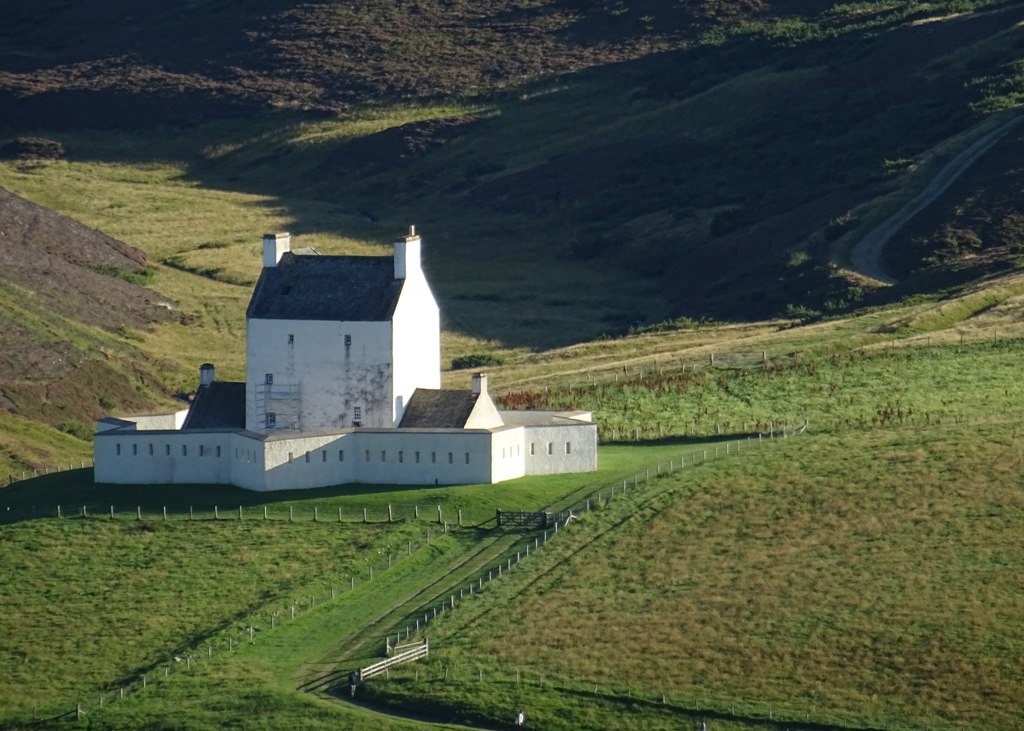
Corgarff Castle
The ballad begins with a warning. 'Turn again, turn again, turn again, I bid thee / If ye burn Auchindoun, Huntly he will head thee.' But the song could equally apply to Corgarff, the castle where the consequences of feuding turned most terrible. Standing by the Lecht road that crosses the high pass between Strathdon and Tomintoul in Aberdeenshire, Corgarff Castle has been built, burned, garrisoned, burned again, and rebuilt so many times that its walls are a palimpsest of Scotland's bloodiest centuries. The worst day in its history produced a ballad that has been sung for over four hundred years.
Twenty-Six Dead at the Tower
The Elphinstone family built the castle around 1530 and leased it to the Forbes of Towie. The Forbes and the Gordons were enemies -- a feud woven deep into the fabric of northeast Scotland. In 1571, Adam Gordon of Auchindoun came to Corgarff while the Forbes laird was away. What happened next became the subject of the ballad Edom o Gordon, one of the Child Ballads collected as number 178. Margaret Campbell, Lady Forbes, refused to surrender the castle. Gordon set it alight. Twenty-six people died in the fire -- Lady Forbes, her children, and their household. The ballad preserves the voice of a woman watching from the tower as flames climb the walls, knowing there would be no rescue. It is one of the starkest depictions of civilian suffering in the entire ballad tradition.
A Castle That Would Not Stay Down
Corgarff's history after the burning reads like a catalogue of Scottish conflict. In May 1607, Alexander Forbes of Towie recaptured the castle from Alexander, 4th Lord Elphinstone, using hammers and battering rams to break down the gate, then filling it with what the records call 'Highland thieves and limmers.' The Earl of Mar acquired it in 1626. In 1645, the Marquis of Montrose used it as an assembly point for his Royalist troops during the Wars of the Three Kingdoms. It was burned again in 1689 during the Jacobite rising. It was burned yet again in 1716 by Jacobite supporters. The Forbes family resettled it in 1745 but forfeited the property due to their own Jacobite leanings. Each time the castle was destroyed, someone rebuilt it. Each time it was rebuilt, someone found a reason to burn it again.
Redcoats on the Lecht
After the final Jacobite defeat at Culloden in 1746, the government converted Corgarff into a garrison post. A star-shaped curtain wall was added around the tower -- the same defensive geometry imposed on castles across the defeated Highlands. Government troops were stationed here not to fight battles but to suppress the illegal whisky trade and enforce the laws against carrying weapons and wearing tartan. The castle became a customs post in a landscape of smugglers. Soldiers patrolled the Lecht road, watching for illicit stills and contraband whisky moving between the glens. It was a mundane assignment in a remote and freezing posting, a far cry from the fire and murder of 1571.
The Ballad Endures
Corgarff Castle is now a scheduled monument managed by Historic Environment Scotland and open to the public. The star-shaped wall, the garrison rooms, and the tower house stand in a landscape of exceptional bleakness and beauty -- high moorland where the wind carries the sound of curlews and the Lecht road climbs toward the ski slopes above Tomintoul. Visitors can walk through the rooms where soldiers once huddled against the cold, and where, centuries earlier, twenty-six people died because a woman refused to open her door to her husband's enemies. The ballad Edom o Gordon has preserved Margaret Campbell's story in a way that the castle itself cannot. Stone can be rebuilt. The dead stay dead. But the song remembers.
From the Air
Located at 57.16N, 3.23W beside the Lecht road (A939) between Strathdon and Tomintoul in Aberdeenshire. The castle sits in an exposed upland setting surrounded by moorland. Aberdeen Airport (EGPD) is approximately 45 miles east. Best viewed at 2,000-3,500 ft AGL. The Lecht ski area is visible to the northwest along the road.