Cormorant Fishing House
Six men in all of Japan hold the title. They are usho, cormorant fishing masters, and they answer directly to the Imperial Household Agency. On summer nights along the Nagara River in Gifu, these masters stand in wooden boats lit by blazing fire baskets, commanding teams of cormorants to dive into black water and surface with ayu, the prized sweetfish, clamped in their beaks. The tradition stretches back more than 1,300 years, and the Cormorant Fishing House, a museum on the river's north bank, is where visitors come to understand how an ancient fishing technique became one of Japan's most carefully guarded cultural treasures.
Birds, Fire, and Darkness
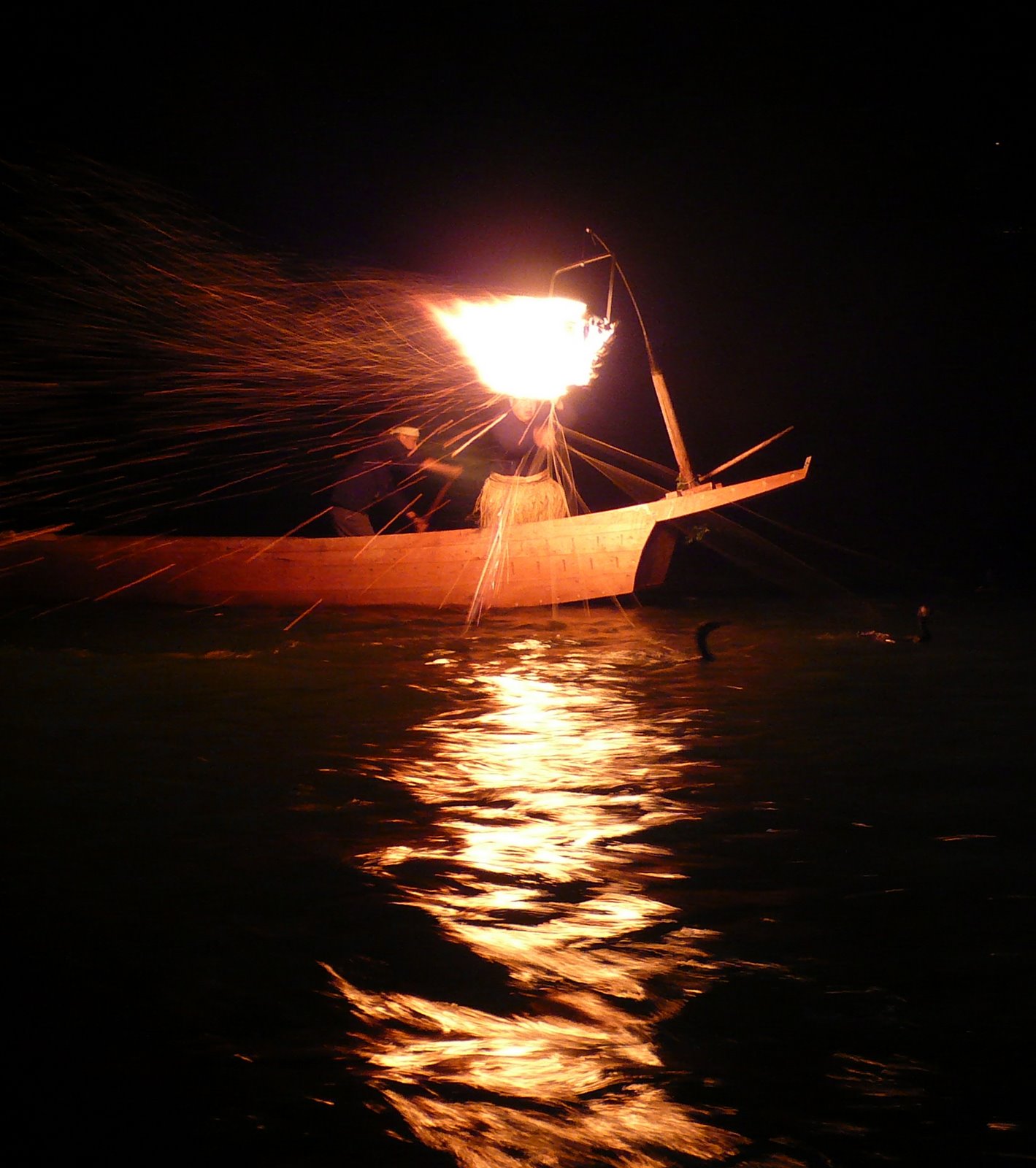
Cormorant fishing, or ukai, works on a principle that borders on choreography. After nightfall, six wooden boats push off from the banks of the Nagara River, each carrying a master fisherman and two boatmen. A kagaribi, an iron fire basket suspended on a pole over the bow, throws flickering light across the water. The flames serve two purposes: they illuminate the river for the master and they attract ayu toward the surface. Trained cormorants, tethered by snares around their necks loose enough to swallow small fish but tight enough to prevent larger catches from going down, plunge repeatedly into the current. Each dive lasts seconds. The master hauls back the birds by their leashes, coaxes the fish from their throats, and sends them diving again. The entire spectacle unfolds in coordinated bursts of fire, water, and feathers.
Warlords and Emperors
The practice along the Nagara River dates to at least the seventh century, making Gifu one of only twelve places in Japan where ukai survives. It gained its most powerful patron in the sixteenth century when Oda Nobunaga, the warlord who controlled Gifu Castle on the hill above, formalized the role of usho and placed the fishermen under his direct protection. Tokugawa Ieyasu, the first Tokugawa shogun, later became an enthusiastic patron, enjoying the spectacle and reportedly ordering fresh ayu delivered to Edo Castle. By the Meiji era, the fishing masters had been designated Imperial Agents of the Imperial Household Agency, a hereditary title passed from father to son. The haiku poet Matsuo Basho was so moved by watching ukai on the Nagara that he composed verse about it. Even Charlie Chaplin, visiting Japan, came to watch.
Training the Untameable
The cormorants used in Gifu's ukai are wild-caught migratory birds, not bred in captivity. Training one takes two to three years of daily handling, during which the master builds a bond closer to partnership than domestication. The birds live in the usho's home, are fed by hand, and are cared for year-round even outside the fishing season, which runs from May 11 to October 15. Masters wear traditional black kimono, straw aprons, and sandals while working, an outfit unchanged across centuries. The hereditary nature of the title means that sons grow up alongside the birds, learning to read their movements and moods before they ever take command of a boat. Today's six masters carry a lineage that connects directly to the fishermen Nobunaga patronized nearly five hundred years ago.
The Museum on the Bank
The Cormorant Fishing House sits on the north bank of the Nagara River, a short walk upstream from the Nagarabashi Bridge where tourist boats depart for evening viewings. Admission is free. Inside, artifacts trace the full arc of ukai history: fishing tools, historical photographs, records of imperial patronage, and explanations of the technique's seasonal rhythms. The museum's most compelling residents are the cormorants themselves, kept on the grounds and visible to visitors, their long necks and dark plumage a living connection to the birds that have fished these waters since the age of the Asuka court. The museum is run by the fishing masters, making it one of the few museums in Japan operated by the practitioners of the tradition it documents. During the off-season, it offers the only way to encounter the birds and their keepers up close.
From the Air
Located at 35.441N, 136.776E on the north bank of the Nagara River in Gifu City. From the air, the Nagara River is the dominant geographic feature, winding through the city with Gifu Castle visible on Mount Kinka to the northeast. The museum sits along the riverbank upstream from Nagarabashi Bridge. Gifu Air Base (RJNG) is approximately 8 km to the south in Kakamigahara. Nagoya Airfield/Komaki (RJNA) is about 30 km to the southeast. Best viewed at 2,000-4,000 feet AGL following the Nagara River corridor through the city.