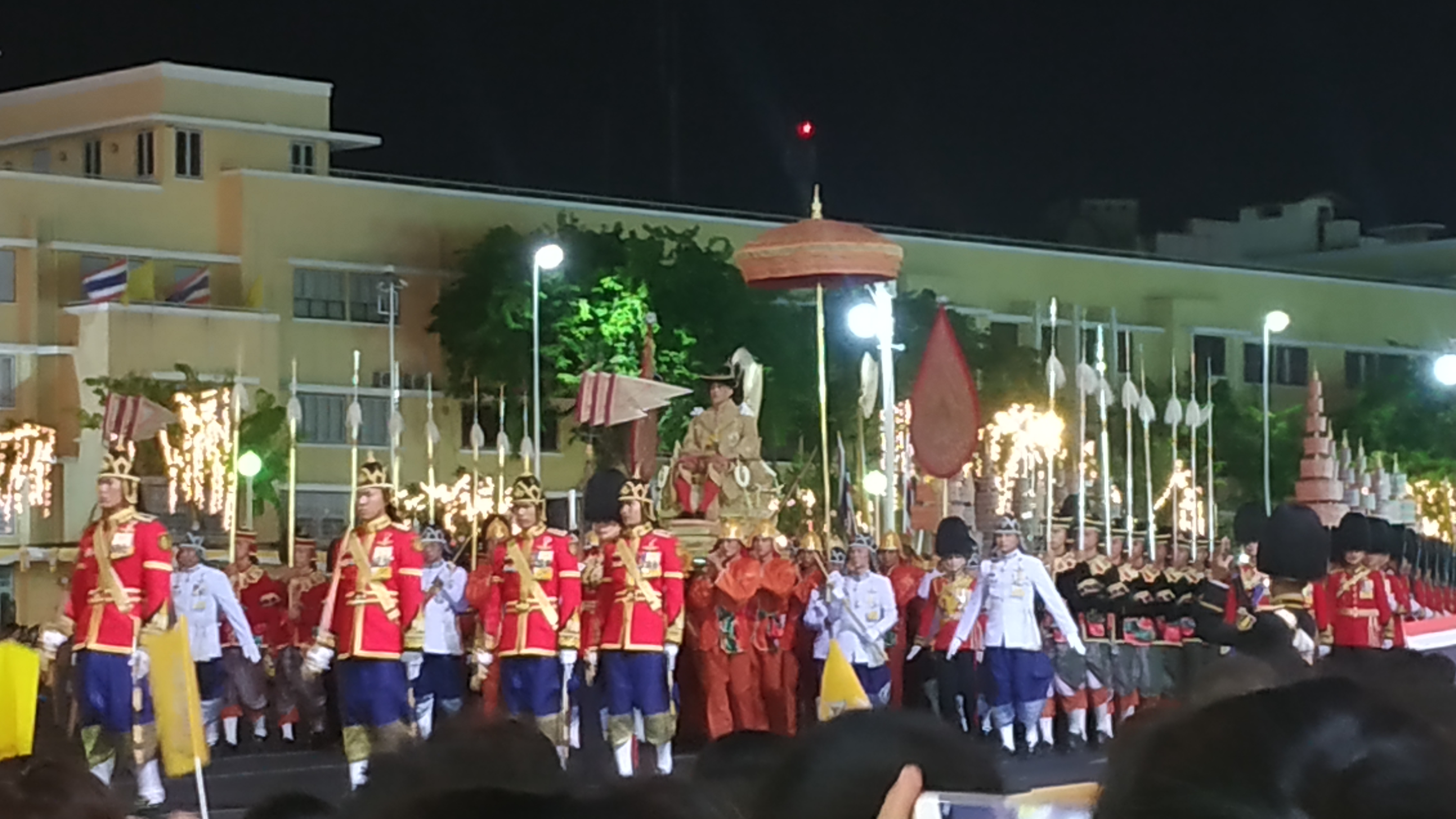
Coronation of Vajiralongkorn
Sixty-nine years had passed since the last coronation. When Vajiralongkorn, Rama X, was crowned king of Thailand on 4 May 2019 at the Grand Palace in Bangkok, the elaborate Brahmanical and Buddhist rites that unfolded had not been performed since his father Bhumibol Adulyadej's coronation in 1950. The rituals were ancient, but the audience was modern -- for the first time in Thai history, the coronation was broadcast live on television and streamed on YouTube and Facebook, allowing millions around the world to witness a ceremony that had previously been seen only by those inside palace walls.
Water from Every Province
The preparations began nearly a month before the coronation itself, anchored in a ritual that symbolically gathered the entire kingdom. On 6 April 2019 -- Chakri Day, honoring the founding of the dynasty -- sacred water was collected from sources in all 76 provinces and Bangkok. Buddhist monks in major temples consecrated the water over the following days. Provincial governors and temple abbots oversaw the gatherings, and the collected waters were formally transported to Bangkok by 18 April. This was not decorative pageantry. In Thai royal tradition, coronation water carries deep significance: the monarch is ritually bathed and anointed with water drawn from across the realm, symbolizing the consent and spiritual participation of the entire nation in the sovereign's authority. The water would be used in the purification and anointing ceremonies on the coronation day itself.
Ancient Rites in a Modern Palace
Vajiralongkorn ascended the throne on 13 October 2016, the day his father died, at the age of 64. He accepted the formal accession invitation from Prem Tinsulanonda, president of the Privy Council, on 1 December 2016. But the coronation was deliberately delayed -- an appropriate mourning period had to pass after King Bhumibol's death and the elaborate royal funeral that followed, and the ceremony itself required years of planning. The coronation drew on Brahmanical and Buddhist traditions that the Chakri dynasty has maintained since the late 18th century. The rites involved investiture of royal regalia, anointment with the sacred waters, and the formal assumption of the full royal title. Television cameras captured what earlier generations experienced only through royal proclamations: the solemnity of rituals performed inside halls that tourists normally see only from outside roped barriers.
A Balcony Address and 300 Drones
On 6 May, two days after the coronation ceremonies, the king granted a public audience from the main balcony of Suthaisawan Prasat Pavilion Hall in the Grand Palace. Prime Minister Prayut Chan-o-cha delivered a loyal address on behalf of the assembled crowds, government officials, and armed forces. The king then addressed the nation on the prospects of his reign. Later that evening, a drone exhibition at Sanam Luang featured 300 drones -- a contemporary flourish against the backdrop of the 18th-century royal plaza. The following day, 7 May, brought an elephant parade around the streets surrounding the Grand Palace. Organized by the Ayutthaya Elephant Palace and Royal Kraal Foundation, eleven elephants and their handlers marched along Sanam Chai Road, evoking the Ayutthaya and Thonburi periods when royalty rode elephants through the old city. The Rice Department released five new rice varieties in honor of the coronation, continuing a tradition begun by Chulalongkorn.
A Kingdom Watching Together
What made this coronation distinct from its predecessors was not the rituals -- those followed patterns centuries old -- but the scale of witness. The Television Pool of Thailand broadcast the ceremonies in Thai and English. Thai PBS and NBT English streamed the events on YouTube and Facebook, creating what was effectively the first globally accessible Thai coronation. For a monarchy that has historically conducted its most sacred ceremonies behind palace walls, the decision to broadcast represented a significant shift. Viewers across Thailand and around the world watched the investiture in real time, transforming a ceremony rooted in mystical Brahmanical tradition into a shared national experience mediated by smartphone screens and social media feeds. The Grand Palace, built in 1782 when Rama I founded both the Chakri dynasty and the city of Bangkok itself, served once again as the stage where Thailand's oldest institutions meet its newest technologies.
From the Air
The coronation took place at the Grand Palace complex, located at 13.7501N, 100.4920E on Rattanakosin Island in central Bangkok. The palace's white walls, golden spires, and elaborate rooflines are unmistakable from the air, occupying a large compound along the east bank of the Chao Phraya River. Sanam Luang, the open field used for the drone exhibition, is directly north. Best viewed at 2,000-3,000 feet. Nearest airport: Don Mueang (VTBD) approximately 15 nm north. Suvarnabhumi (VTBS) approximately 18 nm east-southeast.