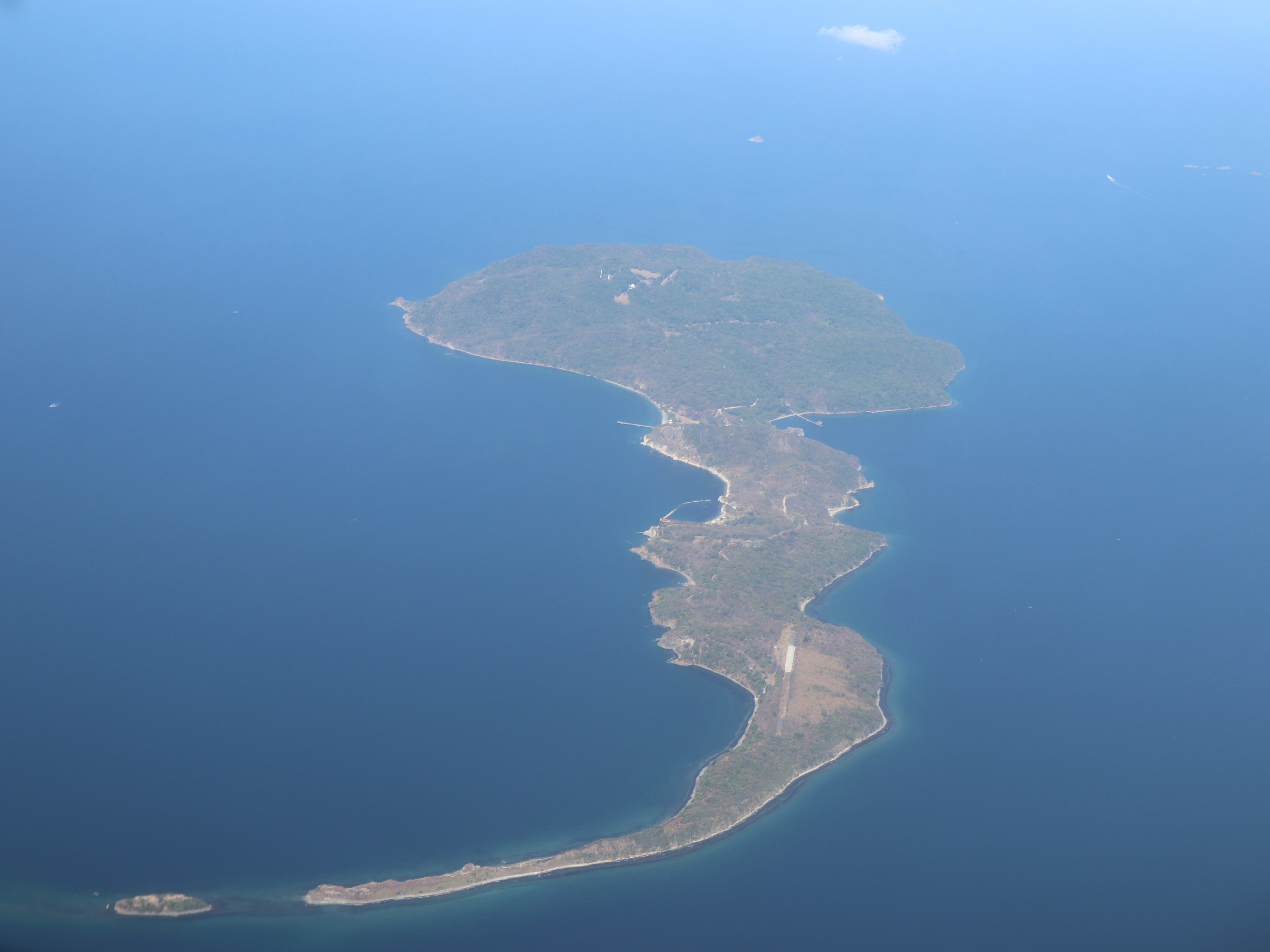
Corregidor
The name comes from the Spanish word corregir, meaning to correct. Under colonial rule, every ship entering Manila Bay was required to stop at Corregidor and have its documents checked and corrected before proceeding to port. The island was customs house, signal station, prison, and fortress all at once, a bureaucratic chokepoint backed by cannon. Four centuries later, the word still fits. Corregidor corrects the comfortable distance most people keep from the past. Walking its shattered batteries and tunnel complexes, there is no abstracting away what happened here.
The Island as Gatekeeper
Corregidor sits 48 kilometers west of Manila at the entrance to the bay, a tadpole-shaped island roughly six kilometers long. Together with Caballo Island it divides the entrance into the Boca Chica and Boca Grande, the narrow and wide channels that funnel all maritime traffic toward one of Asia's great natural harbors. The western head of the island, known as Topside, rises steeply and once bristled with coastal artillery. Bottomside, the narrow neck, connects it to the Tail End, where an airstrip and memorials now occupy the flatter ground. The Spanish recognized its value in 1570, when Miguel Lopez de Legazpi anchored here during his campaign to establish Manila as the colonial capital. For the next three centuries, Corregidor watched over the bay, warning Manila of approaching fleets by signal fire.
Pirates, Privateers, and Galleons
Corregidor's waters have seen more than customs inspectors. In November 1574, the Chinese pirate Limahong anchored a fleet of 65 vessels and 3,000 men between the island and Mariveles, then launched two attacks on Manila. Both failed against the defense led by Captain Juan de Salcedo. Twenty-six years later, during the Eighty Years' War between the Netherlands and Spain, Dutch Admiral Olivier van Noort used the island's surroundings as an anchorage for his ships, the Mauritius and Eendracht, raiding Spanish commerce along the sailing route to Manila. The Spanish counterattack cost them their own flagship, the galleon San Diego, whose extra cannon made her top-heavy and sank her. But they captured the Eendracht, and van Noort retreated with a single ship and 45 surviving men, becoming the first Dutchman to circumnavigate the globe in the process.
Seventy-Two Days Under Fire
When the Japanese invaded the Philippines in December 1941, Corregidor became the last stronghold. General Douglas MacArthur commanded from the Malinta Tunnel, a massive underground complex that sheltered the military high command, a field hospital, and the Philippine government. President Manuel Quezon was evacuated by submarine on February 20, 1942. MacArthur followed on March 11, departing by PT boat under orders from President Roosevelt, famously declaring he would return. Lieutenant General Jonathan Wainwright took command of what remained. After Bataan fell on April 9, Japanese artillery turned its full weight on the island. On May 4 alone, more than 16,000 shells struck Corregidor. Japanese aircraft flew 614 missions, dropping 1,701 bombs totaling 365 tons of explosive. Battery Geary, with its eight 12-inch mortars, was destroyed when a 240mm shell penetrated a magazine, blowing one mortar 150 yards from its position. Wainwright surrendered on May 6, ending organized resistance in the Philippines.
The Return
MacArthur kept his promise. On February 16, 1945, the 503rd Parachute Regimental Combat Team dropped onto Corregidor's Topside in one of the war's most daring operations. The only viable drop zones were a former parade ground and a golf course, both barely adequate. Each C-47 had to make two or three passes to unload its paratroopers onto these tiny targets, and stronger winds than expected drove many soldiers into wooded slopes, ruined buildings, and gun batteries. The injury rate reached 25 percent. One group of paratroopers landed directly on an observation post that included the Japanese commander, killing him. An amphibious assault hit the south shore two hours later. The Japanese garrison, numbering around 5,000 rather than the estimated 850, fought with suicidal determination. The battle for the island lasted ten days, but the Americans and Filipinos held the high ground from the first morning.
What the Light Remembers
Today Corregidor is a national shrine and tourist destination. Most of the war-ravaged buildings have been left as they were, unreconstructed ruins standing in reverence to those who died. On Topside, the Pacific War Memorial rises at the island's highest point, a domed rotunda completed in 1968 at a cost of three million dollars. Its design holds a quiet precision: sunlight passes through the dome's oculus and falls on the central altar, landing directly on it at exactly 12 noon on May 5, the anniversary of the surrender. Behind the memorial stands the Eternal Flame of Freedom, a 40-foot Corten steel sculpture by Aristides Demetrios. In the Malinta Tunnel, an audio-visual presentation created by National Artist Lamberto V. Avellana recreates the events that unfolded in its corridors. The ruins, the memorials, and the tunnel all say the same thing: what happened here should not be abstracted away.
From the Air
Located at 14.386N, 120.573E at the entrance to Manila Bay, 48 km west of Manila. The island is tadpole-shaped, roughly 6 km long, oriented east-west. Topside (western head) rises steeply and is the highest point. Look for the narrow Bottomside connecting to the flatter Tail End with its airstrip (Kindley Field). Nearby islands include Caballo to the south. Nearest major airport: Ninoy Aquino International (RPLL/MNL). Fort Drum on El Fraile Island is visible as a concrete battleship shape to the south. The ruins of batteries and the Pacific War Memorial dome are visible on Topside.