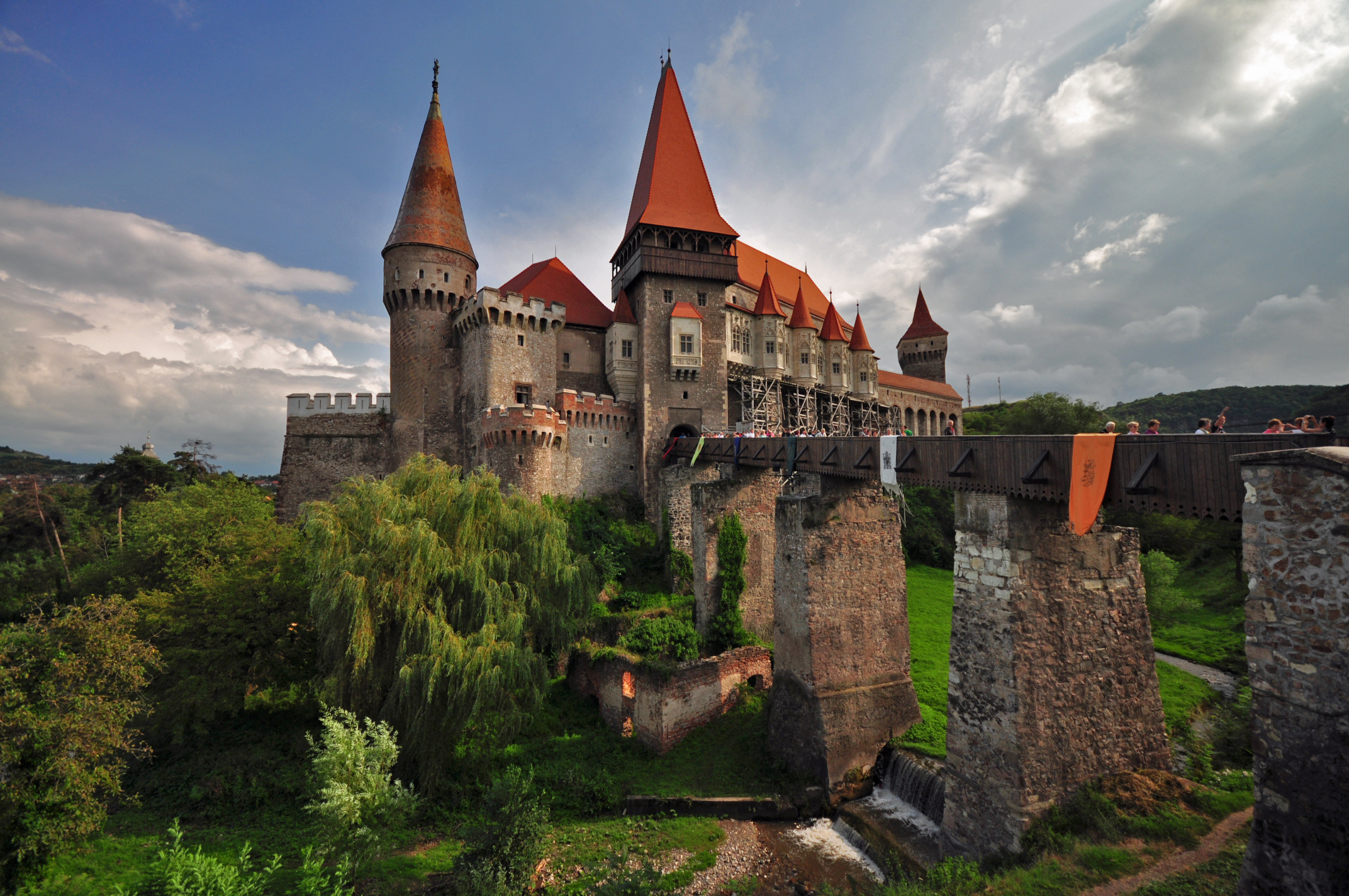
Corvin Castle
The castle's last defense tower is called Neboisa -- "Don't be afraid" in Serbo-Croatian. It is an odd name for a tower in a fortress that once imprisoned Vlad the Impaler. Corvin Castle rises from a rock above the Zlasti River in Hunedoara, Romania, a Gothic-Renaissance sprawl of tall towers, bastions, colored roofs, and stone-carved balconies that ranks among the largest castles in Europe. Its builders, the Hunyadi family, took their later name Corvinus from the raven on their coat of arms. Inside the castle's Mantle wing, a painting still depicts the legend: a raven carrying a golden ring, the origin story of a dynasty that shaped the fate of medieval Hungary.
A Father's Gift, a Son's Ambition
The story begins in 1409, when King Sigismund of Luxembourg granted the estate of Hunedoara to Woyk, a minor nobleman. His son, John Hunyadi, would become one of the most powerful men in Europe. Elected regent-governor of Hungary by the Diet in 1446, Hunyadi transformed his father's modest keep into something far more ambitious. Construction began that same year on what would become Corvin Castle, built on the foundations of an older fortification erected by Charles I of Hungary. The castle's three great spaces -- the Knight's Hall for feasts, the Diet Hall for ceremonies, and the sweeping circular stairway -- were decorated with marble and designed to project power. Hunyadi died in 1456, and work stalled. His son Matthias Corvinus commissioned the Matia Wing starting in 1458. By 1480, construction ceased, and the castle was already recognized as one of the most impressive buildings in Eastern Europe.
Towers Named for War and Silence
Walk the castle today and you encounter architecture as biography. The Buzdugan Tower, named for a type of mace, was built purely for defense, its exterior decorated with geometric motifs that made a military structure beautiful. The Capistrano Tower honors Giovanni da Capistrano, the Franciscan friar who fought alongside Hunyadi at the 1456 Siege of Belgrade. The Deserted Tower and the Drummers' Tower served darker purposes -- both were used as prisons. The castle features a double wall for enhanced fortification and mixes rectangular and circular towers, an architectural innovation for Transylvania at the time. In the 17th century, new owners added the White Tower and the Artillery Tower for military use, plus a two-level palace facing the town. The result is a structure that reads like a geological cross-section of Transylvanian history, each era depositing its own layer of stone and purpose.
The Impaler in the Dungeon
Tourist guides will tell you that Vlad the Impaler -- the Wallachian prince whose reputation inspired Bram Stoker's Dracula -- was held prisoner here by John Hunyadi. The connection to Stoker's novel is tenuous; the author was apparently unaware of the castle's link to Vlad. But the association has proven irresistible. The 2018 horror film The Nun used Corvin Castle as a filming location, and Robert Eggers' 2024 Nosferatu remake used the castle for exterior wide shots -- though like Werner Herzog's 1979 version, most of the film's castle scenes were shot at Pernstejn Castle in the Czech Republic. In the Diet Hall, painted medallions depict rulers of Wallachia and Moldavia, including Matei Basarab and Vasile Lupu. History and legend blur here in ways the Hunyadi family might have appreciated -- they understood the power of a good story, starting with the raven.
Fire, Neglect, and Romantic Reimagining
What visitors see today is not entirely medieval. A disastrous fire and decades of total neglect left the castle in ruins by the 19th century. The restoration that followed was, by scholarly consensus, more romantic than faithful. Critics noted that modern architects "projected to it their own wistful interpretations of how a great Gothic castle should look." The result is a castle that is part authentic medieval fortress, part Victorian fantasy of what a Gothic castle should be -- which, paradoxically, makes it all the more compelling as a destination. In 2021, approximately 276,000 tourists visited Corvin Castle, drawn by its scale, its atmosphere, and its layered identity as military stronghold, noble residence, prison, film set, and national symbol. Romania counts it among the Seven Wonders of the country, a designation that captures both its grandeur and its hold on the popular imagination.
From the Air
Located at 45.75N, 22.89E in Hunedoara, Romania. The castle is a highly visible Gothic structure perched on a rock outcrop above the Zlasti River, easily identifiable from the air by its cluster of tall towers and colored rooftops. It sits in the Jiu Valley industrial corridor. Nearest airport is Sibiu International (LRSB), approximately 100 km east. Deva, with its hilltop fortress ruins, is about 15 km north along the Mures River valley.