Cossack, Western Australia
The town has two names now. Official maps show nothing — the name Cossack was once erased from signs and removed from state records, though the stone buildings remained, which was inconvenient for erasure. The Ngarluma people who have lived here for tens of thousands of years know the place as Bajinhurrba. When colonial settlement arrived in the 1860s, the first settler who landed his stock at the mouth of the Harding River named it Tien Tsin, after the barque that carried him. A governor's ship gave it the third name, Cossack. Now the Ngarluma and Yindjibarndi Foundation manages the former townsite, and visitors can sleep in the heritage buildings by booking through them.
The Pearl Rush
Cossack was the cradle of Western Australia's pearling industry. In the 1860s, small boats worked the pearl shell beds off Port Walcott using Aboriginal labour — women and children among them — to dive. By early 1869, fourteen vessels worked the area; within a few years there were up to 80 luggers. The industry's wealth came at a human cost it never fully accounted for. By 1895, when 57 vessels operated from Cossack, the crew manifests show 989 Malay workers and 493 Aboriginal people — the raw numbers of an industry that crossed the Pacific and Indian Oceans to find bodies willing or compelled to do dangerous underwater work. The pearling also drew Japanese and Chinese workers in sufficient numbers that Cossack developed a 'Chinatown' quarter. When an 1881 cyclone beached or sank every vessel in operation, the fleet rebuilt. In 1886, the industry shifted north to Broome, following richer beds.
Stone Buildings, Empty Streets
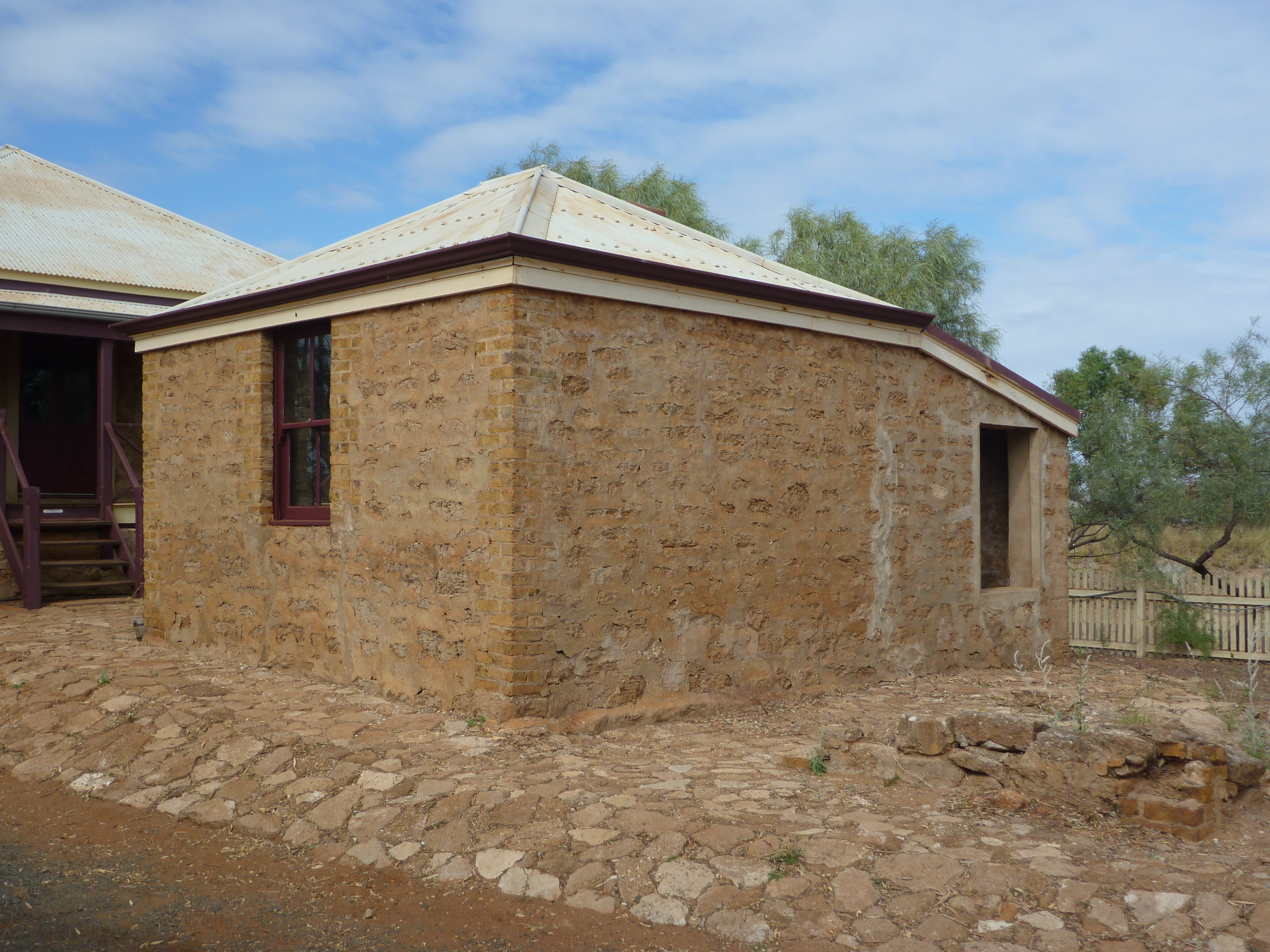
Cossack's main buildings were constructed in the 1880s and 1890s, when the town briefly thrived: a customs house and bond store, a courthouse, a post and telegraph office, a bakehouse, a police lockup. Two hotels served the population — the Weld, named after the governor, and the White Horse, opposite the wharf. The harbour, which seemed adequate for the shallow-drafted luggers of the pearl fleet, proved useless for the deeper vessels of the early twentieth century. Between 1902 and 1904 a jetty was built at Point Samson, and in 1910 the port moved there entirely. The municipality of Cossack was dissolved. The buildings stayed, slowly surrendering to the elements. Many are now listed by the National Trust. The former courthouse functions as a museum. The customs house is a café.
The Leprosarium
In 1913, a leprosarium was established on the far side of the Harding River from the townsite. It operated under the Aborigines Act 1905, under which the Chief Protector of Aborigines had authority to arrest and send any Indigenous person suspected of having leprosy or other infectious diseases. Hundreds were sent to Cossack this way, cut off from their families, treated differently from non-Indigenous patients: forced to build their own huts and undertake manual labour constructing paths, while non-Indigenous patients received decent accommodation. The leprosarium moved to Darwin in 1931 with its remaining 17 patients. What the building embodied — the state's power to detain Aboriginal people under the guise of public health — was not exceptional for its time, which is the disturbing point. It was policy.
The Cemetery
Cossack's small cemetery contains two precincts: European and Japanese. Pearling was dangerous work. Many divers died at sea. Those buried in the Japanese precinct were mostly divers and pearl-industry workers; others, including many Aboriginal people, were lost at sea and have no marker anywhere. The first burial recorded in the cemetery took place in 1869, when a man died walking toward Port Walcott in January and was buried where he fell. The last recorded interment was 1915. Among those buried there is William Shakespeare Hall — a name that feels improbable in a remote coastal cemetery in Western Australia, but there it is, on a headstone in the dust.
Coming Back
Since 2021, the Ngarluma and Yindjibarndi Foundation has managed and operated the Cossack townsite. Visitors can camp there, or book a stay inside the heritage buildings. The Reader Head Lookout, past the townsite, offers sweeping views of the surrounding coastline and inlet. The area remains an important place for fishing and hunting for the Ngarluma, who have always understood the Harding River mouth as a food source. There are ancient petroglyphs in the area, part of the same extraordinary rock art tradition found across the Burrup Peninsula. Cossack offers something increasingly rare: a site where colonial history has not been sanitised, where the buildings and the cemetery and the history of the leprosarium can be encountered in the same afternoon.
From the Air
Cossack lies at approximately 20.68°S, 117.19°E on Butcher Inlet at the mouth of the Harding River, Pilbara coast of Western Australia. From altitude the townsite is a small cluster of stone buildings near the water, with the inlet visible to the north and the low scrub of the peninsula surrounding it. Nearest airport: Karratha (YPKA), approximately 35 km to the west. The coastal terrain is flat; approach from the sea side gives the best orientation to the inlet geography.