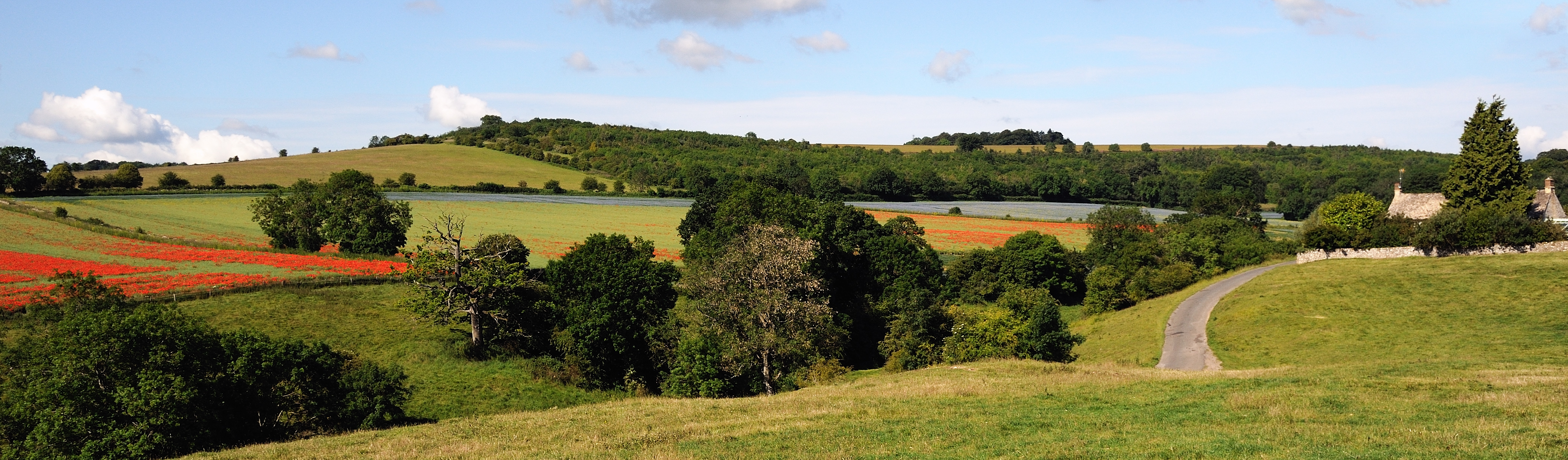
Cotswolds
The stone gives the Cotswolds its color - a warm, golden limestone that glows amber in afternoon light and silver in rain. Quarried from the hills for centuries, it built the villages, the grand manor houses, the medieval 'wool churches' funded by merchants grown rich from fleece, and the dry-stone walls that stitch the landscape into a patchwork of green and gold. Designated an Area of Outstanding Natural Beauty in 1966, the Cotswolds stretch 100 miles from just south of Stratford-upon-Avon to the outskirts of Bath, a rolling landscape that many consider the archetypal English countryside - and that wealthy Londoners have been claiming as their own since the motorcar made escape possible.
Wool and Stone
During the Middle Ages, the Cotswolds grew prosperous from wool. The flocks grazing these gentle hills produced fleece prized across Europe, and the merchants who traded it poured their wealth into churches - grand structures far larger than their villages required, monuments to both God and commerce. These wool churches remain, their perpendicular Gothic towers rising from villages of a few hundred souls. The same prosperity built manor houses that still dot the landscape: Snowshill Manor, Sudeley Castle, Berkeley Castle, William Morris's beloved Kelmscott. The Arts and Crafts movement found its home in Chipping Campden, where Morris's disciples sought to revive traditional craftsmanship against the tide of industrialization. Their legacy persists in the artisan studios of the Stroud Valleys.
Villages of Honey Stone
The village names read like poetry: Bourton-on-the-Water, Stow-on-the-Wold, Moreton-in-Marsh, Chipping Campden. 'Chipping' comes from the Old English for market; these were trading towns when wool meant wealth. Bourton-on-the-Water earns the title 'Venice of the Cotswolds' for the River Windrush flowing past its tea rooms, though the comparison flatters neither city. Stow-on-the-Wold, at the junction of ancient roads, hosts antique shops in buildings that have seen commerce for eight centuries. Broadway, despite its American-sounding name, is quintessentially English, its long main street leading to Broadway Tower, the folly where William Morris sometimes stayed. The villages are neither museum nor theme park - people live here, farm here, commute to Oxford and London - yet they feel preserved, as if modernity simply decided to flow around rather than through them.
The Cotswold Way
The Cotswold Way runs 102 miles from Chipping Campden to Bath, following the escarpment that marks the region's western edge. Designated a National Trail in 1998, it offers views across the Severn Valley to Wales, passing through villages where pubs serve local ales - Hook Norton's Old Hooky, Donnington from near Stow, Stroud Organic. The walking is gentle by British standards, the hills rolling rather than rugged, but the distances are real. Most hikers take a week, staying in village B&Bs that have hosted walkers since the motorcar brought Londoners seeking weekend countryside. For shorter walks, any village offers footpaths through sheep-dotted fields, past churches that have stood since the Crusades, to pubs that have served ale since the Reformation.
Oxford and Bath
The great cities anchor the Cotswolds at either end. Oxford, the City of Dreaming Spires, lies at the eastern edge - its colleges built from the same limestone, its influence stretching into market towns like Burford and Witney where students have sought weekend escape for centuries. Bath, at the southwestern corner, represents a different tradition: Roman spa, Georgian elegance, Baroque terraces climbing the hills in crescents of golden stone. Both cities offer trains from London in under two hours; both serve as gateways to the villages beyond. Gloucester and Cheltenham, with its literary and jazz festivals and the equestrian Gold Cup, mark the western border. The Cotswolds are not remote - they are woven into England's cultural fabric, accessible yet apart.
The Unchanging Landscape
Bill Bryson wrote that a car is the only way to see the Cotswolds, and for covering ground, he was right. Bus services are sparse - some villages see one bus daily, others one per week. But walking remains the truest way to experience the landscape: across fields where sheep have grazed since the Romans, past walls built by hands eight generations gone, into villages where the pub may have changed owners but the building hasn't changed character in 400 years. The area is safe, wealthy, beautiful in the particular English way that prizes understatement. Farmers' markets sell Gloucester cheese and Old Spot pork; antique shops line the high streets of Stow and Burford; the stone glows gold in afternoon light, and has for five centuries, and will for five more.
From the Air
Located at approximately 51.76°N, 1.89°W in south-central England. The Cotswolds span six counties, roughly 100 miles southwest to northeast from Bath to Stratford-upon-Avon. The escarpment along the western edge is visible as a distinct line where the hills drop to the Severn Valley. London Heathrow (EGLL) is 60nm southeast; Bristol (EGGD) is 30nm southwest; Birmingham (EGBB) is 50nm north. The patchwork of fields, honey-colored villages, and medieval churches is best appreciated from lower altitudes in clear conditions.