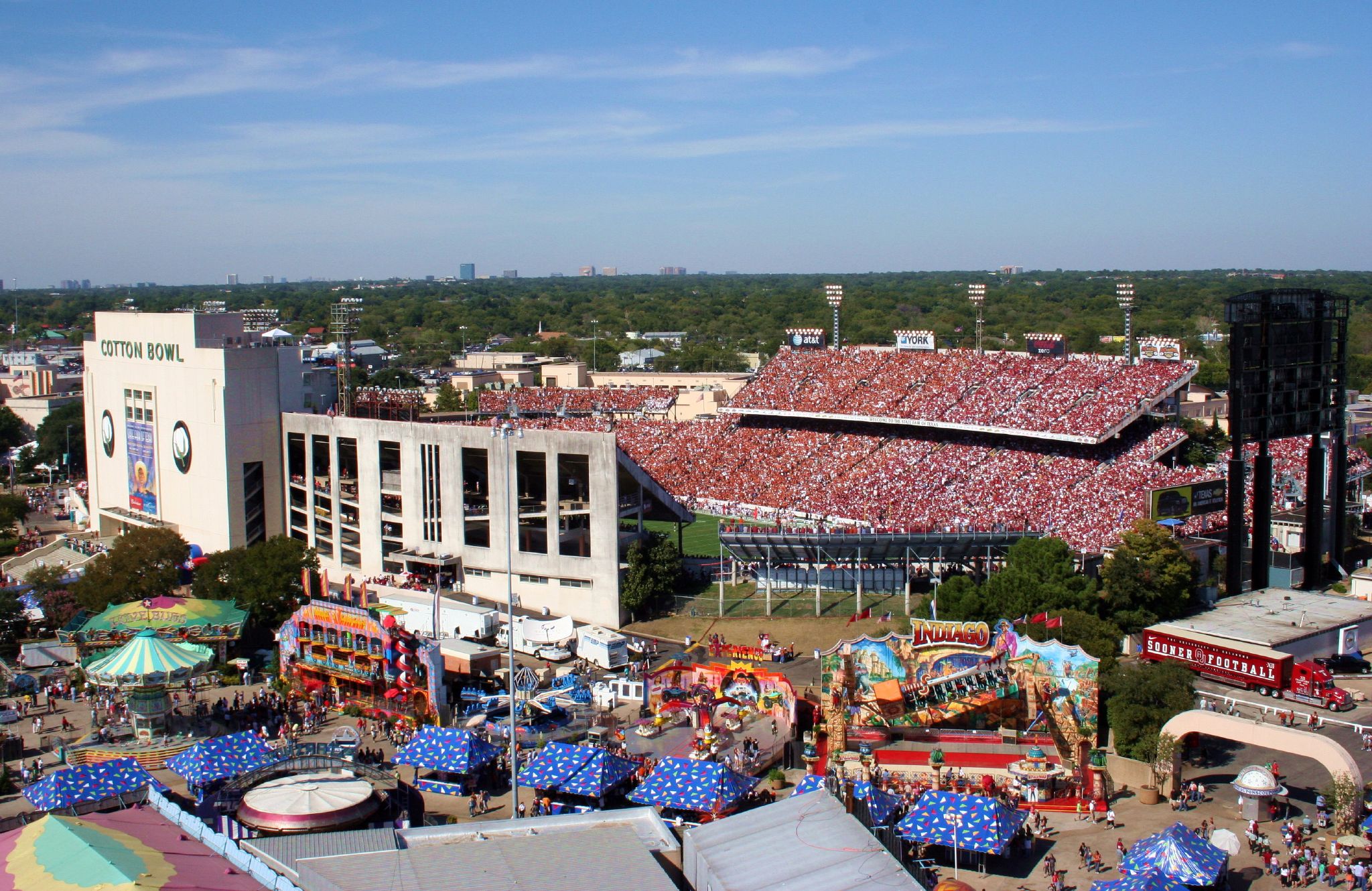
Cotton Bowl Stadium
In 1950, a Dallas baseball promoter hatched a scheme to break the Texas League attendance record: put Ty Cobb in a uniform and let him bat. The 63-year-old Georgia Peach agreed, and the other retired legends followed -- Dizzy Dean, Mickey Cochrane, Tris Speaker, Charlie Gehringer, Home Run Baker. On game day, 54,151 fans packed the Cotton Bowl to watch Cobb hammer balls into the stands, Dean walk the leadoff batter and get himself tossed in a staged ejection, and the whole spectacle unfold on a field built for football in the middle of a state fairground. The attendance record still stands. It was exactly the kind of improbable, oversized event this stadium was made for.
The House That Doak Built
Fair Park Stadium cost $328,000 when it was completed in 1930, a concrete horseshoe seating 45,507 on the grounds of the State Fair of Texas. For its first six years, it was simply where Dallas high schoolers played football. Then in 1936 it was rechristened the Cotton Bowl, and the following New Year's Day it hosted the first Cotton Bowl Classic. The stadium remained modestly sized until one player changed everything. SMU halfback Doak Walker drew such enormous crowds in the late 1940s that a second deck was added to the west side in 1948, boosting capacity to 67,000. The east side followed in 1949, pushing it to 75,504. The distinctive facade that still defines the stadium dates to this expansion. Walker, who won the Heisman Trophy in 1948, did not just fill the seats -- he literally built the upper decks.
Football's Revolving Door
The Cotton Bowl has served as home to more professional and college football tenants than perhaps any stadium in America. The ill-fated 1952 Dallas Texans of the NFL played four games there before going bankrupt and finishing their season as a traveling team based in Hershey, Pennsylvania. Eight years later, a new Dallas team arrived -- the Cowboys, who played their first 12 seasons in the Cotton Bowl from 1960 to 1971, including the 1966 NFL Championship Game against the Green Bay Packers. They shared the stadium with the AFL's Dallas Texans, whose owner Lamar Hunt eventually moved the franchise to Kansas City and renamed it the Chiefs. Every October, the Red River Rivalry between Texas and Oklahoma still splits the stadium down the 50-yard line, half burnt orange and half crimson, a tradition confirmed through 2036.
Where the World Played
In 1993, the Cotton Bowl ripped out the AstroTurf it had laid in 1970, widened the field, expanded the press box, and returned to natural grass -- all to satisfy FIFA's requirements for the 1994 World Cup. The stadium hosted six matches during that tournament, one of only nine venues across the United States. Soccer had deeper roots in the Cotton Bowl than many realized: the Dallas Tornado played there in 1967 and 1968, requiring a wider field that forced storm drains to be relocated. The Dallas Burn, a founding MLS franchise, called it home from 1996 to 2002. By 2024, Dallas Trinity FC -- a women's professional team -- played their first Cotton Bowl home match during their inaugural season, a friendly against FC Barcelona Femeni. And on New Year's Day 2020, 85,630 fans watched the Dallas Stars beat the Nashville Predators 4-2 in the NHL Winter Classic, the first outdoor hockey game ever held in a southern state and the second-highest attendance for any NHL game in history.
Rock and Roll Under the Texas Sun
On October 11, 1956, a 21-year-old Elvis Presley drew more than 27,000 people to the Cotton Bowl, setting a Texas record for outdoor concert attendance. Two decades later, the stadium became ground zero for Texas arena rock. The first Texxas Jam in July 1978 sold out at over 80,000 fans -- a crowd so large that organizers imposed capacity limits on every Jam that followed. Over the next decade, Aerosmith, Van Halen, Heart, Journey, Scorpions, Cheap Trick, and the Eagles all headlined summer shows inside the concrete bowl. The Rolling Stones played seven shows at the Cotton Bowl between 1975 and 2021. Eric Clapton chose it for his first three-day Crossroads Guitar Festival in 2004. From high school football under Friday night lights to Elvis in the afternoon heat to world championship drum corps, this stadium has held nearly every form of live spectacle Texas can produce.
A Stadium That Refuses to Retire
By the early 2000s, the Cotton Bowl Classic had moved to AT&T Stadium in Arlington, the Cowboys had long since departed, and the stadium's capacity had shrunk from its 1990s peak. Yet the Cotton Bowl kept reinventing itself. Temporary end-zone stands boosted seating to 90,000 for Red River Rivalry games. A $57 million renovation in 2008 expanded fixed capacity to 92,100. In December 2023, the city of Dallas committed an estimated $140 million -- the single largest investment in the stadium's history -- to a two-year renovation ensuring the Texas-Oklahoma game stays through 2036. Nearly a century after its construction, the Cotton Bowl sits in Fair Park surrounded by Art Deco exhibition halls, Big Tex, and the smell of Fletcher's corny dogs, still drawing crowds for events its builders in 1930 could never have imagined.
From the Air
Located at 32.779°N, 96.760°W in Fair Park, Dallas. The stadium's distinctive oval shape and white superstructure are visible from altitude against the surrounding fairground buildings. Best viewed from 2,000-4,000 ft AGL. Nearest airports: KDAL (Dallas Love Field, 6 nm NW), KDFW (Dallas/Fort Worth International, 22 nm NW). The Fair Park complex and the Cotton Bowl sit just southeast of downtown Dallas, identifiable by the cluster of Art Deco buildings and large parking areas.