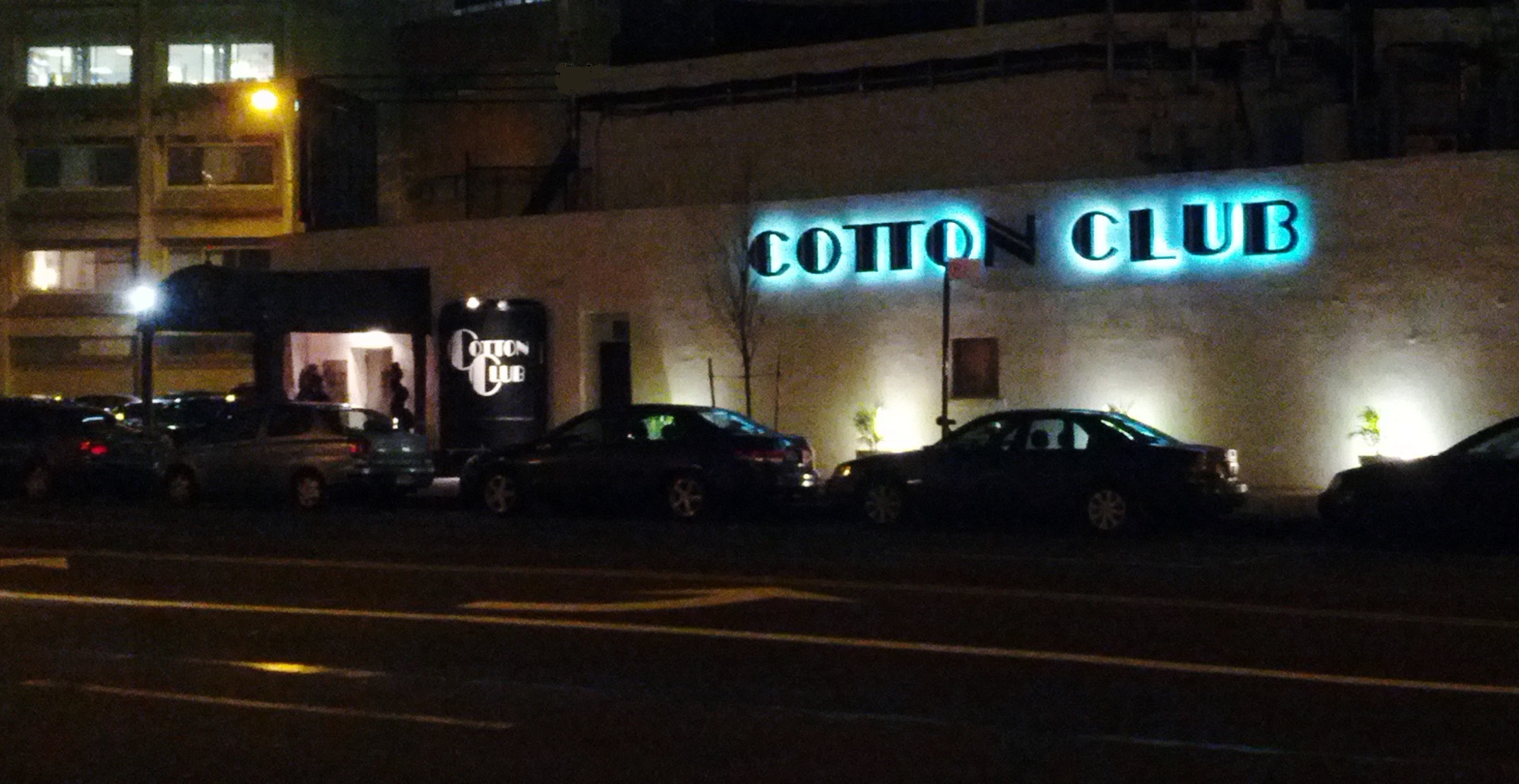
The Cotton Club
Langston Hughes called it "a Jim Crow club for gangsters and monied whites." He was right. The Cotton Club, perched at the corner of 142nd Street and Lenox Avenue in the heart of Harlem, featured the greatest Black musicians of the twentieth century performing for audiences that, until 1935, would not admit a single Black patron through the front door. Duke Ellington, Cab Calloway, Louis Armstrong, Billie Holiday, Lena Horne -- they all took the stage here. And from that stage, through live radio broadcasts on CBS and NBC, the sound of Harlem poured into millions of American living rooms for the first time. The Cotton Club was simultaneously one of the most important cultural institutions of the Jazz Age and one of its cruelest ironies.
A Boxer, a Bootlegger, and a Beer
The building began its nightlife career in 1920, when Jack Johnson, the first Black heavyweight boxing champion, rented the upper floor of a building at 644 Lenox Avenue and opened an intimate supper club called the Club Deluxe. Three years later, Owney Madden -- a bootlegger and gangster freshly released from Sing Sing prison -- acquired the club and renamed it the Cotton Club. Madden wanted a venue to sell his signature beer, Madden's No. 1, to the Prohibition crowd, and Harlem was the ideal location: enforcement was lax, the nightlife was electric, and wealthy white New Yorkers were already making the trip uptown for entertainment. Johnson stayed on as manager, but the club was Madden's operation. The interior was dressed in plantation imagery -- log cabins, cotton fields, a southern mansion backdrop. The performers were Black. The audience was white. The cover charge was steep. And the mob's protection meant the police left the Cotton Club alone, even after a 1925 raid briefly shuttered it for selling liquor.
Jungle Music on the Radio
Duke Ellington's orchestra began its residency at the Cotton Club in 1927, and the engagement transformed American music. The club's management marketed Ellington's muted brass growls and plunger-mute effects as "jungle music," a label designed to feed white fantasies of exotic Africa. Ellington was expected to compose accordingly, and the repertoire filled with titles meant to conjure the primordial. But the music itself was revolutionary -- sophisticated orchestral arrangements that pushed the boundaries of what a dance band could do. Ellington recorded more than 100 compositions during this period. More critically, the Cotton Club's live radio broadcasts, first on WHN, then on WEAF, and after September 1929 on the NBC Red Network, carried Ellington's sound nationwide. He became the first Black bandleader to reach a mass American audience through radio. The first revue his orchestra performed was called the "Creole Revue," featuring Adelaide Hall, who had just recorded the worldwide hit "Creole Love Call" with Ellington. The club gave Ellington something rare for a touring bandleader: a permanent laboratory where he could experiment with overtures, transitions, accompaniments, and new orchestral textures night after night.
Tall, Tan, and Terrific
The Cotton Club's stage shows were lavish revues rivaling Broadway in ambition and budget, featuring singers, dancers, comedians, variety acts, and a house band. But rigid racial codes governed every aspect. Chorus girls were expected to be at least five feet six inches tall, light-skinned, and under twenty-one years old -- the club's slogan, "tall, tan, and terrific," made the colorism explicit. Black performers did not mix with the clientele; after the show, many went next door to a superintendent's basement at 646 Lenox, where they gathered over corn whiskey and peach brandy. Songwriters Dorothy Fields and Jimmy McHugh, along with Harold Arlen, wrote the songs for the revues. Cab Calloway's orchestra replaced Ellington's as the house band in 1931, and his scat-singing style made "hi-de-ho" a national catchphrase. Bill "Bojangles" Robinson earned $3,500 a week -- the highest salary ever paid to a Black entertainer in a Broadway production. Celebrity nights on Sundays drew George Gershwin, Mae West, Irving Berlin, Langston Hughes, and Judy Garland to the ringside tables.
The Doors Finally Open
In June 1935, the Cotton Club finally admitted Black patrons, opening its doors ahead of a Joe Louis fight gala. But the gesture came too late to save the original location. The Harlem race riot of 1935 forced the club to close, and it reopened the following year in a new space where Broadway meets Seventh Avenue in the midtown Theater District. The September 1936 opening was the most extravagant revue in the club's thirteen-year history, with Robinson and Calloway leading a cast of approximately 130 performers. The midtown venue blended old and new -- different decor, different crowd, but the same feel once a customer sat down. It was not enough. Rising rents, shifting musical tastes, and a federal investigation into tax evasion by Manhattan nightclub owners conspired to close the Cotton Club permanently in 1940. The Latin Quarter nightclub took over the Broadway space; the original Harlem building was demolished in 1989.
What the Music Left Behind
No plaque marks the original corner at 142nd and Lenox. The building is gone. But the recordings survive, and the legacy is tangled. Langston Hughes saw the Cotton Club for what it was -- a place where white strangers "were given the best ringside tables to sit and stare at the Negro customers like amusing animals in a zoo." He noted that smaller Black-owned cabarets in the neighborhood were crushed by the competition from a mob-backed club with famous entertainers and a large dance floor. The Cotton Club elevated Black art while degrading Black dignity. It gave Duke Ellington national exposure and creative freedom while requiring him to compose "jungle music" for white consumption. It paid performers well while barring them from the dining room. That contradiction -- genius flourishing under injustice -- defines not just the Cotton Club but the entire Harlem Renaissance, and its echoes have never fully faded.
From the Air
The Cotton Club's original location (40.819N, 73.937W) stood at the corner of 142nd Street and Lenox Avenue (now Malcolm X Boulevard) in Harlem, Upper Manhattan. The building was demolished in 1989. The intersection remains a major Harlem crossroads, identifiable from altitude as Lenox Avenue runs north-south through central Harlem. The second location was at Broadway and 48th Street in the midtown Theater District. Nearby airports: KLGA (LaGuardia, 8 nm E), KJFK (JFK, 14 nm SE), KEWR (Newark, 10 nm SW), KTEB (Teterboro, 8 nm NW). Best viewed at 2,000-3,000 ft AGL approaching from the northeast over the Harlem River.