Courrieres Mine Disaster
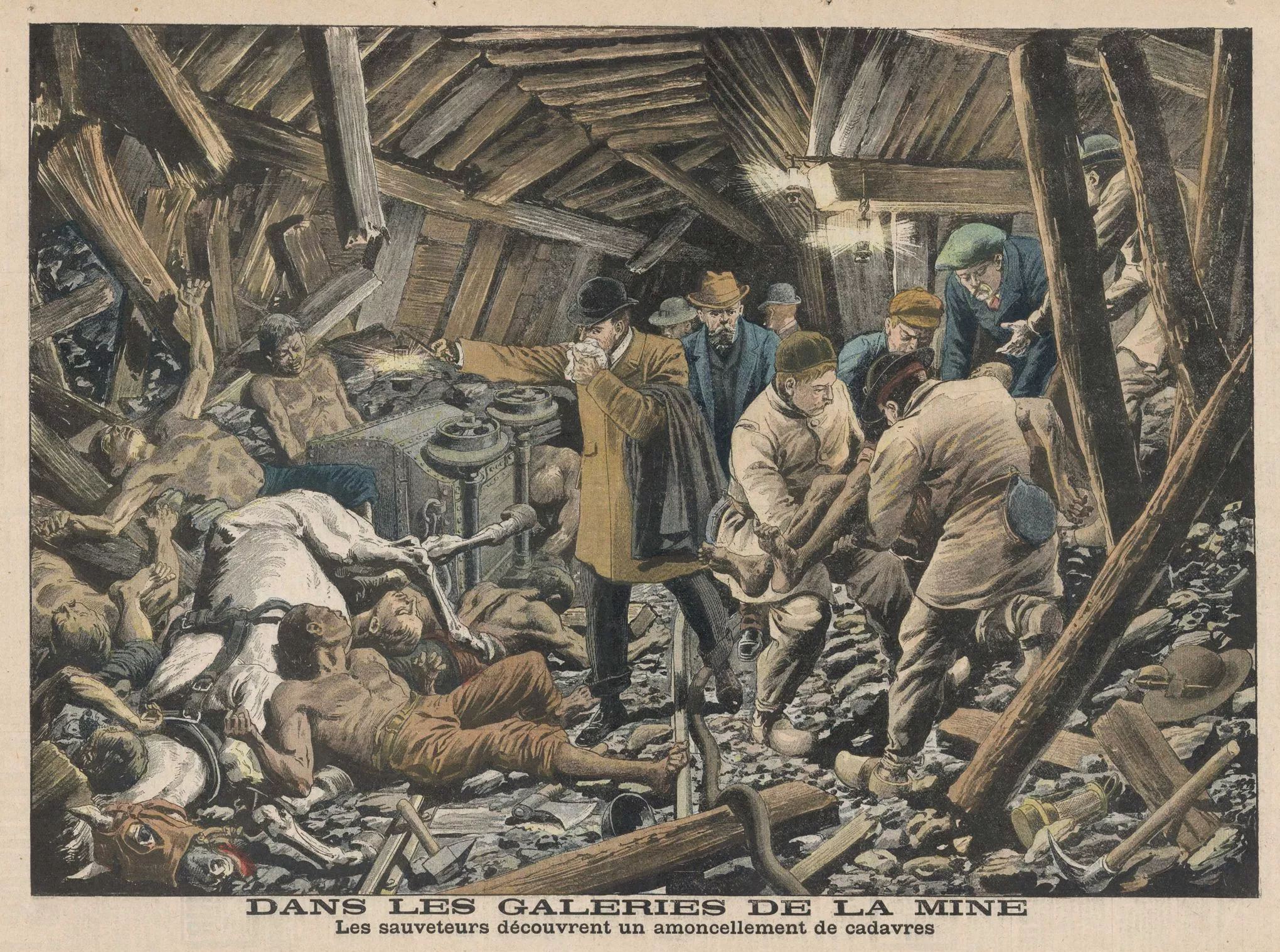
Shortly after 6:30 on the morning of Saturday, March 10, 1906, a sound like thunder rolled through the coal country east of Lens. At Shaft 3 of the Courrieres mine, the elevator cage was hurled to the surface, smashing the pit-head. At Shaft 4, windows and roofs blew outward. At Shaft 2, a cage was raised containing only dead or unconscious miners. One thousand and ninety-nine men would not come home. It remains the worst mining disaster in European history.
Fire in the Dark
The Courrieres mine, operated by the Compagnie des mines de houille de Courrieres, sprawled beneath the Pas-de-Calais countryside two kilometers east of Lens, about 220 kilometers north of Paris. The mine was unusually complex for its era, with multiple pitheads interconnected by underground galleries on several levels, creating a network of roughly 110 kilometers of tunnels. That very complexity, designed to facilitate rescue in case of accident, proved catastrophic. A coal dust explosion, likely ignited by either a mishap with mining explosives or the naked flame of a miner's lamp, swept through the entire interconnected system. Many workers used lamps with open flames rather than the more expensive Davy safety lamps, despite the ever-present risk of igniting methane gas. The General Inspector of Mines noted this in his report, but the exact trigger was never established with certainty.
Bark and Horsemeat
About five hundred miners reached the surface in the hours after the explosion, many severely burned and poisoned by mine gases. But hundreds more were trapped below. Rescue attempts began immediately but were hampered by a problem France had never confronted at this scale: the country had almost no trained mine rescue teams. Expert crews from Paris and from Germany did not arrive until March 12. The mine's tangled galleries created enormous obstacles, with debris blocking passage after passage. By April 1, only 194 bodies had been recovered. Accusations flew that the mining company was deliberately slowing the reopening of blocked shafts to prevent coalface fires and protect the coal seams. Among the survivors who emerged from the depths, some had stayed alive by eating bark stripped from the wooden crossbeams that braced the tunnels. Others survived on the flesh of a rotting mine horse. The dead came from the surrounding villages: 404 from Mericourt, 304 from Sallaumines, 114 from Billy-Montigny, 102 from Noyelles-sous-Lens.
Postcards from a Catastrophe
Courrieres was one of the first French disasters to be covered on a massive scale by the modern press. Lille, the regional capital barely forty kilometers away, had at least five daily newspapers whose reporters competed fiercely for details. Photographs could not yet be printed in newspapers for technical reasons, but were distributed as postcards, and the French sent an average of fifteen postcards per person in 1906. A postcard showing the thirteen survivors who had been pulled alive from the wreckage was available within nine days. In the newspaper L'Humanite, the socialist politician Jean Jaures wrote that the disaster was "a call for social justice that comes to the nation's representatives from the depths of the burning mines." A public relief fund, established by law just four days after the explosion, eventually raised 750,000 francs at a time when a miner's daily wage was less than six.
The Strike That Shook the Republic
The funerals began on March 13, during an unseasonal snowstorm. Fifteen thousand people attended. The anger of the mining communities was directed squarely at the companies that owned the concessions. Strikes began the next day in the Courrieres area and spread rapidly across the coalfields of the Pas-de-Calais and Nord departments. By March 18, the walkout had become a general strike. Minister of the Interior Georges Clemenceau visited the region twice, but according to L'Humanite, "no promises were kept." The number of strikers reached 46,000. The Courrieres disaster left a legacy that reached far beyond the coalfields. It exposed the lethal gap between industrial ambition and worker safety, reshaped French labor politics, and inspired the 1931 film Kameradschaft by G.W. Pabst, a dramatization of cross-border solidarity between French and German miners. The dead are not forgotten in the villages that lost them.
From the Air
Located at 50.416N, 2.898E in the Pas-de-Calais, 2 km east of Lens. The former mining landscape is now largely agricultural and residential, with scattered slag heaps (terrils) visible as conical hills. The Centre historique minier at nearby Lewarde preserves the mining heritage. Nearby airports: Lille-Lesquin (LFQQ, 30 km NE), Lens-Benifontaine (LFQL, 5 km W). The flat terrain of the Nord-Pas-de-Calais coalfield is distinctive from the air.