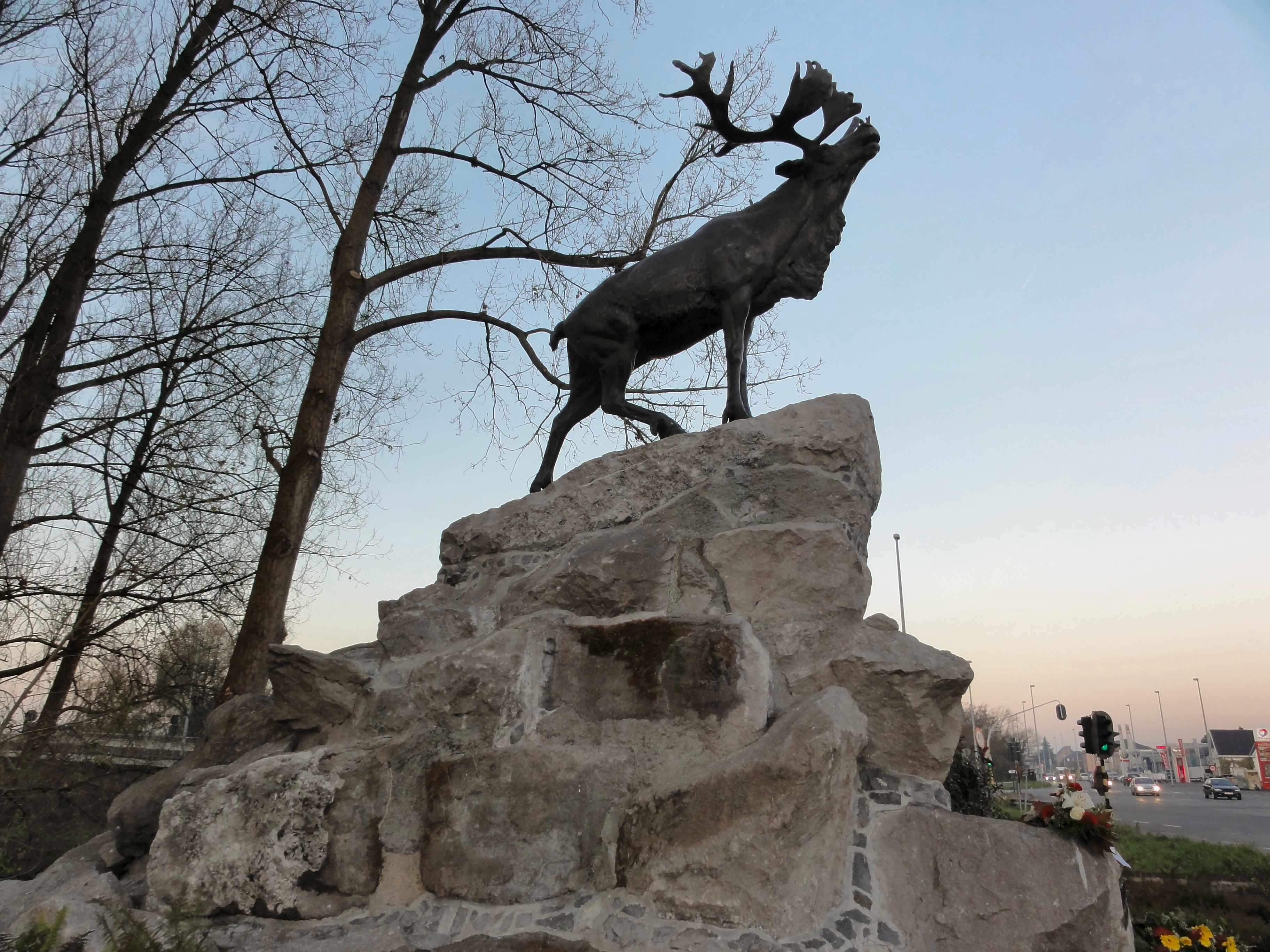
Courtrai Newfoundland Memorial
He was seventeen years old, born on a Newfoundland outport called Middle Arm where his father fished cod and his mother kept the house. He had lied about his age to join up - which was not unusual - and by 14 October 1918 he had been in the line long enough to know what a German machine gun emplacement looked like when it was about to open up on his platoon. Thomas Ricketts of the Royal Newfoundland Regiment did what came next without being ordered, and what came next won him the Victoria Cross at the youngest age any British Army combatant ever had. The bronze caribou on a granite cairn at the edge of Kortrijk faces the river where he and his battalion crossed, in the dark, on rafts, six days later. It looks toward the enemy. It always will.
Newfoundland in Flanders
The Dominion of Newfoundland in 1918 was not yet part of Canada and would not be until 1949. It was its own thing, fiercely so - a country of cod merchants, sealers, miners, and farmers, ruled from St. John's, attached to the British Crown by its own choice. When war came in 1914 the colony raised a single regiment, sent it overseas, and rebuilt it twice when it was nearly destroyed. The first destruction was at Beaumont-Hamel on 1 July 1916, the Somme's opening day, when 780 Newfoundlanders went over the top and only 68 answered the roll the next morning. The regiment rebuilt, fought again, and by autumn 1918 was attached to the 28th Infantry Brigade of the 9th (Scottish) Division, pushing east from Ypres in the last great Allied offensive of the war.
Passchendaele and the Flanders Position
September 1918 sent them back over ground their predecessors had bled for the year before. The Newfoundlanders helped retake parts of Passchendaele Ridge, lost in the German spring offensive, and broke through what the German command called the Flanders Position - the line of trenches and concrete pillboxes meant to anchor the Western Front for another winter. In two days of fighting they advanced fourteen and a half kilometres, an almost unthinkable distance by 1916 standards. The line was breaking. Behind it, German morale was breaking faster. Soldiers were surrendering in groups, then in companies. The war that everyone had assumed would last another year was about to end in weeks.
0535, 14 October 1918
The Battle of Courtrai opened at 5:35 in the morning. German field guns shelled the advancing infantry. Pillboxes hidden in ruined farms swept the open ground with machine guns. Somewhere in the storm, the Newfoundlanders' attack stalled. Tommy Ricketts, a Lewis gunner, was running ahead with his section leader to outflank a battery of field guns that was holding up the whole platoon. They ran out of ammunition. Ricketts, alone, doubled back across open fire to get more, brought it forward, and helped his section close on the position. By the end of the action his platoon had taken four field guns, four machine guns, and eight prisoners. By the end of the day the Newfoundlanders had captured eight field guns, ninety-four machine guns, and five hundred prisoners. Three hundred riflemen were fit for action the next morning. The rest were dead or wounded.
The Crossing of the Lys
The river itself held the advance for several days. The Germans were entrenched on the eastern bank, and the Lys at Kortrijk was wide enough and well-defended enough to be a serious obstacle. On the night of 19-20 October, the Newfoundlanders crossed by raft in the dark. They saw the sunrise on the far bank. It is impossible, a century later, to recover what that meant - to wake up alive on the east side of a river you had been told would be your grave. The German line in Belgium did not survive much longer. Three weeks later, on 11 November, the armistice was signed. Ricketts received his Victoria Cross from King George V at Sandringham. He went home to Newfoundland, became a pharmacist in St. John's, and died young, in 1967.
The Caribou Faces Forward
The Newfoundland government raised six caribou memorials overseas to mark where its regiment fought - four in France, one in Belgium, and one at Gallipoli. The British sculptor Basil Gotto designed them. Each statue stands on a cairn of Newfoundland granite, shipped from home, and each faces the direction in which the Newfoundlanders advanced. At Kortrijk the caribou looks east-northeast, toward Ghent and the river they crossed. Around its small park grow plants native to Newfoundland and Labrador - a quiet, deliberate kindness, soil from one cold place to soothe the bones of boys from another. The bronze plaque on the cairn reads simply: COURTRAI, 1918. The memorial is on the northwest side of the road to Ghent, about twenty-five metres from the city's ring road. People pass it daily. Most do not know what it cost.
From the Air
50.839°N, 3.285°E, on the northeast edge of Kortrijk in West Flanders, beside the N43 Gentsesteenweg near its junction with the R8 ring road and just north of the Lys/Leie River. Cruise at 1,500-2,500 ft for a clear view of the river meander where the 1918 crossing was made. Nearest airports: Kortrijk-Wevelgem (EBKT, ~6 km west) and Lille-Lesquin (LFQQ, ~30 km southwest). Flat Flemish farmland, with the Lys running roughly east-northeast toward Ghent.