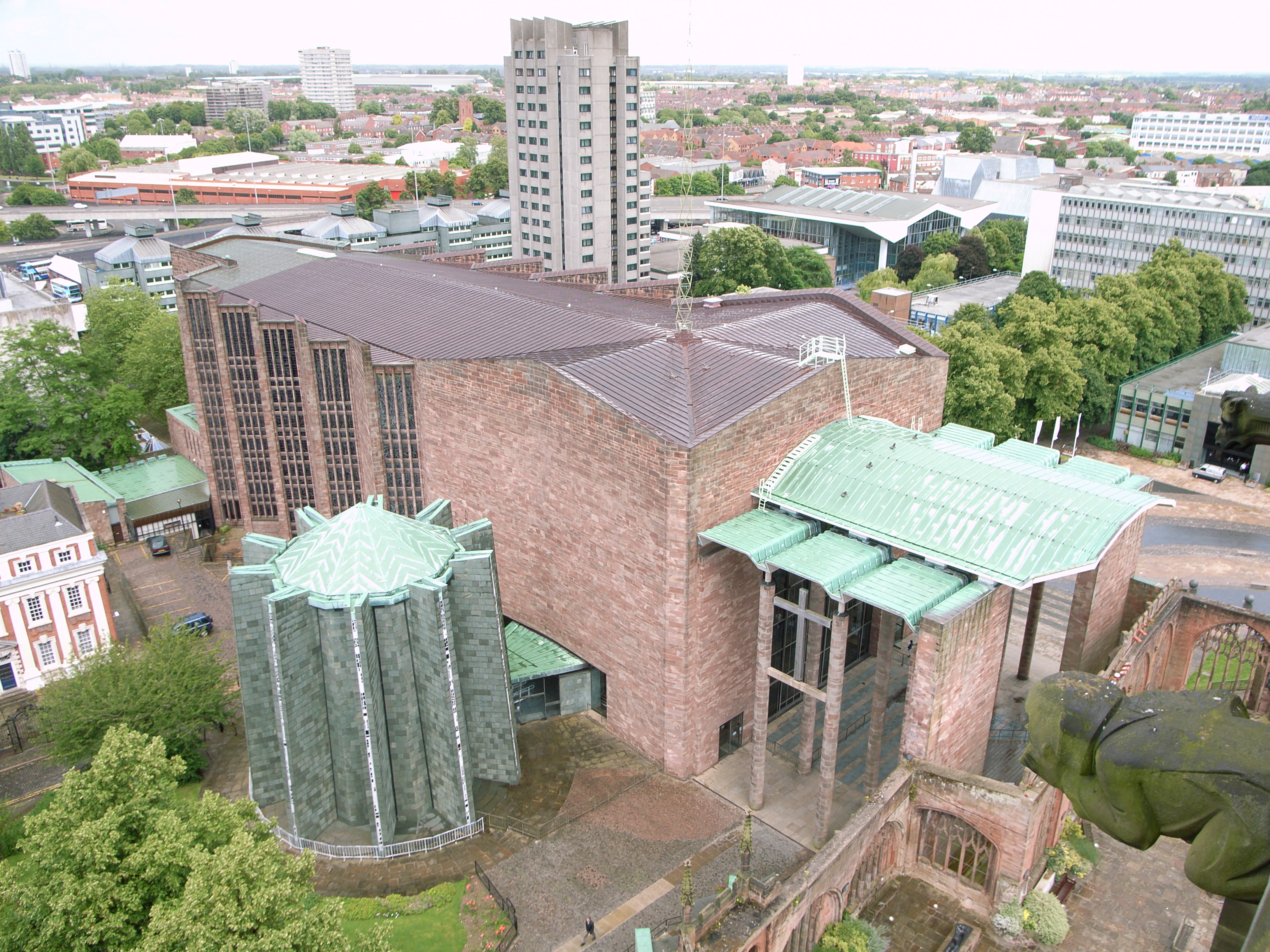
Coventry Cathedral
The morning after the bombing, Provost Richard Howard walked through the smoldering ruins of St Michael's Cathedral and found two charred roof timbers that had fallen in the shape of a cross. He bound them together and set them upright in the rubble. Behind the makeshift cross, someone chalked two words on the sanctuary wall: "Father Forgive." It was November 15, 1940. The Luftwaffe had dropped 500 tons of high explosive and 36,000 incendiary bombs on Coventry in a single night, an operation the Germans codenamed Moonlight Sonata. The medieval cathedral, dating to the 14th century, was gutted. Its tower and spire survived, rising 284 feet above the ashes. What happened next -- the decision not to rebuild the old cathedral but to preserve its ruins and construct something entirely new beside them -- made Coventry a symbol of a choice more profound than architecture.
Three Cathedrals
Coventry has had three cathedrals, each reflecting its era. The first was St Mary's, a monastic building that served as cathedral from 1102 to 1539, when it was dissolved. Only fragments of its walls remain. The second was St Michael's, a grand 14th-century parish church that became one of the largest in England, elevated to cathedral status only in 1918. Its perpendicular Gothic nave, built by the city's prosperous medieval wool merchants, was among the finest in the country. The November 1940 raid destroyed the roof, the interior, and the stained glass, leaving the outer walls and the magnificent tower and spire standing as a shell. For two decades, the ruins stood open to the sky while the city debated what to do. When the decision came, it was radical: the ruins would remain exactly as they were, a permanent monument to destruction, while a new cathedral would rise immediately adjacent.
Basil Spence's Bold Answer
The architect chosen through an international competition in 1950 was Basil Spence, whose design did not replace the old cathedral but completed it. The new St Michael's, consecrated on May 25, 1962, is oriented at right angles to the ruins, connected by a porch that allows visitors to pass directly from the bombed shell into the modern interior. Spence's building is uncompromising: a concrete and sandstone structure whose jagged, saw-toothed walls admit light through enormous stained-glass windows by John Piper and Patrick Reyntiens. Graham Sutherland's vast tapestry of Christ in Glory -- 78 feet tall, the largest tapestry in the world at the time -- dominates the east end. Jacob Epstein's bronze sculpture of St Michael triumphing over the Devil adorns the exterior. The font is a rough boulder from a hillside near Bethlehem. Nothing about the building asks you to forget what happened next door.
Father Forgive
The charred cross that Provost Howard erected in the ruins in November 1940 still stands. Behind it, the words "Father Forgive" are inscribed -- not "Father, forgive them," a crucial distinction. The prayer does not assign blame to one side. It asks forgiveness for all, a theological statement that became the foundation of the cathedral's ministry of reconciliation. In 1940, Howard made a Christmas Day radio broadcast calling for reconciliation with Germany rather than revenge. It was a deeply unpopular message at the time. After the war, the cathedral established the Community of the Cross of Nails, a network of over 200 partner organizations worldwide dedicated to reconciliation, now active in places from Northern Ireland to South Africa to the Middle East. Coventry twinned with Dresden, the German city that suffered its own devastating firebombing in 1945, and with Volgograd (formerly Stalingrad).
Ruin and Renewal
Walking from the ruins into Spence's cathedral is one of the most affecting architectural experiences in Britain. You pass from open sky, through walls that still bear the scars of incendiary bombs, into an interior flooded with colored light from Piper's baptistery window -- a blaze of abstract color that moves from cool blues and greens at the edges to an explosion of gold and red at the center, representing the journey from darkness into light. The ruins are not a relic. They are kept as a functioning part of the cathedral precinct, used for performances, services, and ceremonies. The old and new stand together as a single statement: that destruction and creation are not opposites but companions, that the proper response to devastation is not to pretend it did not happen but to build something worthy beside what remains. It is this refusal to choose between memory and hope that makes Coventry Cathedral unlike any other religious building in England.
From the Air
Located at 52.41N, 1.51W in Coventry city center. The medieval cathedral spire (284 ft) is a prominent landmark alongside the distinctive angular roof of Spence's modern cathedral. The two structures are immediately adjacent. Nearest airports: EGBE (Coventry, 4nm S), EGBB (Birmingham, 15nm NW). Best viewed at 1,500-2,500 ft AGL to see both structures together.