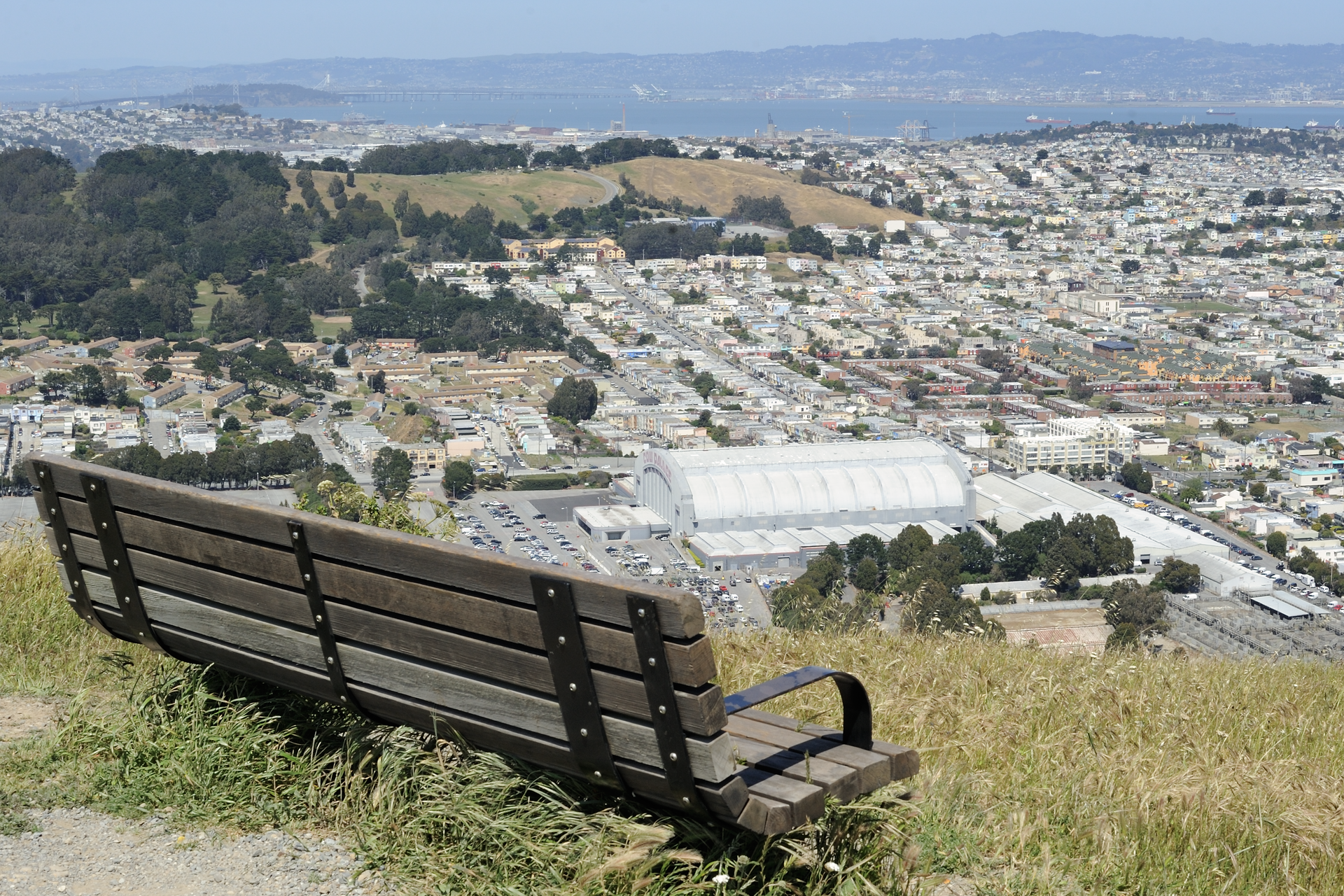
Cow Palace
The name started as a joke and became an institution. When the California State Legislature funded a livestock pavilion in the late 1930s, critics mocked the expense during the Depression, calling it a "palace for cows." The name stuck, and the Cow Palace opened in 1941 as a building that would refuse to be pigeonholed. Built on the border between San Francisco and Daly City -- the property line literally runs through the parking lot -- the arena has hosted everything from Republican National Conventions to professional wrestling, from the Grand National Rodeo to Beatles concerts, all under a name that still makes first-time visitors do a double take.
Conventions and Cowboys
The Cow Palace's early decades established its character as a venue that would host anything. Republicans gathered here twice to nominate presidential candidates: in 1956 to renominate Dwight D. Eisenhower, and in 1964, when Barry Goldwater's insurgent campaign won the nomination in a convention that reshaped the party's future. Between political conventions, the arena returned to its livestock roots -- the Grand National Rodeo has been a fixture for decades, filling the building with the dust and noise of competitive roping and riding. The juxtaposition of presidential politics and rodeo competition captures the Cow Palace's essential personality: a democratic space in the most literal sense, open to whoever books it.
The Sound and the Fury
The Cow Palace's concert history reads like a rolling encyclopedia of American popular music. The San Francisco Warriors played NBA basketball here from 1962 to 1964 and again from 1966 to 1971, but the building's acoustic memory is dominated by music. The Rolling Stones, the Beatles, Elvis Presley, and virtually every major touring act of the 1960s and 1970s passed through. The arena's cavernous interior, designed to accommodate livestock shows, gave concerts a raw, echoing quality that smaller theaters could not replicate. The sound bounced off concrete walls meant for cattle auctions, and somehow that worked.
On the Border
The Cow Palace's location is its own story. The building sits in Daly City, but a portion of the upper parking lot extends into San Francisco. This geographic ambiguity has complicated every conversation about the arena's future, since decisions involve two municipalities, the California Department of Food and Agriculture (which owns the building), and state legislators who control the purse strings. In 2008, State Senator Leland Yee advanced legislation to allow Daly City to purchase the Cow Palace for redevelopment, including housing. The proposal reflected a broader trend: aging arenas sitting on valuable land in the Bay Area, where every acre is contested ground.
An Arena That Refuses to Go Quietly
The Cow Palace has outlasted the era that built it. The livestock pavilion concept -- a state-funded facility for agricultural exhibitions -- belongs to a California that was still fundamentally a farming economy. Today the building operates as a general-purpose event center, hosting trade shows, sporting events, and concerts in a market crowded with newer, shinier competitors. Its survival depends not on architectural distinction or modern amenities but on something simpler: location, inertia, and the deep reluctance of any California politician to demolish a building that voters remember fondly. The palace for cows endures, its name still the best joke in Bay Area real estate.
From the Air
Located at 37.7067°N, 122.4186°W on the San Francisco-Daly City border. The large arena building and surrounding parking lots are visible from the air along the northern edge of Daly City. Best viewed at 2,000-4,000 feet AGL. Nearest airport: KSFO (San Francisco International, 6 nm south). The building is identifiable as the large structure west of US 101, near the county line.