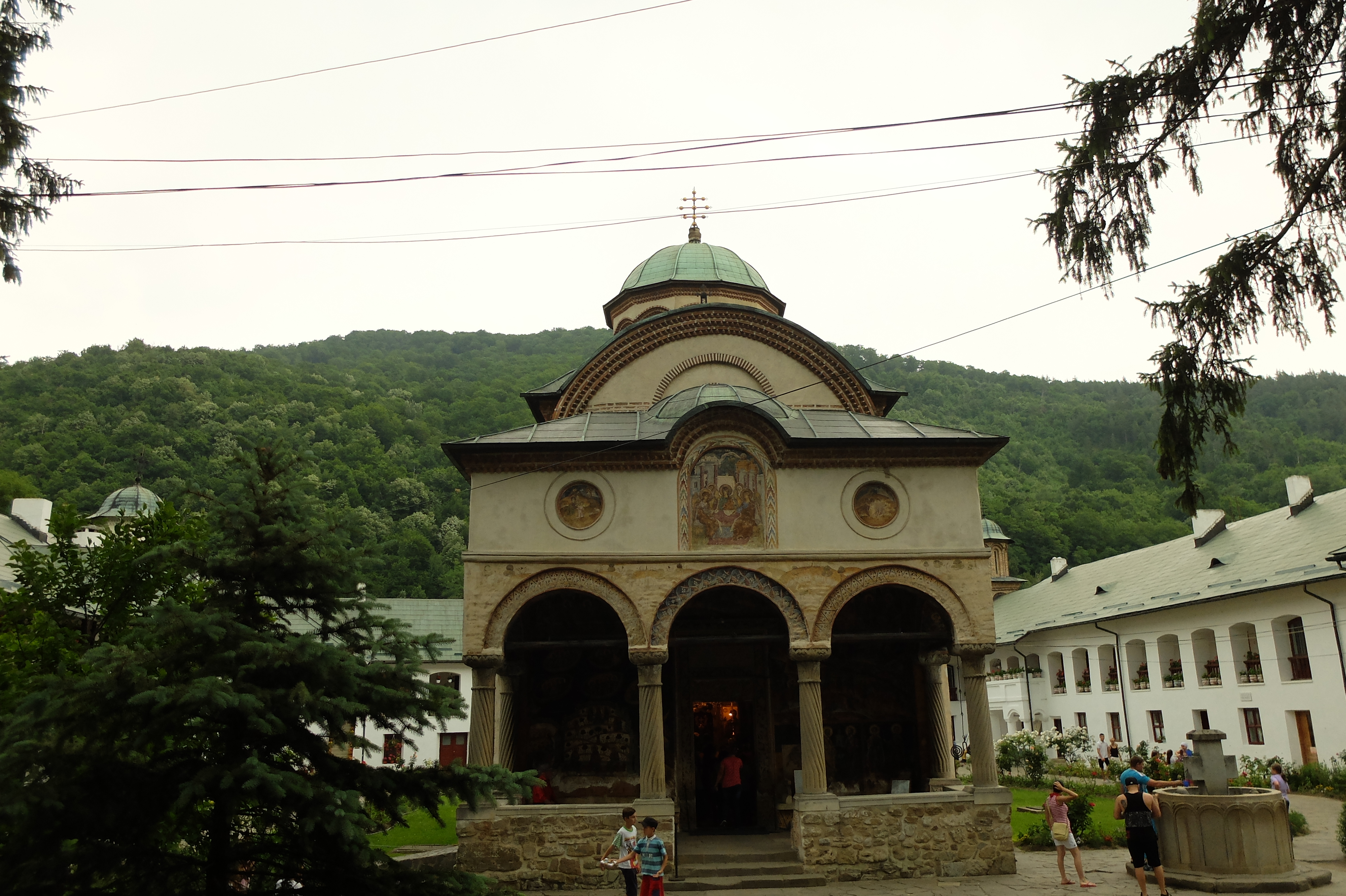
Cozia Monastery
The name means walnut. In Cuman -- a Turkic language spoken by the steppe peoples who once passed through these valleys -- "koz" meant walnut, and the mountain above this bend in the Olt River was thick with walnut trees. The monastery that Mircea the Elder founded here between 1387 and 1391 was originally called Nucetul, Romanian for "walnut grove," before the mountain's older Turkic name prevailed. Cozia Monastery has stood on the right bank of the Olt near the town of Calimanesti in Valcea County for more than six centuries. Its founder chose the site for reasons both spiritual and strategic: the Olt Valley was a natural corridor through the Southern Carpathians, and a fortified monastery here served as both a house of God and a checkpoint on the road into Wallachia.
The Prince Who Built in Stone
Mircea the Elder ruled Wallachia during its greatest territorial extent, and Cozia was his most enduring architectural legacy. The Church of the Holy Trinity, consecrated in 1388, is a triconch -- a three-lobed design -- built from alternating layers of stone and brick that give its walls a striped appearance. The vertical proportions are elongated, almost stretched, with stone rosettes and decorative frames adorning the facade. Art historians trace the design to the Morava school of Serbian architecture, suggesting that Serbian artisans worked alongside local builders. The synthesis is distinctly Wallachian: Byzantine in spirit, Serbian in technique, and Romanian in its final expression. Mircea is buried here, and his tomb has made Cozia a pilgrimage site for Romanians who regard him as one of the nation's founding figures. When Nicolae Ceausescu visited in 1966, he wrote in the monastery's Golden Book about its importance as a national symbol -- though the irony of a communist dictator venerating a medieval prince was apparently lost on no one.
The Infirmary Church and Its Frescoes
In 1543, a century and a half after the main church was consecrated, voivode Radu Paisie added a smaller building within the complex: the Bolnita, or infirmary church. Originally a hospital chapel, it became the unexpected treasure of Cozia. Inside, frescoes attributed to masters David and Radoslav cover the walls with images that art historians consider among the last Wallachian monuments of high Byzantine art. A votive portrait of Mircea the Elder and his sons anchors the composition, painted long after the prince's death but with a specificity that suggests the artists worked from earlier depictions. The stonework, credited to a mason named Maxim, reflects Radu Paisie's family connections with the Serbian Brankovic dynasty. The administrator Stroe's portrait in the murals is regarded as one of the first realistic works in Romanian art -- a face that belongs to a specific person rather than an idealized type.
Centuries of Repair and Reinvention
Cozia has been rebuilt, repaired, and reimagined by nearly every era of Romanian history. Between 1850 and 1856, princes Gheorghe Bibescu and Barbu Stirbei oversaw extensive restorations. A century later, from 1958 to 1980, the communist government launched a multi-decade program that consolidated the monastic cells, reinforced the towers, and replaced the aging roof with copper. The monastery has also been a stage for modern political history: during the January 1999 Mineriad, when coal miners from the Jiu Valley marched on Bucharest, Prime Minister Radu Vasile negotiated an agreement with miners' leader Miron Cozma at the monastery, producing what became known as the "Peace of Cozia." Romanian poets have been drawn to the place for generations. Dimitrie Bolintineanu, Ion Pillat, and Grigore Alexandrescu all wrote poems titled or inspired by Cozia, finding in its stones the kind of symbolic weight that poets require.
The Monastery and Its Shadows
Cozia's history includes chapters that demand honest telling. Historical records indicate that the monastery owned a significant number of enslaved Romani people, including many identified as Rudari, a relationship that began in the 14th century and persisted as long as slavery remained legal in Wallachia. This was not unusual for Romanian monasteries of the period -- monastic institutions were among the largest slaveholders in the principalities -- but it is a dimension of Cozia's past that its architectural beauty can obscure. The people who maintained the grounds, worked the fields, and served the monks did so under coercion, and their labor sustained the very institution that visitors now admire for its spiritual grandeur. Today, Cozia sits quietly above the Olt, its triconch church reflected in the river on still mornings. A stamp honored it in 1968. Tourists photograph the rosettes. The walnut trees that gave the mountain its name still grow on the slopes above.
From the Air
Located at 45.272N, 24.315E on the right bank of the Olt River near Calimanesti. Best viewed from 2,000-3,000 feet AGL, where the monastery complex is visible against the forested slopes of the Olt Valley. The river runs through a gorge here, with Cozia Mountain rising to the west. Nearest airports: Craiova (LRCV) approximately 55 nm southwest, Sibiu International (LRSB) approximately 35 nm north. The Transfagarasan highway is visible to the east.