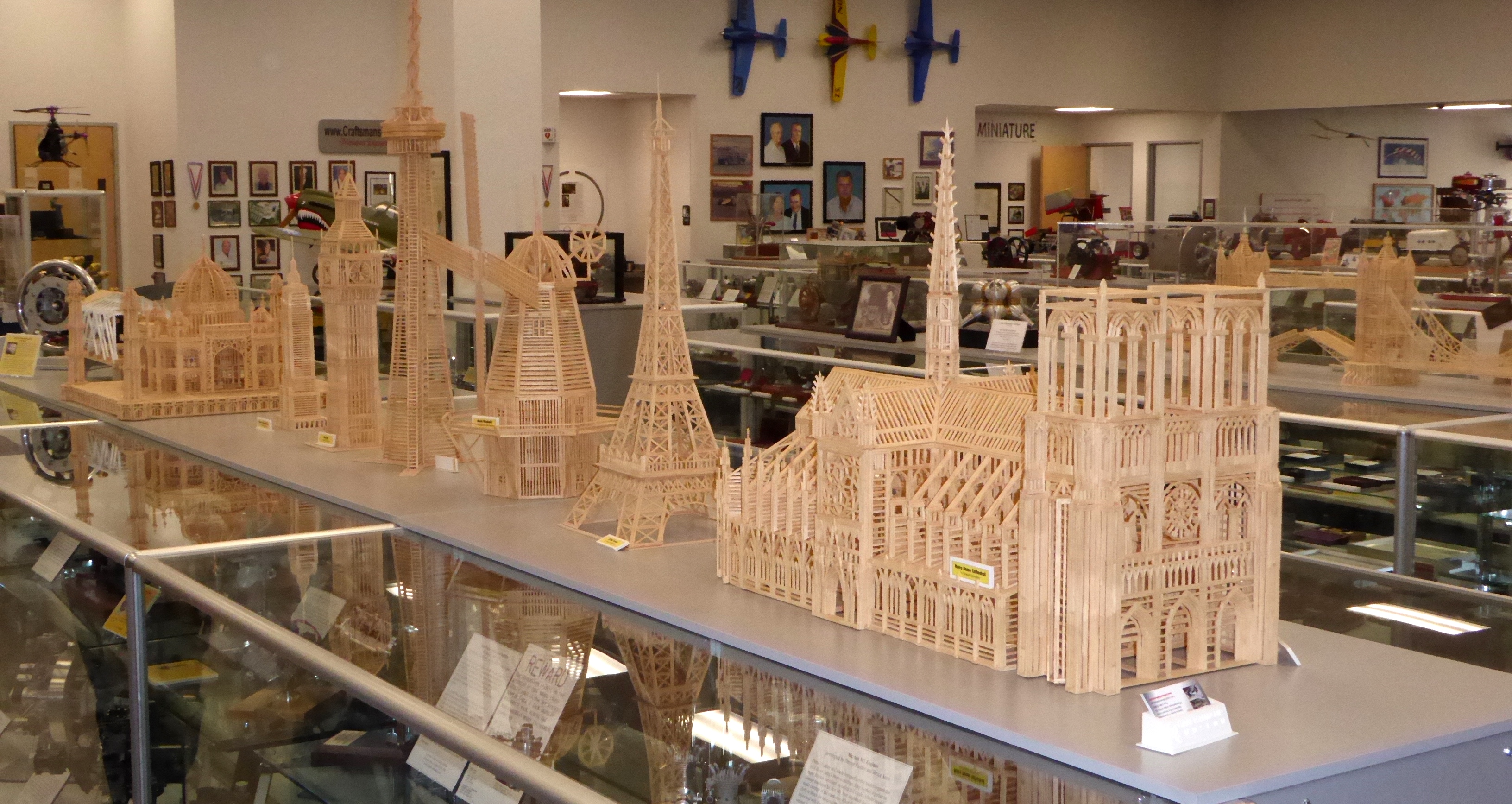
Craftsmanship Museum
At one-sixth scale, a 1932 SJ Duesenberg is about the size of a large dog. Every component that exists in the full-size automobile exists in this version: the engine with its supercharger, the transmission, the suspension geometry, the interior fittings. It took one man approximately 20,000 hours — more than a decade of working days — to build it. The car runs. It is on display at the Miniature Engineering Craftsmanship Museum in Carlsbad, California, where it shares space with working miniature steam engines, scale models of World War II fighter aircraft, and a Norden bombsight that guided American bombing raids in the European theater. The museum is not about nostalgia, though it contains plenty of that. It is about what hands can do when given enough time and sufficient precision.
Joe Martin's Idea
The Miniature Engineering Craftsmanship Museum was founded in 1997 by Joe Martin, who had built a business selling miniature engineering tools and materials to hobbyists and professionals working at small scales. Martin recognized that the work his customers were producing — engines machined from scratch, mechanical systems built to tolerances that challenged the limits of hand tools — was not being preserved or displayed anywhere. Museums collected paintings and furniture and ceramics. Nobody was collecting working miniature mechanisms. Martin began documenting exemplary work online in 1997, assembled a physical collection, and opened a brick-and-mortar museum in 2006. The Carlsbad location followed in 2011.
The Objects and What They Required
The museum's collection spans functional categories that would seem unrelated except for the discipline they share. The working miniature steam engines, some of them small enough to hold in two hands, operate on the same thermodynamic principles as their full-size counterparts and require the same precision of fit between moving parts — clearances measured in thousandths of an inch. The WWII fighter models are built to documentary accuracy: not approximations of a P-51 Mustang, but representations accurate enough to train someone in the aircraft's systems. The Norden bombsight, a full-size example rather than a scale model, represents a different kind of precision — an analog computing device that used gyroscopes and optics to calculate a bomb release point from altitude. All of these objects required their makers to sustain attention across thousands of hours.
The Scale of Commitment
The 1/6-scale Duesenberg is the museum's signature piece, but it is not anomalous. The collection includes multiple objects representing commitments of thousands of hours. A working miniature V-12 engine machined from raw stock. Navigational instruments built to tolerances that served real purposes. What the museum accumulates is evidence of a specific human capacity: the ability to sustain precise effort across a timescale that does not offer quick feedback. The object does not tell you it is going well for most of the process. You must commit to the process and trust that the accumulation of correct decisions will eventually produce something that works. The museum argues, implicitly, that this capacity has value beyond its products — that the discipline of building something precisely, over time, produces a kind of person as well as a kind of object.
From the Air
The Craftsmanship Museum is located at approximately 33.1326°N, 117.238°W in eastern Carlsbad. The surrounding area is visible from altitude as light industrial and commercial development east of the coastal residential neighborhoods. Recommended viewing altitude 3,000–5,000 ft AGL. Nearby airports: KOKB (Oceanside Municipal, ~12 nm north), KSEE (Gillespie Field, ~16 nm southeast).