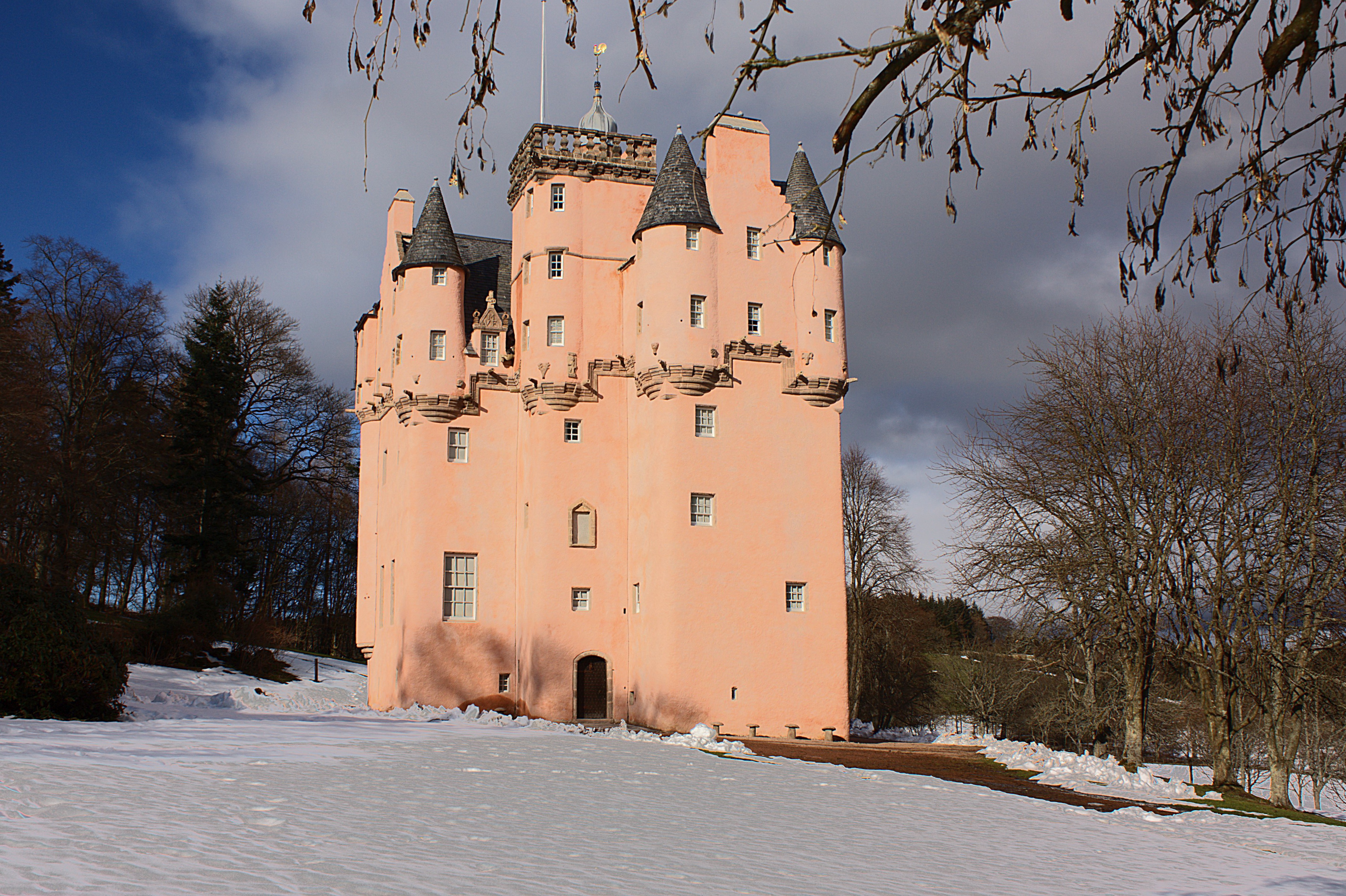
Craigievar Castle
Craigievar Castle does something that very few buildings manage: it looks exactly like what you imagined a castle should look like before you ever saw a real one. Seven storeys of pink-harled granite rise from a simple rectangular base and then explode at the roofline into a forest of turrets, corbelled rounds, conical caps, and crow-stepped gables. The effect is theatrical, almost absurd, and entirely genuine. This is not a Victorian fantasy or a Disney fabrication. It was built in the 1620s by a merchant who had more money than lineage and wanted the world to know it.
Willy the Merchant's Tower
William Forbes, known as 'Danzig Willie' or 'Willy the Merchant,' made his fortune in the Baltic trade, shipping goods between Aberdeen and the ports of northern Europe. In 1610, he purchased the unfinished castle from the Mortimer family, who had run out of money during construction, and completed it to his own specifications by 1626. The result was the finest example of Scottish Baronial architecture in the northeast - an L-plan tower house that used height rather than breadth to project wealth and status. Forbes was not a nobleman. He was a businessman, and Craigievar was his statement of arrival. The castle's domestic scale - it was always a home, never a fortress - reflects the priorities of a man who wanted comfort and display, not defence.
Plaster and the Nine Worthies
The interior of Craigievar contains some of the finest decorative plasterwork in Scotland. The great hall ceiling is a tour de force of early seventeenth-century craftsmanship, featuring elaborate strapwork patterns and medallion portraits of the Nine Worthies - the classical, biblical, and medieval heroes who represented the ideal of chivalric virtue. Joshua, David, Alexander the Great, Caesar, King Arthur, Charlemagne, and their companions look down from the ceiling in plaster relief, a programme of decoration that connected a Baltic merchant's castle in Aberdeenshire to the wider intellectual currents of Renaissance Europe. The Forbes family arms appear throughout, establishing the owner's identity in every room. A carved Royal Arms of the United Kingdom over the hall fireplace, dated to 1626, marks the year of completion.
Four Centuries Without Electricity
What makes Craigievar remarkable among Scottish castles is how little it has changed. The building was never significantly altered after its completion, in part because later Forbes generations lacked the resources to modernise and in part because the castle's remote location kept it out of the path of military conflict. The Jacobite risings, the agricultural improvements, and the Victorian rebuilding mania that transformed most Scottish country houses passed Craigievar by. When the Forbes-Sempill family donated the castle to the National Trust for Scotland in 1963, they stipulated that electricity should not be installed in the main rooms. The castle is still experienced by natural light and candlelight, as it was in 1626. This is not affectation - it is fidelity. The rooms look, feel, and even smell as they have for four centuries.
The Disney Connection
Craigievar's silhouette - the slender tower bursting into turrets at the top - has long been cited as an inspiration for Walt Disney's castle motif, and the resemblance is striking. Whether Disney or his designers ever visited Craigievar is undocumented, but the castle fits the archetype so perfectly that it hardly matters. The profile works because of a structural logic: the lower floors are plain and functional, bearing the weight of the building, while the upper floors, freed from structural responsibility, blossom into decorative elaboration. The turrets are not defensive. They are ornamental, catching the light and breaking the roofline into a composition that changes with every angle. From the approach road, through a woodland of mature beech trees, the first glimpse of the pink tower above the canopy is genuinely startling.
The Castle in Its Landscape
Craigievar sits in the rolling farmland of upper Donside, where the Aberdeenshire lowlands begin their transition into the Grampian Highlands. The setting is sheltered and domestic - a small estate surrounded by woods and fields, with no dramatic cliff or commanding height. The castle was never intended to dominate the landscape. It was intended to charm it. The grounds include a walled garden and mature woodland, and the approach is deliberately theatrical, revealing the tower in stages through gaps in the trees. The National Trust for Scotland limits visitor numbers to protect the fragile plasterwork interiors, giving the experience an intimacy that larger castles cannot match. Inside, the spiral staircase winds upward through seven floors of rooms that grow smaller and more private as you ascend, until the final turret rooms look out across the Aberdeenshire countryside from a height that still feels, after four hundred years, faintly vertiginous.
From the Air
Craigievar Castle is located at approximately 57.174°N, 2.718°W in the Aberdeenshire countryside, about 6 miles south of Alford. The pink-harled castle is visible from the air as a distinctive tower rising from woodland. The surrounding landscape is rolling farmland in the upper Don valley, with the Grampian foothills visible to the west. Nearest airport is Aberdeen Airport (EGPD), approximately 26 miles east. Best viewed at 1,000-2,000 feet to appreciate the castle's silhouette against the landscape.