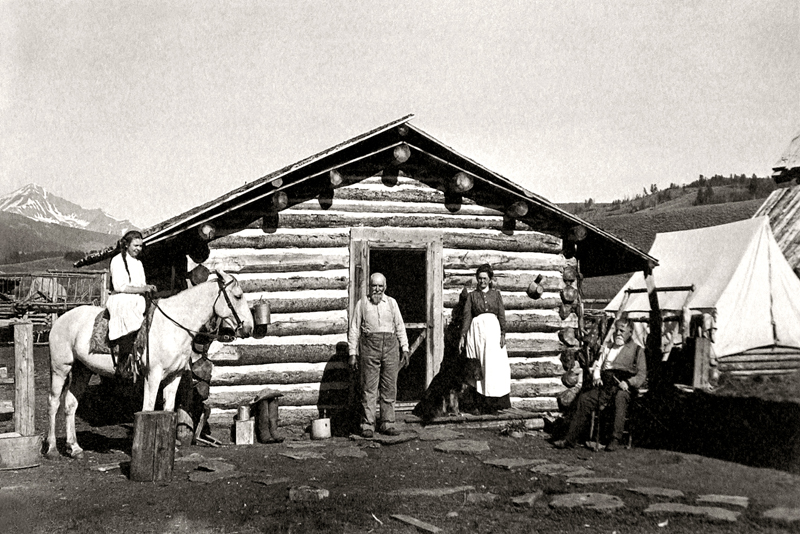
Crail Ranch Buildings
Frank Crail was nearly 60 years old and had just lost his job as a district court clerk when he paid $150 for 160 acres of meadowland in the Gallatin Basin. It was December 1901, and most men his age would have been content with defeat. Instead, Crail hauled his family up a rough logging road along the Gallatin River the following spring and moved into an abandoned cabin to start over. The two rustic buildings that survive from his homestead now sit amid the manicured fairways of Big Sky Resort, their weathered logs a reminder that this playground for the wealthy was once just another hard-won claim on the Montana frontier.
From Indiana to the High Country
Frank Crail's path to that meadow wound through three decades of western adventure. Born in Tipton County, Indiana in 1842, he joined a wagon train to Montana Territory at age 22, seeking fortune in the gold fields. By 1868 he was working a quartz mine near Helena, but he found mining disagreeable and freight hauling through Indian country too dangerous. The Homestead Act of 1862 offered another path. In 1871, Crail partnered with two ranchers to develop land in the Bridger Mountains north of Bozeman. He married Sallie Creek in 1886, when he was 44 and she was 22. They had three children, and Crail traded ranching for respectability as a district court clerk. Then he lost the 1901 election, and at an age when most pioneers were buried or broken, he started again.
The Wheat That Won Prizes
The Crail family proved up their original claim and eventually expanded to 960 contiguous acres. By 1910, they had built a two-story, four-room cabin and filled the property with barns and outbuildings. They raised horses, cattle, and sheep, but Frank Crail was also an experimenter. He developed a strain of winter wheat suited to the high country and named it Crail Fife, perhaps nodding to his family's origins in the Scottish town of Crail in Fife. The State of Montana entered his wheat samples in the 1904 Louisiana Purchase Exposition in St. Louis, where they won prizes. Crail marketed his seeds to growers in Montana and Colorado, proving that even in the harsh Gallatin Basin, innovation could flourish alongside subsistence.
Three Generations, Then Gone
Sallie Crail died in 1914 at age 50. Frank's son Eugene went off to World War I in 1918, and his daughter Lillian left for nursing school in Chicago, never to return to ranch life. Frank Crail died on his land in 1924, and his son Emmett kept the operation running through the Depression and two world wars. In 1950, after nearly half a century on the ranch, Emmett sold to a California couple who expanded the holdings to 1,440 acres. The land changed hands again in 1962 to a cattleman named Sam Smeding, who used the historic buildings only for storage. The meadows where Crail's prize wheat once grew lay quiet, waiting for a different kind of transformation.
From Bunkhouses to Museum
Chet Huntley, the retired NBC newsman and Montana native, arrived in 1968 with investors and a vision for a ski resort. The Crail Ranch was among the first parcels purchased. The consortium demolished many buildings, converted the hay fields into a golf course, and used the surviving cabins as worker bunkhouses. But in 1980, local preservationists persuaded the resort to cede a one-acre parcel containing the two original cabins. The Gallatin Canyon Historical Society secured National Register listing in 1982. The grounds opened to the public in 2001, and the Crail Ranch Homestead Museum now displays photographs and objects telling the story of homesteading in Big Sky. The two cabins stand as Montana's version of a creation myth, the modest beginnings from which a resort empire grew.
From the Air
Located at 45.27N, 111.30W in the Gallatin Basin south of Bozeman. The museum site is visible near the Big Sky Resort golf course. Elevation approximately 6,500 feet. Nearest airports are Bozeman Yellowstone International (KBZN) 45nm north and West Yellowstone (KWYS) 40nm south. The Gallatin River valley provides a scenic corridor between Bozeman and Yellowstone National Park.